Pamukkale

Turkey · Aegean · Travel guide

Pamukkale

What the white travertine terraces really cost, why you should stay one night and how to see Hierapolis without the tour buses.

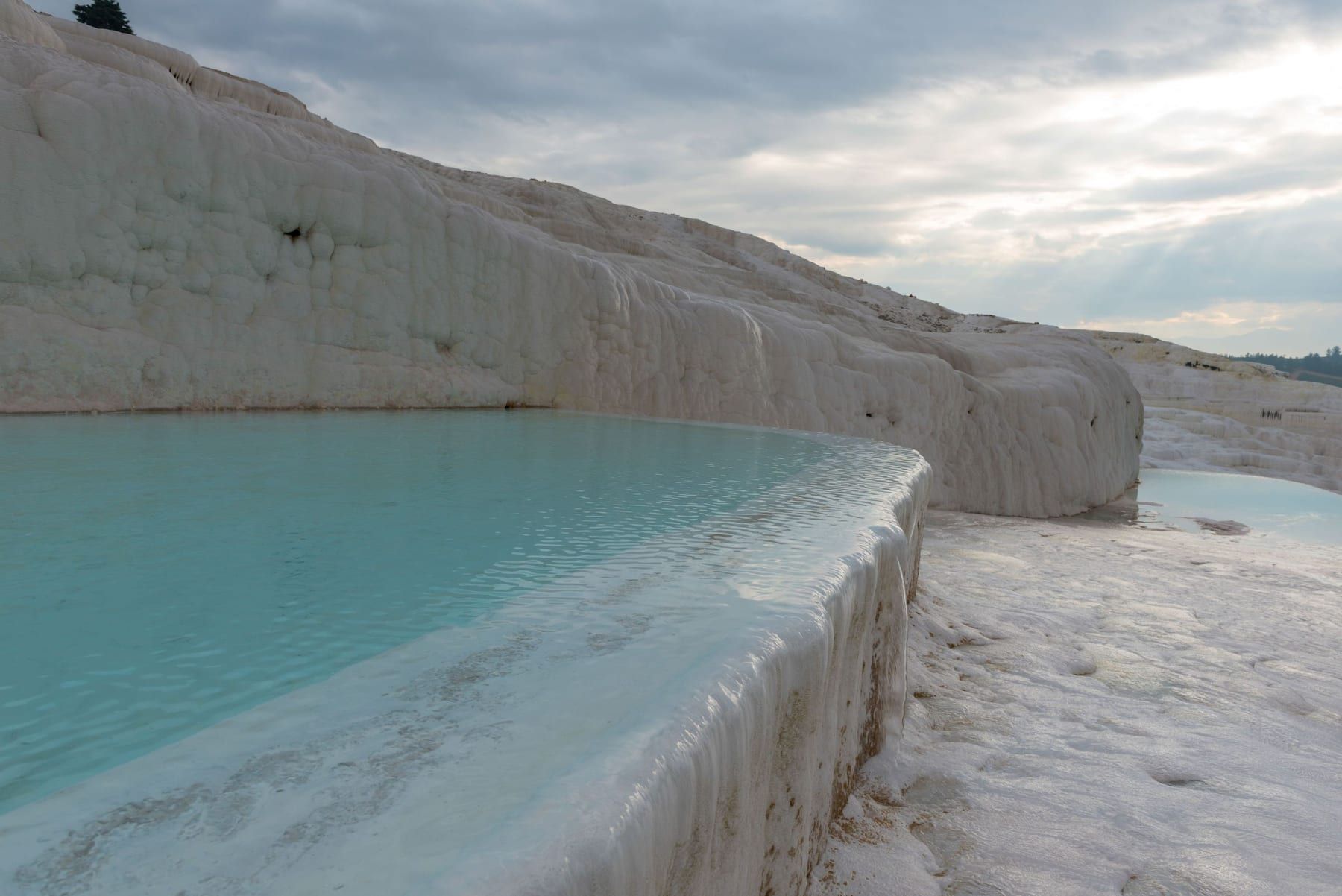
Photo: Ehtiram Mammadov / Pexels

What does a trip to Pamukkale cost?

Adjust the values to your trip: the calculator updates live (EUR, converted from CHF estimates).

1,712 EUR
≈ 856 EUR per person
  • Flights 749 EUR
  • Accommodation 321 EUR
  • Food 321 EUR
  • Local transport 107 EUR
  • Tandem paragliding 214 EUR

Estimates for orientation, not booking prices. Flights and hotels vary strongly by season: current prices are behind the links below.

Money & payment: You pay in Turkish lira (TRY). The exchange rate moves a lot, which is why all prices here are given in francs and euros. Cards are accepted almost everywhere; you need cash for the dolmuş, markets and tips. Flight time: 3 to 4 hours.

Recommended hotels

Nine options in three price ranges, each among the best-rated on Booking.com.

Budget

Melrose House Hotel

Dorfzentrum, Pamukkale

One of the most popular guesthouses in the village, family-run and very well rated for years. Simple, clean rooms, a small pool in the garden, home-cooked dinner on request and help with bus and flight transfers. The south gate of the terraces is ten minutes on foot.

from EUR 35 / night View →

Venus Suite Hotel

Dorfzentrum, Pamukkale

Small hotel with a garden, pool and a view of the white terraces from the terrace. Rooms are plain but clean, the breakfast generous and home-made. The family organises paragliding, trips to Laodicea and transfers to Denizli airport at fair prices, without any pushiness.

from EUR 45 / night View →

Bellamaritimo Hotel

Dorfzentrum, Pamukkale

Good location on the edge of the village with a direct view of the travertine terraces, quieter than the guesthouses on the main road. Pool, rooftop terrace for sunset, solid breakfast, helpful team. A reliable compromise of price, cleanliness and location for one or two nights passing through.

from EUR 30 / night View →

Mid-range

Hotel HAL-TUR

Dorfzentrum, Pamukkale

Directly opposite the terraces, with the best view of any hotel in the village: from the pool and the balcony you watch the white slope glow. Rooms are freshly renovated, and the terrace in the evening is a good place for a beer with a view, at civilised prices.

from EUR 75 / night View →

Pamukkale Whiteheaven Suite Hotel

Dorfzentrum, Pamukkale

Newer hotel with generous rooms, a quiet spot on the edge of the village and a well-kept pool in the garden. Very good reviews for service and breakfast, and the family helps with everything from bus planning to paragliding. For couples who want a bit more comfort without going to a resort.

from EUR 85 / night View →

Tripolis Hotel

Dorfzentrum, Pamukkale

Larger hotel with an outdoor pool, hammam and thermal pool, with a view of the terraces from the garden. Often used by groups, but that means a wide breakfast buffet and half board in the evening at a fair price. A good choice for families who need a pool and some space to let off steam after a hot day on the terraces.

from EUR 90 / night View →

Luxury

Doğa Thermal Health & Spa

Karahayıt, Pamukkale

The most modern thermal resort in the region: large indoor and outdoor pools with thermal water, a spa with hammam and treatments, spacious modern rooms. You come here to relax; the terraces are 10 minutes away by dolmuş. Full board is the norm, and it is very popular with Turkish families too.

from EUR 170 / night View →

Spa Hotel Colossae Thermal

Karahayıt, Pamukkale

A classic among the thermal hotels of Karahayıt, with a large park, several pools filled with the village's red, iron-rich water, a hammam and tennis courts. Rooms are rather conservatively furnished, the service friendly and well drilled. Good value for a resort with spa, especially outside the summer holidays.

from EUR 140 / night View →

Richmond Pamukkale Thermal

Karahayıt, Pamukkale

Sprawling thermal resort with a view over the plain, a large outdoor pool, thermal pools, hammam and spa with massages. Rooms are spacious and quiet, the kitchen good. For couples and families who want to combine Pamukkale with two days of wellness without having to go into the village every evening.

from EUR 160 / night View →

If you book through these links we earn a small commission, at no extra cost to you.

Experiences worth your time

Hierapolis & travertine terraces with a guide

Have the ancient city explained instead of just walking across the terraces: theatre, Plutonium, necropolis, baths museum and the Martyrium of St Philip. With a guide you understand why an entire spa town stood here. Around three hours, best early in the morning.

View & book →

Tandem paragliding over the terraces

Take-off above Hierapolis, flight directly over the white slope, landing in the village. 15 to 20 minutes in the air, video included, around CHF 90 to 110 (about EUR 95 to 120). The thermals are calmer in the morning and late afternoon.

View & book →

Sunrise hot air balloon flight

Cheaper and less crowded than in Cappadocia: you rise in the morning light above the white terraces and the ancient city of Hierapolis. Flight time around 30 to 45 minutes, hotel transfer usually included. Cancelled in wind, so do not leave it until your last day.

View & book →

Cleopatra Pool

Swimming in 36-degree thermal water among toppled Roman columns, extra entry around CHF 15 (about EUR 16). Come early in the morning or in the last hour; at midday it is as crowded as a public baths. Bring swimwear and a towel, lockers are available on site.

View & book →

Laodicea excavations

One of the seven churches of the Book of Revelation, with colonnaded streets, two theatres and an early Christian church. Hardly any visitors, 10 km from Pamukkale, easy to combine with Hierapolis in one day. Entry around CHF 10 (about EUR 11).

View & book →

Kaklık Cave

An underground mini-Pamukkale: limestone terraces and warm water inside a cave, 45 km east of Pamukkale. Worth it as a half-day trip with a hire car or as part of a day tour, especially when the terraces up top have little water.

View & book →

Day tour from Antalya or Izmir

For anyone without time for an overnight stay: bus, guide, entry and lunch in one package. A long drive, but no organising, around CHF 50 to 80 (about EUR 55 to 85). Better than nothing, but a night in the village beats any tour.

View & book →

Thermal baths in Karahayıt

Red, iron-rich thermal water in the resort pools of the neighbouring village of Karahayıt, often bookable as a day guest. Ideal after a hot day on the limestone, combined with a hammam and massage. Five minutes by dolmuş from Pamukkale.

View & book →

If you book through these links we earn a small commission, at no extra cost to you.

Food & drink

Pamukkale itself is a village; the cooking comes from Denizli: lamb from the clay oven, rooster from the pot, tarhana soup for breakfast. In the village the pensions cook home food, and in the hills around Çal wine has been grown for thousands of years.

Denizli Kebabı

Kebab houses around Bayramyeri in the centre of Denizli

Whole pieces of lamb, cooked on skewers in a stone oven for hours until they fall apart without a knife, served on flatbread with onions. A portion CHF 8 to 12 (about EUR 8.50 to 13).

Tip:Order at lunchtime when the oven has just been opened; ask for half a kilo (yarım kilo), enough for two.

Tandır

Restaurants on the main road between Denizli and Pamukkale

Lamb from the clay oven, slow-cooked in a pit or clay cylinder, even more tender and fattier than the kebab. With rice and ayran CHF 9 to 13 (about EUR 9.50 to 14).

Tip:Not fresh every day; ask whether the tandır was lit today.

Horoz Haşlama

Lokantas in the centre of Denizli

Denizli is famous across Turkey for its crowing roosters, and boiled rooster with rice is the Sunday meal of the area. Firm, strong meat, nothing like chicken. CHF 7 to 10 (about EUR 7.50 to 11).

Tip:Usually on offer at lunchtime; in the pensions on advance order.

Gözleme

Women at the sac in the lanes behind the main street of Pamukkale village

Paper-thin dough baked on a sac griddle, filled with spinach, cheese, potato or minced meat. The lunch between two walks on the terraces. CHF 3 to 5 (about EUR 3.20 to 5.30) a piece.

Tip:Buy where the dough is being rolled right now; add an ayran and you are full for CHF 5.

Tarhana Çorbası

Soup kitchens (çorbacı) in Denizli and breakfast in the pensions

Soup made from dried, fermented dough with yoghurt, tomato and pepper, in Denizli tart and served with butter and mint. The breakfast speciality of the region. CHF 1.50 to 2.50 (about EUR 1.60 to 2.70).

Tip:A bag of dried tarhana from the market is a light souvenir, ready in ten minutes.

Ev Yemeği at the pension

Family pensions in the centre of Pamukkale village

Dinner at the family pensions: soup, vegetables in olive oil, köfte or chicken, salad, rice and dessert, just as the family eats. CHF 6 to 9 (about EUR 6.40 to 9.50) per person, often with a view of the floodlit terraces.

Tip:Sign up in the afternoon and they cook for you too; cheaper and better than the picture-menu restaurants on the road to the south gate.

Çal wine

Pamukkale Şarapçılık in Güney near Çal; in Pamukkale at the licensed restaurants

In the hills of Çal, 60 kilometres north, grapes have grown since antiquity, today mainly Çalkarası, a local red grape with a light, fruity character. CHF 4 to 6 (about EUR 4.30 to 6.40) a glass in a restaurant, a bottle from CHF 10.

Tip:Rosé from Çalkarası is the safest choice; the winery is reachable only by hire car.

History & background

Pamukkale means "cotton castle" in Turkish, and anyone who sees the white terraces from the plain for the first time understands the name immediately. For thousands of years, calcium-rich thermal water at around 35 degrees has flowed out of the mountain here, releasing carbon dioxide as it cools and depositing travertine. Layer by layer, this created the pools that are now a UNESCO World Heritage Site. The healing power of the water was already known to the kings of Pergamon, who founded the city of Hierapolis directly above the terraces in the 2nd century BC. Under the Romans it became a spa town with a theatre for 12,000 spectators, baths, temples and one of the largest necropolises in Asia Minor, because many of the sick who came to be cured stayed forever. The apostle Philip is said to have been martyred here; his tomb church was only uncovered in 2011. Earthquakes destroyed the city several times, and a final major one in the 14th century sealed its fate. Until the 1990s, hotels stood right on the terraces and piped the water into their pools; only World Heritage status brought their demolition and today's strict visitor management. Ten kilometres away lies Laodicea, one of the seven churches of the Book of Revelation.

Insider tips

Day trip or overnight stay: the most important decision

The vast majority of visitors arrive on a day trip from Antalya, Kusadasi or Izmir. That means three to four hours on a bus each way, arrival around midday when the limestone glares and the terraces are packed, departure at 4 pm. For CHF 50 to 80 (about EUR 55 to 85) you will have seen exactly the photos everyone else has. The honest recommendation: stay one night in the village of Pamukkale. You walk up in the late afternoon once the buses have gone, stay until sunset when the terraces glow pink, and at 8 the next morning you have Hierapolis almost to yourself again. The entry ticket is valid for one day only, so choose evening or morning, or pay twice. Guesthouses in the village start at CHF 35 (about EUR 37) per night, which is less than the premium for an organised tour.

Tickets, gates and the thing about shoes

Hierapolis and the terraces form one site with one ticket, currently around EUR 30 for foreign visitors; Turkish citizens pay considerably less. There are three entrances: the south gate directly above the village, from which you climb barefoot up over the terraces, the north gate by the necropolis where the tour buses park, and the upper south entrance with a car park near the Cleopatra Pool. A strict no-shoes rule applies on the terraces; you carry them in your hand or in your rucksack. The limestone is rough, but slippery where wet, and children and older people need time. Important to know: not all the pools hold water. The water is distributed on a rotation schedule so that the limestone keeps forming everywhere. The famous turquoise pools near the top edge are partly artificial. If you want to see the natural terraces with water in them, spring is your best bet.

Cleopatra Pool: is it really worth it?

The ancient pool up in Hierapolis is the second big selling point: you swim in 36-degree, gently fizzing thermal water among toppled Roman columns that an earthquake threw into the basin in the 7th century. The extra entry fee is around CHF 15 (about EUR 16); lockers and showers are there, you bring your own swimwear and towel. Whether Cleopatra ever bathed here is legend. The experience is still special, but with caveats: between 11 am and 3 pm the pool is as crowded as a public baths, and the submerged columns are slippery. My advice: go right after opening in the morning or in the last hour before closing. Then you have the water almost to yourself. If you would rather save the money, head to one of the thermal hotels in Karahayıt instead, where red, iron-rich water comes out of the ground and the pools come with the room.

See Hierapolis properly, not just the terraces

Most people walk across the terraces, take the photo and turn back. Yet Hierapolis is a complete Roman city. The theatre is one of the best preserved in Turkey, with an intact stage wall and reliefs, and the view from the top row across the plain is the best on the whole site. The Plutonium, the "gate to the underworld", where toxic carbon dioxide streams from a fissure and ancient priests sacrificed animals, has been open to visitors again for a few years. The Martyrium of St Philip sits on the hill behind the theatre, a quiet spot that hardly anyone sees. And the necropolis in the north, with over 1,200 tombs, is one of the largest of antiquity. You need three to four hours for all of it, plus water and a hat, because there is almost no shade. The small archaeological museum in the old baths is included in the ticket.

Laodicea, Kaklık and Karahayıt: what else there is

With an overnight stay you have time for the surroundings, and they are better than their reputation. Laodicea, 10 km towards Denizli, was a wealthy trading city and has been under excavation for 20 years: colonnaded streets, two theatres, an early Christian church, and often you are there with a handful of people. Entry is around CHF 10 (about EUR 11), a taxi there and back from Pamukkale about CHF 25 (about EUR 27). The Kaklık Cave, 45 km to the east, is an underground mini-Pamukkale with limestone terraces and warm water, a good half-day trip with a hire car. Karahayıt, 5 km to the north, is the region's thermal village: red, iron-rich water, large resort hotels with pools, lots of Turkish spa guests. Less charming than the village of Pamukkale, but if you want wellness, this is the place. The dolmuş between Denizli, Pamukkale and Karahayıt runs every 20 minutes for about CHF 1 (about EUR 1).

Paragliding, balloons and eating in the village

In recent years Pamukkale has become a spot for tandem paragliding: take-off on the hill above Hierapolis, a 15 to 20 minute flight directly over the white terraces, landing in the village. It costs around CHF 90 to 110 (about EUR 95 to 120) including video, and booking directly in the village is often cheaper than online. Sunrise balloon flights are available too, for about CHF 100 to 150 (about EUR 105 to 160), much cheaper than in Cappadocia but also shorter. Food in the village is simple and honest: pide and gözleme for CHF 4 to 6 (about EUR 4 to 6.50), a kebab set menu for CHF 10 to 12 (about EUR 11 to 13). Avoid the restaurants with picture menus right on the main road to the south gate; two lanes further on, the guesthouse families cook themselves. Denizli is known for rooster meat and tandır, lamb from a clay oven, if you have time in the city.

Frequently asked questions about Pamukkale

How many days should you plan for Pamukkale?

One overnight stay is the sweet spot: terraces in the late afternoon, Hierapolis the next morning, then move on. If you want to add Laodicea, the Kaklık Cave and a thermal bath in Karahayıt, stay two nights. Longer is only worthwhile for spa guests. A pure day trip works, but shows you only the most crowded and hottest version of the place.

When is the best time to visit Pamukkale?

April to June and September to October. Temperatures are pleasant then (20 to 28 degrees), and in spring most of the terraces hold water. In July and August the thermometer on the plain climbs to 35 to 40 degrees, and the white limestone reflects the sun mercilessly. Winter is quiet and cheap, and the 35-degree thermal water makes bathing pleasant even when it is 10 degrees outside.

How do I get to Pamukkale from Western Europe?

Fastest: fly to Denizli (DNZ) with a change in Istanbul, around CHF 300 to 400 (about EUR 320 to 430) return from Zurich. Denizli Çardak airport is 65 km from the village; the shuttle bus takes a good hour and costs about CHF 8 (about EUR 9), a taxi around CHF 50 (about EUR 54). Alternative: a direct flight to Izmir or Antalya, then three to four hours by bus to Denizli, from where a dolmuş leaves for Pamukkale every 20 minutes. From Izmir there is also a train to Denizli, slow but pleasant.

Can you bathe in the terraces at Pamukkale?

Yes, in the designated pools along the footpath up from the south gate. You go barefoot, the water is ankle to knee deep and pleasantly warm. Proper swimming is only possible in the Cleopatra Pool at the top, for an extra fee. Large parts of the terraces are fenced off to protect the limestone, and guards keep watch. A bikini or swimming trunks under your clothes is enough.

Is the Cleopatra Pool worth the entry fee?

If you come early in the morning or late in the afternoon: yes, bathing among the Roman columns is unique. At midday with a packed pool, not really. The extra entry is around CHF 15 (about EUR 16), and you bring your own swimwear and towel. If what you mainly want is to relax in thermal water, you are better off and more at peace in a resort in Karahayıt with its own thermal pool.

Can you combine Pamukkale with Ephesus or Cappadocia?

Both work well. Ephesus near Selçuk is around three hours away by bus, and many people travel Izmir, Selçuk, Pamukkale, Antalya or the other way round. Cappadocia is eight to nine hours on the night bus from Denizli, or a flight via Istanbul. A classic two-week route: Istanbul, Cappadocia, Pamukkale, Ephesus and finally the beach on the Aegean.

Itineraries with this destination

Activities in the region

More destinations in Aegean