Bad Gastein

Austria · Salzburg & Salzkammergut · Travel guide

Bad Gastein

A waterfall in the middle of town, grand hotels from the imperial era that are half ruin, half design hotel, and a ski area with 760 kilometres of piste: what Bad Gastein costs, how to get there by night train and when the town is at its best.

Photo: Martin Leitgeb / Pexels

What does a trip to Bad Gastein cost?

Adjust the values to your trip: the calculator updates live (EUR, converted from CHF estimates).

2,349 EUR
≈ 1,174 EUR per person
  • Getting there 257 EUR
  • Accommodation 749 EUR
  • Food 535 EUR
  • Local transport 80 EUR
  • 6-day Ski amadé pass (winter) or a week of thermal spas (summer) 728 EUR

Estimates for orientation, not booking prices. Getting there means train or car from Switzerland, return, per person. Hotels vary strongly by season: current prices are behind the links below.

Money & payment: You pay in euros (EUR). Cards work almost everywhere; mountain huts and sausage stands often want cash. Tipping is expected: 5 to 10 percent, by naming the rounded total when you pay. In ski resorts a visitor tax of EUR 2 to 4 per night is added to the hotel price. Getting there: By train (ÖBB Railjet), car or a flight to Vienna, 2 to 8 hours.

Recommended hotels

Nine options in three price ranges, each among the best-rated on Booking.com.

Budget

Euro Youth Hotel & Krone

Bahnhofsplatz, Bad Gastein

Hostel and simple hotel in an old spa house right at the station and 200 metres from the Stubnerkogel cable car, with dorms, double rooms, bar and ski room. The most practical address for skiers on a small budget and night-train arrivals.

from CHF 40 / night (about EUR 43) View →

Hotel Salzburger Hof Bad Gastein

Grillparzerstrasse, Bad Gastein

Large, somewhat dated spa hotel with its own thermal bath, indoor pool and half board, between the station and the centre. Value for money is right, the furnishings are not new, the clientele tends to be older. For anyone who values thermal water in the house over design.

from CHF 95 / night (about EUR 102) View →

Boutiquehotel Lindenhof

Stubnerkogelbahn, Bad Gastein

Family-run villa with 21 rooms on Poserstrasse, opposite the Stubnerkogelbahn and the piste, with sauna, ski room and sun terrace, breakfast included. Solid, friendly and inexpensive, for a ski weekend or a hiking week without pretensions.

from CHF 95 / night (about EUR 102) View →

Mid-range

Hotel Miramonte

Reitlpromenade, Bad Gastein

The house that shaped the new Bad Gastein generation: 1950s architecture on the slope, rooms with retro design, a sun terrace with views over the valley, a small spa, yoga and a clientele somewhere between Berlin and Stockholm. Ten minutes to the centre, a little away from the ski lift.

from CHF 180 / night (about EUR 193) View →

Haus Hirt

Kaiserhofstrasse, Bad Gastein

Alpine boutique hotel above the town, where Thomas Mann once stayed, with spa, thermal pool, art on the walls and good cooking. Family-friendly with childcare, ski bus to the cable car. For couples and families seeking atmosphere without the grand hotel price.

from CHF 200 / night (about EUR 214) View →

Hotel Norica Therme

Centre, Bad Hofgastein

Four-star thermal spa hotel with a direct bathrobe walkway into the Alpentherme Gastein, half board and spa, in the flat centre of Bad Hofgastein. For families and spa guests, ski bus to the Schlossalmbahn, Bad Gastein ten minutes away by bus.

from CHF 170 / night (about EUR 182) View →

Luxury

Hotel Straubinger

Straubingerplatz, Bad Gastein

The grand hotel of 1791 right by the waterfall, reopened as a luxury hotel in 2023 after twenty years standing empty, with high-ceilinged rooms, thermal spa and restaurant on the square. The centrepiece of the town centre and the house for anyone who wants to experience Bad Gastein the way Kaiser Wilhelm saw it.

from CHF 380 / night (about EUR 407) View →

Das Regina Bad Gastein

Kaiser-Franz-Josef-Strasse, Bad Gastein

Belle Époque villa with rooms somewhere between Art Nouveau and Scandinavian design, a thermal pool on the terrace with views over the valley and a much-praised restaurant. Between the centre and the station, for couples who want style and thermal water.

from CHF 280 / night (about EUR 300) View →

Alpenhaus Gasteinertal

Kötschachtal, Bad Gastein

Spa hotel at the entrance to the Kötschachtal in a quiet location with a large thermal and wellness area, natural swimming pond, award-winning cuisine and a hotel bus to the Stubnerkogel cable car. For anyone who wants peace, water and good food after a ski day or a hike, ten minutes from the bustle.

from CHF 300 / night (about EUR 321) View →

If you book through these links we earn a small commission, at no extra cost to you.

Experiences worth your time

Stubnerkogel with suspension bridge and Glocknerblick

By cable car from the station up to 2,246 metres, then across the 140-metre suspension bridge to the Glocknerblick glass platform and the Felsenweg rock trail. Cable car return CHF 35, reduced with the Gastein Card, two to three hours, only in clear visibility. June to October and as a ski mountain in winter.

View & book →

Felsentherme Bad Gastein

Thermal spa built into the rock with indoor and outdoor pools fed by the 17 hot springs, a sauna village and mountain views. 4 hours CHF 30 to 34, day ticket CHF 38 to 42, sauna extra; full of skiers after 5 pm, almost empty in the morning.

View & book →

Gasteiner Heilstollen

Ride the gallery train two kilometres into the old gold mountain, an hour at up to 41 degrees in radon-rich air, a therapy for rheumatism and respiratory complaints. A single session after a medical examination CHF 80 to 90, half a day, not wellness. In Böckstein, bus free with the guest card.

View & book →

Gastein ski pass and Ski amadé

Four ski mountains in the valley with around 200 kilometres of piste and validity throughout Ski amadé with 760 kilometres. Day pass around CHF 70, six days CHF 340 to 370, 5 to 10 per cent cheaper online. Sportgastein for freeriders, Schlossalm for families, Stubnerkogel from the station.

View & book →

Alpentherme Gastein in Bad Hofgastein

The larger, more modern thermal spa of the valley with a family area, slides, sauna world and relaxation world with a thermal lake. Day ticket CHF 40 to 45, 4 hours CHF 32 to 36, reduced with the Gastein Card. The better choice for families, ten minutes by bus from Bad Gastein.

View & book →

Sportgastein and Nassfeld

High valley at 1,600 metres at the end of the valley with alpine pastures, Ankogel views and peace, toll road CHF 8 per car in summer, bus free with the guest card, circular walk two hours. In winter the most snow-sure freeride area of the valley with the Goldbergbahn up to 2,700 metres.

View & book →

Waterfall walk and Kaiser-Wilhelm-Promenade

The 341-metre waterfall of the Gasteiner Ache in the middle of town, from the Kongressplatz over the waterfall bridge to the promenade with Café Gamskar and the best view of the grand hotels. Free, an hour, lit up in the evening, loudest during the snowmelt in June.

View & book →

Gasteiner Museum and Kraftwerk

Spa history with photos of the imperial guests in the Grand Hotel de l'Europe (CHF 6, an hour) and the old power station by the waterfall as an art space with changing exhibitions, with the sommer.frische.kunst festival in summer. For rainy days and anyone who wants to understand the town.

View & book →

If you book through these links we earn a small commission, at no extra cost to you.

Food & drink

Bad Gastein eats in two registers: Pinzgau and Pongau home cooking in the huts and the old inns, Kasnocken, Schlipfkrapfen, game from the valley, and alongside it the new kitchens in the renovated Belle Époque hotels, which cook regionally but with a Viennese wine list. Plus the coffee-house heritage of the spa guests. Prices are below Zell am See and well below Switzerland; only in the design hotels do you pay city prices.

Kasnocken and Pressknödel

Huts on the Stubnerkogel and the Schlossalm, inns in Böckstein

Small dumplings with mountain cheese in an iron pan, or flat cheese dumplings in beef broth, the safe lunch in the huts of the Stubnerkogel and the Schlossalm for CHF 14 to 18 (about EUR 15 to 19). With cabbage salad as a counterweight.

Tip:Eat in the ski huts before 11.30 am; then you get a seat in the sun and the Nocken fresh from the pan.

Game from the Gastein valley

Traditional inns in Bad Gastein and the Kötschachtal, hotel restaurants with half board in October

Venison ragout, saddle of venison or chamois goulash with bread dumplings, red cabbage and lingonberries, in almost every inn in autumn, CHF 22 to 32. The valley has been hunting country since Kaiser Wilhelm's day, and the game really does come from here.

Tip:October is game-week season, when there are set menus for CHF 35 to 45, often better than the à la carte.

Schlipfkrapfen

Inns in Bad Hofgastein and Dorfgastein, dish of the day in Bad Gastein

Half-moon pasta pockets with a potato and quark filling, in brown butter with chives, a Pongau and Pinzgau classic, CHF 12 to 15 as a main course. Vegetarian, filling, and just right after a ski day.

Tip:Often only fresh on certain weekdays; watch the board at the entrance or ask at the hotel.

Gasteiner Bauernkrapfen

Alps in the Kötschachtal and in Sportgastein, farmers' market in Bad Hofgastein

Thinly stretched yeast dough, fried in lard, with sauerkraut as a main course or with lingonberries and icing sugar as a sweet, CHF 6 to 10. Best on the alpine pastures in summer.

Tip:Share; one Krapfen is plate-sized. And at weekends many alps only bake in the morning.

Kaiserschmarrn

Huts on the Graukogel and Stubnerkogel, cafés on the Kaiser-Wilhelm-Promenade

In Bad Gastein with imperial legitimacy: Franz Joseph was a regular. Torn, caramelised, with Zwetschkenröster (stewed plums), CHF 12 to 16 in the huts, CHF 14 to 18 in the hotel cafés with a view of the waterfall.

Tip:Made fresh it takes 15 minutes; order it with your main course. Two people can easily share one.

Gasteiner mineral water and beer from the region

In every inn and in the huts, Kaltenhausen beers in the hotel restaurants

Gasteiner is bottled in Bad Hofgastein and sits on shelves all over Austria; here it costs CHF 3 to 4 a bottle in an inn. Alongside it Stiegl from Salzburg or beer from Hofbräu Kaltenhausen, half litre CHF 4.50 to 5.50.

Tip:Tap water is mountain spring water and free if you ask for it explicitly; otherwise the bottle ends up on the bill.

Coffee and cake with a waterfall view

Café Gamskar on the Kaiser-Wilhelm-Promenade, cafés on the Straubingerplatz

The spa guests brought the coffee-house culture with them: Melange CHF 4.50 to 5.50, Sachertorte or Topfenstrudel CHF 5 to 7. In the Belle Époque hotels you sit in an Art Nouveau salon or on the terrace above the waterfall while you eat.

Tip:Café Gamskar has the best view of the town and waterfall; full in the afternoon between 2 and 4 pm, empty in the morning.

Book a food tour: Bad Gastein

Through markets and eateries with a guide, tastings included.

View & book →

If you book through these links we earn a small commission, at no extra cost to you.

History & background

The Gastein valley has been known since the Middle Ages for two things: gold and hot water. In the 15th and 16th centuries the Radhausberg above Böckstein was one of the most productive gold mines in the Alps, and the mining families Weitmoser and Zott became so rich that Salzburg prince-archbishops borrowed money from them. The thermal springs, 17 of them at up to 47 degrees, were already being tapped back then; Emperor Frederick III and Paracelsus bathed here. When the gold ran out, the water remained, and in the 19th century it made Bad Gastein the meeting place of the European high aristocracy: Kaiser Wilhelm I came almost every summer, as did Franz Joseph and Sisi, Bismarck, Schopenhauer, Thomas Mann and Somerset Maugham. Because there was no room in the narrow valley, the grand hotels were built vertically up the slope around the 341-metre waterfall of the Gasteiner Ache, six or seven storeys high, with lifts and Belle Époque facades that today look as if someone had set a piece of Vienna down in a mountain gorge. The Tauern railway arrived in 1905, and in 1946 miners discovered in the disused gold gallery on the Radhausberg that the warm, radon-rich air relieved joint complaints; the healing gallery opened in 1952. In the 1970s and 1980s the town lost its lustre, many grand hotels stood empty, and a Viennese investor bought half the town centre and let it decay for 20 years. Since around 2010 artists, Berliners and Scandinavians have been arriving, finding their own way of life in the faded palaces; in 2023 the restored Straubinger opened as a luxury hotel. Today Bad Gastein is both: a spa town with walking frames and a design destination with rooftop bars, decay and new beginnings in the same street.

Insider tips

Getting there: night train, Railjet or car via the Fernpass and Pass Thurn

Bad Gastein lies on the Tauern railway, and the station stands above the town right next to the Stubnerkogel cable car. The classic route is the Railjet from Zurich to Salzburg (5 hours 30 minutes) and on by train through the Salzach valley to Bad Gastein (1 hour 20 minutes), around 7 hours 30 minutes in all, CHF 100 to 150 (about EUR 107 to 161) per person return with Sparschiene and the Half Fare Card. The nicer option is the Nightjet: the night train from Zurich to Vienna or Graz can be timed so that you change in Salzburg or Schwarzach-St. Veit in the morning and are on the Stubnerkogel by 9 am; in winter there is also the Ski Nightjet, which depending on the season stops directly in the Gastein valley, so check the timetable each year. Couchette from CHF 60 to 90 per person, sleeper from CHF 120, but you save a hotel night and arrive rested. By car it is around 5 hours from Zurich via the Arlberg or the Fernpass, Kitzbühel and Pass Thurn, or via Salzburg and the Tauern motorway (vignette CHF 12 for ten days). In town you do not need the car: ski buses and the local bus between Bad Gastein, Bad Hofgastein and Dorfgastein are free with the guest card and ski pass, the districts are steep, and many hotels have no garages or expensive ones (CHF 10 to 18 a day).

Understanding the town: waterfall, slope and the empty hotels

Bad Gastein is not a flat town but a staircase. Between the station at the top at 1,080 metres and the Kongressplatz by the waterfall lie 100 metres of altitude and four hairpin bends, and the same again down to the Felsentherme and the district of Böckstein. There are stairs, lifts in the Kongresshaus and in some hotels, and the town bus, but plan for every route going uphill or downhill; with a pushchair, wheeled suitcase or after a ski day this is a factor when choosing a hotel. Until 2023 the centre around the Straubingerplatz was a surreal sight: the Hotel Straubinger, the Badeschloss and the old post office stood empty for twenty years, with broken windows above the main street. The province of Salzburg bought the buildings back in 2017, and the Straubinger and the Badeschloss have since reopened as hotels. A few buildings are still empty, and it is precisely this mix of grandeur and patina that makes the town so photogenic and has been drawing artists, festivals and design hotels for ten years. The waterfall is at its loudest in May and June and is lit up in the evening. The Kaiser-Wilhelm-Promenade runs flat along the slope to Café Gamskar with the best view of the town and waterfall, 20 minutes. Bad Hofgastein, ten minutes down the valley, is the opposite: flat, wider, with the large Alpentherme, more families, less atmosphere, often cheaper and just as well connected to the ski area.

Thermal water: Felsentherme, Alpentherme and the healing gallery

The 17 springs deliver around five million litres of water at up to 47 degrees every day, and many hotels have their own thermal pools, which is a real argument when choosing a hotel. There are two public spas: the Felsentherme in Bad Gastein is built into the rock, with indoor and outdoor pools, a sauna village and mountain views, 4 hours CHF 30 to 34 (about EUR 32 to 36), day ticket CHF 38 to 42, sauna extra. The Alpentherme in Bad Hofgastein is more modern and larger, with a family area, slides and a relaxation world, day ticket CHF 40 to 45. The Gastein Card, which you receive as an overnight guest, gives discounts on both. The Gasteiner Heilstollen, the healing gallery in Böckstein, is something else: a train takes you two kilometres into the old gold mine gallery, where you spend an hour on loungers in radon-rich air at 37 to 41 degrees and 70 to 100 per cent humidity. This is a medical therapy, mainly for rheumatism, ankylosing spondylitis and respiratory diseases, with a medical examination beforehand, not wellness. One session costs CHF 80 to 90; a course of treatment is ten sessions, and many health insurers cover part of it. If you are healthy and curious, you can book a single taster session, but you should know that radon is a radioactive gas, that the dose from one session is considered harmless, and that the heat makes it strenuous. Eviano's view: worth a trip for rheumatism sufferers; for everyone else the thermal spa is enough.

Ski amadé and the Stubnerkogel: an honest assessment of the ski area

The Gastein valley has four ski mountains: the Stubnerkogel directly from Bad Gastein station (up to 2,250 metres, linked to the Schlossalm in Bad Hofgastein, together around 90 kilometres of piste, the main event), the Graukogel opposite (small, steep, old, for quiet days and powder), Dorfgastein-Grossarl (family mountain at the entrance to the valley, 25 minutes by bus) and Sportgastein at 2,700 metres behind Böckstein, the most snow-sure and most beautiful freeride terrain, toll road free with the ski pass. The Gastein ski pass costs around CHF 70 (about EUR 75) a day, six days CHF 340 to 370, and is automatically valid throughout Ski amadé, so also in Schladming, Flachau, Wagrain, Zauchensee and 760 kilometres of piste, which you can only reach by car or train, however (Flachau and Schladming are 45 to 75 minutes away). Honestly: Gastein alone has enough for a week, the Stubnerkogel to Schlossalm link has been really good since the new Schlossalmbahn in 2018, the runs are long and intermediate, windy and often hard-packed at the top. The valley run down to Bad Gastein is steep and a mogul field in the afternoon. Ski pass and hotel together come to around 30 per cent less than Davos. Online pre-sale saves 5 to 10 per cent, ski hire CHF 140 to 200 a week. In summer the Stubnerkogel is there for the suspension bridge: 140 metres long at 2,300 metres, with the Glocknerblick glass platform and the Felsenweg rock trail, cable car return CHF 35, reduced with the Gastein Card. Cross-country skiing is available in Böckstein and Sportgastein, tobogganing from the Graukogel.

Where to stay and the price traps: Belle Époque, spa hotels and the small print

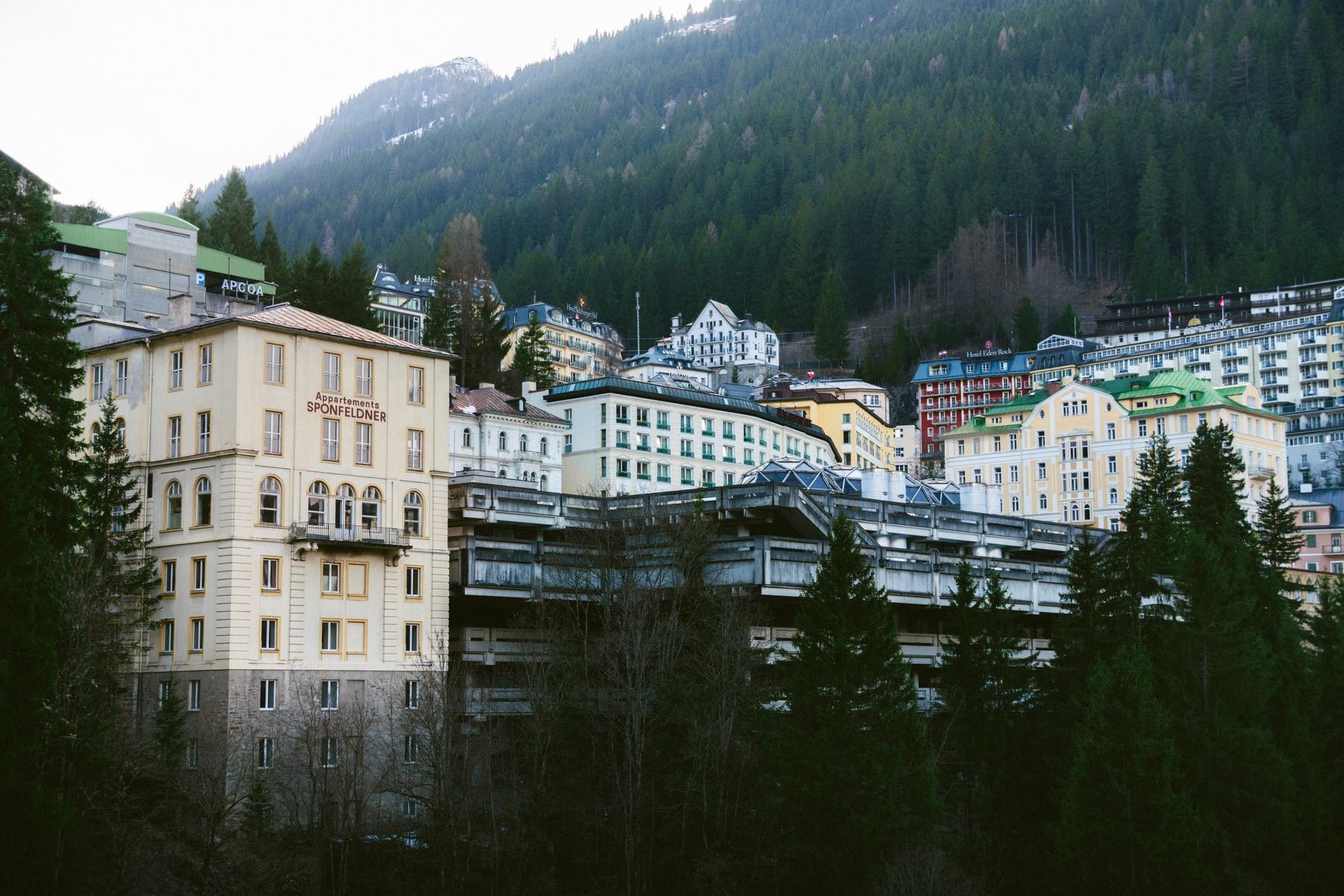
Bad Gastein has three hotel worlds. The renovated Belle Époque houses around the waterfall (Straubinger, Badeschloss, Haus Hirt, Miramonte, Regina) are what you come for: stucco, high ceilings, rooftop terraces, art, prices from CHF 180 to 450 (about EUR 193 to 482). The classic spa hotels with a thermal bath in the house, their own treatment department and half board are often a little old-fashioned, but with thermal water included, CHF 110 to 180, and their clientele is older on average. And then the guesthouses and apartments in Böckstein and above the station from CHF 70, ideal for skiers who only need to sleep. Hotels by the station are perfect for skiers (Stubnerkogel cable car in two minutes), but for the town it is 15 minutes of stairs. Price traps: the visitor tax of CHF 3 to 4 per person per night, thermal bath often only at certain times, minimum stay of seven nights in the winter holidays, garages extra. Season: Christmas to Epiphany, February and Easter are expensive and full, January and March cheap and good. Summer is quieter; here hikers, spa guests and health-cure guests count, mid-July to the end of August full, June and September lovely and empty. In the between-seasons (mid-April to mid-May, end of October to early December) many houses close, though the thermal spas stay open. Booking: winter holidays in autumn, the rest six to eight weeks ahead. The summer festival sommer.frische.kunst in August and Snow Jazz Gastein in March are reasons to come at exactly those times.

Underrated: Sportgastein, Nassfeld, Böckstein and the Kötschachtal

The most beautiful part of the valley lies behind Böckstein: the Gasteiner Alpenstrasse runs eight kilometres to the Nassfeld and to Sportgastein at 1,600 metres, toll CHF 8 (about EUR 9) per car in summer, bus free with the guest card. At the top is a wide high valley with alpine pastures, views of the Ankogel and one of the quietest walking areas in the Salzburger Land, circular walk two hours, and for the experienced the climb to the Kreuzkogel. In winter Sportgastein is the freeride area; in summer you hardly see twenty people a day there. Böckstein itself, the district at the end of the valley, has the Montanmuseum Altböckstein in the old gold washery, the pilgrimage church and the car-shuttle rail terminal; mushroom picking in summer, the cross-country trail in winter. The Kötschachtal branches off at the edge of Bad Gastein and is a flat, car-free side valley with the Grüner Baum at its entrance and alpine pastures further in, two hours there and back, pushchair-friendly too. On the Bad Hofgastein side: the Schlossalm with the new cable car and the Hohe Tauern views, and the local history museum in the Weitmoserschlössl with the story of gold mining. For culture: the Gasteiner Museum in the Grand Hotel de l'Europe tells the spa history with photos of the imperial guests, and the Kraftwerk, a former power station, is today an art space and events venue with a view into the waterfall. And bring swimming things in summer too, as many hotel thermal pools are open to visitors.

Frequently asked questions about Bad Gastein

How do I get from Switzerland to Bad Gastein, and do I need a car?

By Railjet from Zurich to Salzburg and on through the Salzach valley, around 7 hours 30 minutes, CHF 100 to 150 (about EUR 107 to 161) return with Sparschiene and the Half Fare Card. Nicer is the Nightjet overnight with a change in the morning, couchette from CHF 60 to 90. By car around 5 hours. On the spot you do not need a car: the station is at the Stubnerkogel cable car, ski bus and local bus are free with the guest card, and the town is so steep that parking is a chore anyway.

What does a ski week in Bad Gastein cost?

Six-day ski pass CHF 340 to 370 (about EUR 364 to 396, valid throughout Ski amadé), mid-range hotel with half board CHF 110 to 170 per person per night outside the holidays, ski hire CHF 140 to 200, hut lunches CHF 15 to 22, thermal spa CHF 30 to 40 per visit if the hotel has no thermal bath of its own. Allow CHF 1,400 to 2,000 per person including travel, 20 to 30 per cent more in the February holidays. That is well below Davos or Lenzerheide for a similar ski area.

Is Bad Gastein worth it in summer?

Yes, if you like thermal water, hiking and the peculiar charm of the Belle Époque houses. The suspension bridge on the Stubnerkogel, Sportgastein, the Kötschachtal and the waterfall during the snowmelt are the highlights, plus the art festival in August. If you are looking for bathing lakes and mountain-village idyll, you are better off in Zell am See. June and September are the best summer months, when prices are 30 per cent below winter.

What is the healing gallery, and is it for me?

An old gold mine gallery in Böckstein where you breathe radon-rich air for an hour at 37 to 41 degrees and high humidity, a recognised therapy for rheumatism, ankylosing spondylitis, arthrosis and respiratory diseases. One session costs CHF 80 to 90 (about EUR 86 to 96) after a medical examination; a course of treatment is ten sessions over three weeks. For healthy people it is not a wellness attraction; radon is radioactive and the heat is strenuous. If you just want to relax, go to the Felsentherme.

Bad Gastein or Bad Hofgastein, where is it better to stay?

Bad Gastein for atmosphere, the waterfall, Belle Époque hotels, bars and direct access to the Stubnerkogel at the station, but steep and with stairs. Bad Hofgastein for families, the larger Alpentherme, flat paths, more supermarkets and the Schlossalmbahn, often 10 to 20 per cent cheaper. Both hang on the same ski area and are ten minutes apart by free bus. Dorfgastein is the third and quietest option at the entrance to the valley, for families with small children.

When is the best time to visit Bad Gastein?

For skiing: January after Epiphany and March, with Snow Jazz Gastein in March as a bonus, good snow thanks to Sportgastein until April. For summer: June, when the waterfall is at its loudest, and September with clear air, both quiet and cheap. Christmas, February and August are full and expensive. Mid-April to mid-May and November are the between-seasons with many hotels closed; only the thermal spas keep going.

Activities in the region

More destinations in Salzburg & Salzkammergut