Gstaad

Switzerland · Bern & Bernese Oberland · Travel guide

Gstaad

What a week in the Saanenland really costs in summer and winter, why Gstaad can be cheaper than its reputation, and where you get the mountains without a fur coat.

Photo: Abhishek Navlakha / Pexels

What does a trip to Gstaad cost?

Adjust the values to your trip: the calculator updates live (EUR, converted from CHF estimates).

3,221 EUR
≈ 1,610 EUR per person
  • Getting there 193 EUR
  • Accommodation 1,231 EUR
  • Food 696 EUR
  • Local transport 268 EUR
  • Ski pass Gstaad Mountain Rides (6 days) 835 EUR

Estimates for orientation, not booking prices. Getting there means train or car from Switzerland, return, per person. Hotels vary strongly by season: current prices are behind the links below.

Money & payment: You pay in Swiss francs (CHF). Cards and the Twint app work practically everywhere, even on alpine pastures. Many shops accept euros but give change in francs at a poor rate. Service is included in prices; rounding up is customary. Getting there: By train (SBB) or car, 1 to 4 hours from Zurich.

Recommended hotels

Nine options in three price ranges, each among the best-rated on Booking.com.

Budget

Gstaad Saanenland Youth Hostel

Saanen, Gstaad

Modern youth hostel in Saanen, two minutes from the station, in chalet style with family rooms, breakfast included and access to the sports centre next door. With the guest card, train and mountain railways are free. The cheapest way to sleep in the Saanenland.

from CHF 60 / night (about EUR 64) View →

Hotel Landhaus Saanen

Village, Saanen

Simple village inn in Saanen with wood-panelled rooms, a restaurant with Oberland cooking and fair prices, five minutes on foot from the station. For anyone who wants the valley and can do without the Promenade.

from CHF 130 / night (about EUR 139) View →

Hotel Bären Gsteig

Village, Gsteig bei Gstaad

Historic inn from 1756 in the farming village of Gsteig at the end of the valley, with a carved facade, simple rooms and a restaurant with cheese dishes. PostBus from Gstaad in 15 minutes, starting point for Glacier 3000 and hikes to the Arnensee.

from CHF 140 / night (about EUR 150) View →

Mid-range

Hotel Arc-en-ciel Gstaad

Eggli, Gstaad

Family-run chalet hotel by the Eggli lift, ten minutes on foot from the village centre, with indoor pool, spa and one of the best pizzerias in the valley. For families who want Gstaad without Palace prices.

from CHF 220 / night (about EUR 235) View →

Hotel Bernerhof Gstaad

Station, Gstaad

Four-star house right by the station and at the start of the Promenade, with indoor pool, spa, children's programme and several restaurants. Central, family-friendly, the same family for decades. Considerably cheaper in summer than in winter.

from CHF 240 / night (about EUR 257) View →

ERMITAGE Wellness- & Spa-Hotel

Schönried, Gstaad

Wellness hotel on the sunny slope in Schönried with a large spa, outdoor pool and a view over the valley, five minutes by train from Gstaad, pistes at the door. For anyone who values spa over Promenade; in price the five-star house is really already luxury class.

from CHF 450 / night (about EUR 482) View →

Luxury

Gstaad Palace

Palacestrasse, Gstaad

The fairytale castle above the village since 1913, in the third generation of the Scherz family, with spa, pool, the GreenGo club in the cellar and a guest list from Grace Kelly to Madonna. Expensive, formal, unique. In summer from CHF 700, in winter from CHF 1,200.

from CHF 700 / night (about EUR 749) View →

The Alpina Gstaad

Oberbort, Gstaad

The younger luxury house from 2012 above the village, chalet architecture with a Six Senses spa, the starred restaurant Sommet and the Japanese Megu. More modern than the Palace, similarly expensive, for anyone who wants design with wood.

from CHF 800 / night (about EUR 856) View →

Park Gstaad

Wispilenstrasse, Gstaad

Five-star house by the Wispile lift with a generous spa, indoor and outdoor pool and garden, within walking distance of the Promenade. Slightly less myth than the Palace and Alpina, but often CHF 200 to 300 cheaper per night at the same standard.

from CHF 550 / night (about EUR 589) View →

If you book through these links we earn a small commission, at no extra cost to you.

Experiences worth your time

Glacier 3000 with Peak Walk

Cable car from the Col du Pillon in 15 minutes up to 2,971 metres, suspension bridge between two summits, Alpine Coaster, view from Mont Blanc to the Eiger. CHF 85 return, Half Fare CHF 43, included with the ski pass. PostBus from Gstaad 30 minutes, three to four hours.

View & book →

Lauenensee and Gelten Falls

PostBus from Gstaad in 25 minutes (free with the guest card), circuit of the moorland lake in 45 minutes, climb to the Gelten Falls in 90 minutes, swimming in summer. Free apart from the PostBus, half a day to a full day, pushchair possible as far as the lake.

View & book →

Wispile high trail to the Lauenensee

Gondola from Gstaad up the Wispile (CHF 30 return, free with the guest card), then along the ridge with views of the Gummfluh and Wildhorn to the Lauenensee in three hours, back by PostBus. One of the most beautiful high-level hikes in the Oberland, June to October.

View & book →

Cheese cellar of the Molkerei Gstaad

Beneath the dairy shop 3,000 wheels of Saanen cheese are stored, some more than ten years old. Tour with tasting from CHF 15 by prior arrangement, one hour. Afterwards buy Hobelkäse and two-year-old Saanen cheese in the shop.

View & book →

Saanen: church of St. Mauritius and wooden houses

Stroll through the main village with carved chalets from the 17th and 18th centuries, frescoes from 1470 in the church, the Museum der Landschaft Saanen (CHF 8). Two flat kilometres from Gstaad along the river, two hours, free.

View & book →

GoldenPass to Montreux

Panoramic railway via Rougemont, Château-d'Oex and the hairpins of Les Avants down to Lake Geneva, 1 hour 45, around CHF 20 each way with Half Fare, GoldenPass Express with Prestige class for a supplement. Combine as a day trip with Chillon Castle.

View & book →

Balloon flight from Château-d'Oex

The balloon village of Switzerland, ten minutes by train: flights over the Pays-d'Enhaut from CHF 400 per person, year-round in calm weather, in January the international balloon week free from the ground. Balloon museum CHF 8.

View & book →

Gstaad Menuhin Festival

Seven weeks of classical music from mid-July to early September in the churches of Saanen, Rougemont and Lauenen and in the festival tent. Church concerts from CHF 30, tent CHF 80 to 250, book early. A concert in Saanen church is the Gstaad evening par excellence.

View & book →

Ski day Gstaad Mountain Rides

Two hundred kilometres of pistes between Zweisimmen, Saanenmöser, Eggli and Glacier 3000, sunny and rarely full, most snow-sure in February. Day pass online CHF 70 to 80, ski hire from CHF 45, ski bus included. December to March.

View & book →

If you book through these links we earn a small commission, at no extra cost to you.

Food & drink

The Saanenland is cheese country: Saanen cheese matures for years, Hobelkäse comes to the table shaved wafer-thin, and on every alp cheese is made in summer. Add the proximity to French-speaking Switzerland with fondue and meringues from Gruyère. The range runs from the starred restaurant in the Alpina to the cheese toast in the village restaurant in Gsteig, and the village restaurant usually wins.

Saanenkäse and Hobelkäse

Molkerei Gstaad on the Promenade and alpine dairies on the Wispile and Eggli

Hard matured alpine cheese, two to ten years old, cut into rolls with a plane. CHF 5 per 100 g for two-year-old, CHF 10 for ten-year-old, as a Hobelkäse platter in a restaurant CHF 18 to 25.

Tip:Eat the Hobelkäse rolls with bread and pears, with a glass of white wine from the Vaud.

Cheese fondue moitié-moitié

Village inns in Saanen, Gsteig and Lauenen

Half Gruyère, half Vacherin Fribourgeois, the French-Swiss version from just over the pass, in the Saanenland often refined with Saanen cheese. CHF 30 to 45 per person, cheaper in Saanen and Gsteig than in Gstaad.

Tip:Fondue in the valley is French-Swiss in character: with kirsch, bread and at the end the crust, the religieuse.

Meringues with double cream

Cafés in Château-d'Oex and Rougemont, confectioners in Gstaad

Here with Gruyère double cream, which is thicker than Oberland Nidle, and often with berries. CHF 10 to 15 as a dessert, a must in Château-d'Oex and Rougemont.

Tip:The double crème is served separately; you take as much as you like, and that is a lot.

Käseschnitte

Mountain restaurants on the Eggli, Wispile and Rinderberg

Cheese toast: bread soaked in white wine, gratinated with Saanen cheese, with ham, egg or tomatoes. The lunch on the alp and in every village restaurant, CHF 18 to 26.

Tip:The "Saaner Schnitte" with Hobelkäse is the local version.

Cattle descent cooking: boiled beef and soup

Village festivals in Lauenen, Saanen and Gsteig in September

In September at the cattle descent in Lauenen and Saanen there is boiled beef with horseradish, barley soup and alpine cheese straight from the alpine dairywoman, CHF 15 to 25 at the festival.

Tip:The cattle descent in Lauenen has time slots; come early, then you see the decorated cows and still get soup.

Hot chocolate and cake on the Promenade

Cafés and confectioners on the Promenade in Gstaad

The only thing you should buy on the Promenade: hot chocolate with cream for CHF 8 to 9 and a slice of cake for CHF 7, with a view of dogs in coats strolling past.

Tip:In winter after the ski day, in summer on the terrace; inside it feels more expensive than outside.

Saanen farmhouse bread and Rahmtäfeli

Bakeries in Saanen and Gstaad, farm shops in the Lauenen valley

Dark bread from the village baker, plus the little caramel sweets made from cream that the Saanenland makes like the neighbouring Simmental. Bread CHF 5 to 7, Täfeli CHF 6 a bag.

Tip:Rahmtäfeli keep for weeks and are the souvenir for CHF 6 instead of CHF 600.

Book a food tour: Gstaad

Through markets and eateries with a guide, tastings included.

View & book →

If you book through these links we earn a small commission, at no extra cost to you.

History & background

Until the 20th century Gstaad was a hamlet in the municipality of Saanen, and Saanen is still the political centre today, with the church of St. Mauritius from 1444 and the carved wooden houses that characterise the Saanenland. In the Middle Ages the region belonged to the Counts of Gruyères and passed to Bern in 1555 after their bankruptcy, which is why the Saanenland speaks Bernese German but culturally lies between the Oberland and French-speaking Switzerland; the neighbouring villages of Rougemont and Château-d'Oex are French-speaking. The people of Saanen lived from cheese: Saanen cheese, hard and stored for years, was traded over the passes to Italy, and to this day wheels older than ten years mature in the dairy cellar in Gstaad. Everything changed in 1905, when the Montreux-Bernese Oberland Railway reached the village and the English from Montreux found their way into the mountains. In 1913 the Gstaad Palace opened on the hill above the village, a fairytale castle with towers that is still owned by the Scherz family. Boarding schools such as the Institut Le Rosey, which has moved from Rolle to Gstaad for the winter since 1916, brought the children of wealthy families, who later came themselves: Julie Andrews, Elizabeth Taylor, Roger Moore, Bernie Ecclestone. Yehudi Menuhin founded the festival in 1957 that is now called the Gstaad Menuhin Festival and every summer brings seven weeks of classical music to the churches and a tent. The tennis tournament has been played since 1915, and since 1997 there has been the beach volleyball tournament at 1,050 metres. In 1999 the Glacier 3000 cable car opened to the Scex Rouge above the Col du Pillon, designed by Mario Botta. Gstaad has around 3,000 inhabitants, Saanen as a municipality 7,000, and the chalet regulations of 1950 still prohibit buildings that do not look like a chalet, even next door to the Palace.

Insider tips

Getting there and around: GoldenPass and PostBus instead of private jet

You reach Gstaad by train from two sides: from Zurich via Bern and Zweisimmen in 2 hours 45, from Bern in 1 hour 45, from Basel in three hours, or from Lake Geneva from Montreux with the GoldenPass in 1 hour 45 through the hairpin bends above Les Avants, one of the most beautiful railway lines in Switzerland. Since 2022 the GoldenPass Express with its gauge-changing bogies has run directly from Interlaken via Zweisimmen to Montreux, stopping in Gstaad. With a Half Fare Card a Zurich return costs around CHF 90 (about EUR 96), supersaver tickets from CHF 30 each way. By car from Zurich 2 hours 30 via Bern and the Simmental, vignette CHF 40, from Geneva two hours over the Col des Mosses. Parking in Gstaad CHF 15 to 25 a day, and the Promenade is car-free. On the spot you need no car in summer: the guest card (which comes with the visitor tax of CHF 4 to 6 per night) gives free travel by train and PostBus between Zweisimmen, Château-d'Oex, Gsteig and Lauenen and, from two nights in summer, the mountain railways free as well, with the exception of Glacier 3000. That is one of the most generous guest offers in Switzerland, and it makes Gstaad cheaper in summer than any other Oberland valley. In winter the ski bus runs with the ski pass. For Glacier 3000 you take the PostBus from Gstaad to the Col du Pillon in 30 minutes.

Where to stay: Saanen, Schönried and Gsteig instead of the Promenade

Prices in the Saanenland have a range like nowhere else: a mid-range double room costs CHF 180 to 250 (about EUR 193 to 268) in summer, CHF 250 to 400 in winter, the Gstaad Palace and the Alpina from CHF 900 to 1,500, double that in Christmas week with a minimum stay of seven nights. Gstaad itself is the most expensive village, but there are ways out within five minutes by train. Saanen, the main village, has the prettier wooden houses, the church, two good inns and the youth hostel, with prices a third lower. Schönried and Saanenmöser lie on the sunny slope at 1,250 metres with direct piste access and family hotels. Gsteig and Lauenen at the end of the valley are farming villages with one inn each and silence; from Lauenen you walk to the Lauenensee. Château-d'Oex and Rougemont are French-speaking, five to ten minutes by train, and cheaper again. Holiday flats are plentiful in the Saanenland, from CHF 150 a night for four people in summer, and in Gstaad itself often let only from a week. Book six months ahead for Christmas and the February holidays, two to three months for July and August and the Menuhin Festival; for June and September a month is enough, and prices then fall by a third. Price trap: "Gstaad" in the address when the house actually stands in Schönried and you are paying the premium for the name.

Cost traps and savings: winter prices honestly, summer with the guest card

In winter Gstaad is honestly expensive, but no more so than Zermatt or St. Moritz. The Gstaad Mountain Rides ski pass costs CHF 70 to 80 (about EUR 75 to 86) a day in online advance sale, six days CHF 380 to 420, Glacier 3000 included, but only a small part of the 200 kilometres of pistes lies above 2,000 metres; only Glacier 3000 and the slopes above Saanenmöser and Zweisimmen are snow-sure. Hence our advice: for skiing Gstaad is a February place, in December and March often green lower down. Ski hire CHF 45 to 60 a day, ski school CHF 80 per half-day group lesson. Food: lunch on the piste CHF 25 to 35, dinner in Gstaad CHF 50 to 80, in Saanen CHF 35 to 50, a coffee on the Promenade CHF 6, in the village shop in Saanen CHF 3. In summer the sums turn around: from two nights the mountain railways (Eggli, Wispile, Rinderberg, Horneggli, Rellerli, Videmanette) are free with the guest card, which saves CHF 30 to 40 per person per day, and hotels are a third cheaper than in winter. Glacier 3000 costs CHF 85 return from the Col du Pillon, CHF 43 with Half Fare, Peak Walk included, pointless in fog. The Menuhin Festival has concerts from CHF 30 in the churches; the tent costs CHF 80 to 250. Tennis Swiss Open in July: qualifying days free, main draw from CHF 40.

Timing and season: summer is Gstaad's best-kept secret

Gstaad has two faces. From mid-December to the end of March it is a winter sports resort with the jet set in Christmas week and the February holidays, with high prices, full restaurants and ski pistes that lie at 1,000 to 2,000 metres and suffer in a warm winter. From June to October it is a hiking valley with cows, a festival and half-empty hotels, where the guest card pays for the mountain railways. For us the best time is mid-June to mid-July (alpine flowers, Menuhin Festival from mid-July, no summer holidays yet) and September to mid-October (cattle descents, autumn light, hotels at their cheapest). In July there is the Swiss Open tennis tournament, in July the beach volleyball, in August the Country Night Festival and the Hublot Polo Gold Cup, in September the cattle descent in Lauenen, in January and February the balloon week in Château-d'Oex and the Snow Bike Festival. The Christmas and New Year period is not recommended for ordinary travellers, because hotels demand minimum stays of seven to ten nights and the village then belongs to those for whom price is no object. Shoulder season from mid-April to early June and from mid-October to early December: mountain railways stand still, many hotels close, the valley is empty and green, prices at rock bottom. Glacier 3000 runs year-round apart from maintenance weeks, in summer with skiing until early May.

Glacier 3000, Lauenensee, Wispile, Rinderberg: where to go for what

Glacier 3000 is the only high mountain terrain in the Saanenland: from the Col du Pillon the cable car floats in 15 minutes up to the Scex Rouge at 2,971 metres, with Botta's concrete building at the top, the Peak Walk, a suspension bridge between two summits (free), the Alpine Coaster (CHF 9, about EUR 10, per ride), a view of Mont Blanc, the Matterhorn and the Eiger on clear days, and in winter the only snow-sure run in the region. CHF 85 return, Half Fare CHF 43, included with the ski pass. The Lauenensee at the end of the valley beyond Lauenen is the most beautiful outing for little money: PostBus from Gstaad in 25 minutes (free with the guest card), circuit of the lake with its moorland meadows in 45 minutes, then up to the Gelten Falls in 90 minutes or to the Gelten hut in three hours; in summer you can swim in the lake. The Wispile above Gstaad is the family mountain: gondola from the village, a circuit with cows and a cheese dairy at the top, and the hike along the ridge to the Lauenensee in three hours, one of the most beautiful high-level walks in the Oberland without glaciers. The Rinderberg from Zweisimmen has the longest toboggan run in summer and the more snow-sure slopes in winter. The Eggli is the local mountain with the new gondola from 2021 and the connecting path to the Horneggli. All four cost nothing with the guest card in summer, individually CHF 25 to 40 return.

Underrated: Saanen, cheese cellar, Rougemont, Château-d'Oex and doing the Promenade properly

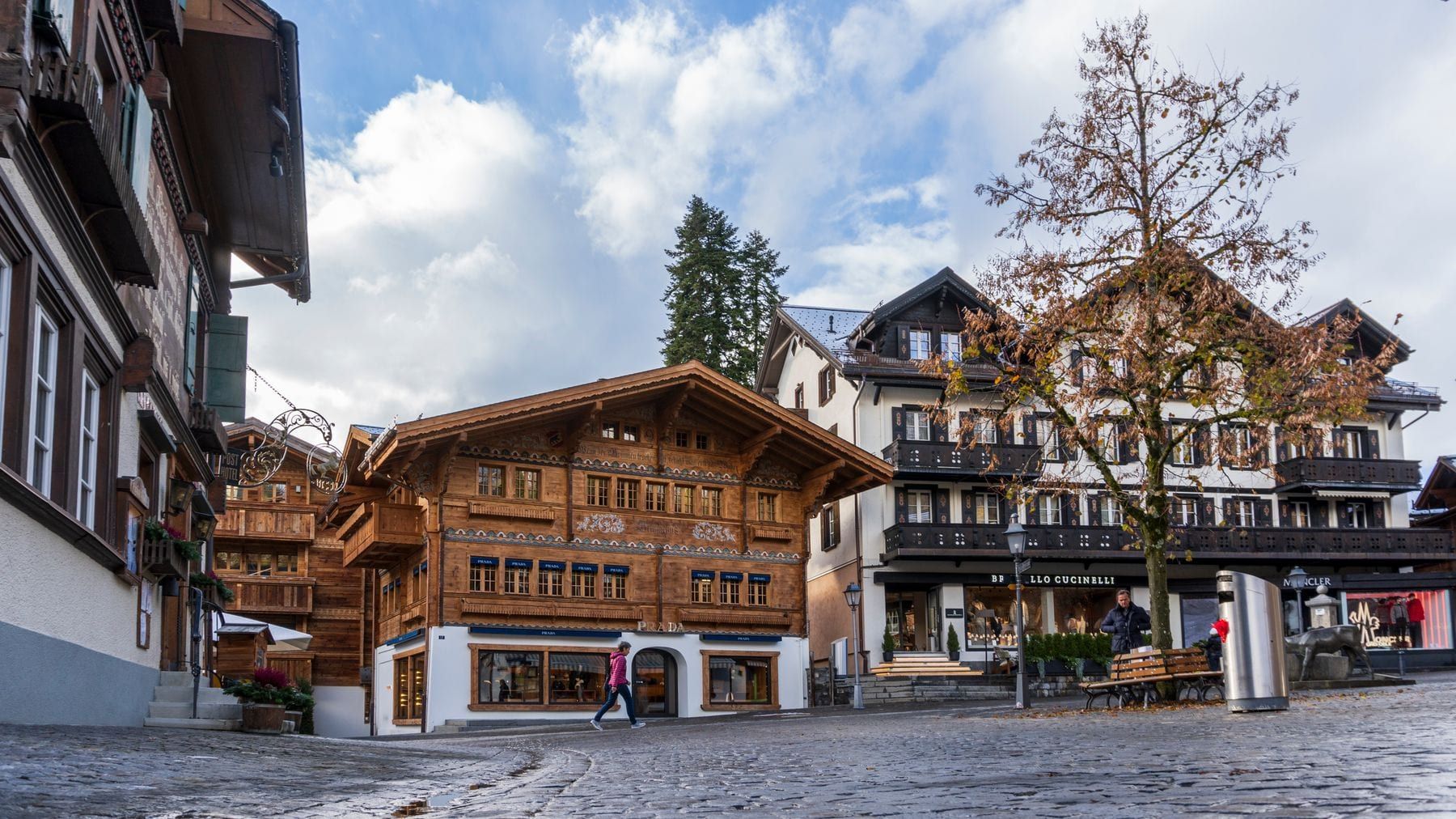
The Promenade of Gstaad is 300 metres long, and you are through it in ten minutes: shop windows from Louis Vuitton to Prada, two good cafés, a Charly's with hot chocolate for CHF 9 (about EUR 10) and the facades with carved inscriptions that are worth reading. Afterwards walk to Saanen, two flat kilometres along the river or one train stop. There stand the really old wooden houses of the valley with facade paintings from the 18th century, the church of St. Mauritius with frescoes from 1470 and the Museum der Landschaft Saanen (CHF 8). In the dairy shop in Gstaad, 3,000 wheels of Saanen cheese and Hobelkäse are stored underground; the cheese cellar can be visited by prior arrangement, tasting CHF 15, and the ten-year-old cheese costs CHF 10 per 100 g and is an experience. Rougemont, ten minutes by train towards Montreux, is the first French-speaking village, with a monastery church from the year 1080 and a village scene that beats Gstaad for beauty. Château-d'Oex is the balloon village: every January a hundred hot-air balloons rise for the international balloon week, and flights from CHF 400 per person are available year-round; the balloon museum Espace Ballon costs CHF 8. And if you want to experience Gstaad in winter without skis: winter hiking trails, tobogganing from the Eggli and Wispile (sledge CHF 10), cross-country skiing in the Lauenen valley and an afternoon in the Palace spa for day guests from CHF 80, which gets you into the castle for the price of a dinner.

Frequently asked questions about Gstaad

How do I get to Gstaad, and do I need a car?

By train from Zurich via Bern and Zweisimmen in 2 hours 45, from Bern in 1 hour 45, from Montreux with the GoldenPass in 1 hour 45, Half Fare return from Zurich around CHF 90 (about EUR 96). By car from Zurich 2 hours 30, from Geneva two hours, parking CHF 15 to 25 a day. You do not need a car: the guest card gives free travel by train and PostBus throughout the Saanenland, in summer from two nights also on the mountain railways.

Is Gstaad not far too expensive for ordinary travellers?

In winter, in Christmas week and in the February holidays yes, if you stay in Gstaad itself: CHF 300 to 400 (about EUR 321 to 428) for a mid-range room, minimum stays, CHF 70 dinners. In summer no: rooms in Saanen or Schönried from CHF 150, mountain railways free with the guest card, a picnic with Saanen cheese at the Lauenensee. Then Gstaad is cheaper than Grindelwald or Zermatt, and you see the Promenade without paying there.

What does a week in Gstaad cost?

In summer for two people with seven nights mid-range in Saanen (CHF 1,400), food (CHF 900), Glacier 3000 with Half Fare (CHF 86), mountain railways with the guest card (CHF 0), travel from Zurich with Half Fare (CHF 180) around CHF 2,600 (about EUR 2,782), so CHF 1,300 per person. In winter with a ski pass (CHF 400 per person) and winter prices more like CHF 2,200 per person. With the Saanen youth hostel and picnics in summer, CHF 700 per person.

Is Glacier 3000 worth it?

In clear weather yes: the Peak Walk between two summits, a view from Mont Blanc to the Eiger, glacier, Alpine Coaster. CHF 85 return (about EUR 91) without discount, CHF 43 with Half Fare, included with the ski pass. In cloud it is a concrete building in fog, so check the webcam in the morning. In summer the Lauenensee with the Wispile high trail is the more beautiful and free day; Glacier 3000 is the extra for a clear morning.

Is Gstaad a good ski area?

For families and leisurely skiers yes: 200 kilometres of pistes spread over several sectors between Zweisimmen and Glacier 3000, wide, sunny, rarely full. For experts and snow reliability limited: most pistes lie between 1,000 and 2,000 metres, only Glacier 3000 is high. The best time is February; December and March are often green lower down. Ski pass CHF 70 to 80 (about EUR 75 to 86) a day in advance sale, cheaper than Zermatt, dearer than Austria.

When is the best time to visit Gstaad?

Mid-June to mid-July and September to mid-October for hiking, free mountain railways with the guest card and low hotel prices; mid-July to early September additionally with the Menuhin Festival, tennis and beach volleyball. For skiing, February. Christmas and New Year only if price and minimum stay do not matter. In January the balloon week in Château-d'Oex. Shoulder season April, May and November: empty and cheap, but railways and many hotels closed.

Itineraries with this destination

More destinations in Bern & Bernese Oberland