Backpackers Villa Sonnenhof
Well-kept hostel in an old villa right on the Höhematte park with a Jungfrau view, dorms and double rooms, breakfast included, garden and kitchen. For years one of the best-rated hostels in Switzerland.
Switzerland · Bern & Bernese Oberland · Travel guide
What the trip up to the Jungfraujoch really costs, when it is worth it and when it is not, and why Interlaken itself is only the base, not the destination.
Photo: Baublewave / Pexels
Adjust the values to your trip: the calculator updates live (EUR, converted from CHF estimates).
Estimates for orientation, not booking prices. Getting there means train or car from Switzerland, return, per person. Hotels vary strongly by season: current prices are behind the links below.
Money & payment: You pay in Swiss francs (CHF). Cards and the Twint app work practically everywhere, even on alpine pastures. Many shops accept euros but give change in francs at a poor rate. Service is included in prices; rounding up is customary. Getting there: By train (SBB) or car, 1 to 4 hours from Zurich.
Nine options in three price ranges, each among the best-rated on Booking.com.
Budget
Well-kept hostel in an old villa right on the Höhematte park with a Jungfrau view, dorms and double rooms, breakfast included, garden and kitchen. For years one of the best-rated hostels in Switzerland.
The oldest hostel in Switzerland, in Matten since 1945, 15 minutes on foot from the West station. Dorms, tents in summer, its own club in the cellar. For young backpackers who want to meet people, not for those seeking peace and quiet.
Modern youth hostel right next to Interlaken Ost station, multi-bed and family rooms, breakfast buffet, access to the indoor pool next door. It does not get more practical than this for early mountain trains.
Mid-range
The oldest hotel in town, it has taken in guests since 1491, among them Byron and Mendelssohn. Renovated rooms, Japanese garden, between the Höhematte and the Ost station. History at a mid-range price.
Family-run house from 1789 right on the Aare with its own garden terrace on the river, five minutes from the West station. Quieter than the Höheweg, and Unterseen with its restaurants is next door.
Traditional hotel on the Höheweg with generous, partly freshly renovated rooms, a terrace with Jungfrau view and a popular kitchen. A good choice for families who want to stay central without paying grand hotel prices.
Luxury
The grand hotel of Switzerland par excellence, on the Höhematte since 1865, with 5,500 square metres of spa, Jungfrau views from the south rooms and old-school service. If you want a Belle Époque hotel once in your life, this is the place.
Belle Époque house from 1874 at the upper end of the Höheweg, with spa, garden towards the Aare and a view of the Jungfrau. A little cheaper and more personal than the Victoria-Jungfrau, in almost the same location.
The fairytale hotel of 1875 above Lake Brienz next to the Giessbach Falls, with its own funicular from the boat jetty, art nouveau hall and terrace above the water. April to October only, no spa, but romance that no new building can imitate.
If you book through these links we earn a small commission, at no extra cost to you.
By train and Eiger Express from Interlaken Ost in two hours up to 3,454 metres, Sphinx terrace, Ice Palace and Aletsch Glacier. Around CHF 250 return, CHF 125 with Half Fare, plus CHF 10 reservation. Five to six hours, only in clear visibility.
Eight minutes by funicular from Interlaken up the local mountain to the viewing platform over both lakes and the Eiger, Mönch and Jungfrau. CHF 44 return, Half Fare CHF 22, included in the Berner Oberland Pass. Most beautiful in the evening at sunset, two hours.
Nostalgic rack railway from Wilderswil in 50 minutes up to 1,967 metres, alpine garden with 650 species, panorama path to the Oberberghorn. CHF 70 return, CHF 35 with Half Fare, June to October only. Half a day to a full day.
From Interlaken Ost via Iseltwald and Giessbach to Brienz, 75 minutes each way, also on the steamboat Lötschberg. CHF 60 to 70 for the round trip without discount, half price or free with Half Fare and passes. Get off at Giessbach and see the waterfalls.
Tandem flight from Beatenberg or Amisbühl landing on the Höhematte, 15 to 20 minutes in the air, CHF 180 to 200. Year-round in calm weather, most stable in the morning. Two hours including transfer and briefing.
More than 100 historic houses from every part of the country on 66 hectares near Brienz, with crafts, farm animals and demonstrations. Admission CHF 32, bus from Brienz. Four hours to a full day, mid-April to the end of October.
The last daily steam-operated rack railway in Switzerland climbs from Brienz in an hour to 2,244 metres, with a view at the top over the lake and the Alps as far as the Titlis. CHF 96 return, Half Fare CHF 48. June to October, half a day.
A kilometre of walkable stalactite cave with waterfalls, by legend the dragon's lair of Saint Beatus. Admission CHF 20, a constant 8 to 10 degrees, bring a jacket. By boat or bus from Interlaken, two to three hours.
Interlaken is the outdoor capital of Switzerland: canyoning in the Saxetenbach or rafting on the Lütschine, half a day from CHF 120 to 180 including equipment. May to October, swimming compulsory, from age 14.
If you book through these links we earn a small commission, at no extra cost to you.
Interlaken cooks for the world, and you can taste it: fondue next to sushi next to kebab on the Höheweg. You find honest Oberland cooking in Unterseen, in the villages on the lakes and up on the alps: Lake Brienz fish, alpine cheese, meringues from Meiringen, rösti. Eat in the restaurants at lunchtime, compare fondue prices in the evening.
Lake Brienz is clear and low in nutrients, and the fish correspondingly delicate: whitefish (Felchen) fried with almond butter or perch fillets (Egli) in batter, CHF 32 to 45 in lakeside restaurants. Not always from the lake, so ask.
Tip:If the menu says "aus dem Brienzersee", it is seasonal and dearer; "Egli-Filets" with no origin stated often come from Eastern Europe.
Legend has it that meringue comes from Meiringen in the Hasli valley, 40 minutes to the east. With thick Oberland cream and ice cream CHF 9 to 14, a little cheaper in Meiringen.
Tip:In Meiringen the Sherlock Holmes Museum is right next door, Reichenbach Falls included.
Half Gruyère, half Vacherin, with kirsch and garlic, in the Oberland often with local alpine cheese. CHF 28 to 45 per person, most expensive on the Höheweg.
Tip:Fondue is a winter dish; in July at 28 degrees only tourists order it, and the kitchen knows that.
Bernese alpine cheese from the summer pastures around the Joch, hard and spicy, as Hobelkäse shaved wafer-thin into rolls. CHF 3 to 4 per 100 g in dairies, on the alps straight from the herdsman.
Tip:Buy it on the alp, where it is cheapest and you see where it comes from.
Rösti made from boiled potatoes, gratinated with alpine cheese, with a fried egg or bacon. The lunch in every mountain restaurant, CHF 20 to 28.
Tip:On the mountain the rösti is the best value on the menu.
Thin honey gingerbread from the Hasli valley, a souvenir that needs no refrigeration, CHF 5 to 10 a pack. In Brienz, the woodcarving village, there are also biscuits made in carved moulds.
Tip:Better than the chocolate from the Höheweg, and at half the price.
Alpine macaroni: pasta, potatoes, cream, cheese and fried onions, with apple sauce on the side. The meal after the hike, CHF 20 to 26 in mountain restaurants.
Tip:Eat it with the apple sauce, even if it sounds odd: that is part of it.
Through markets and eateries with a guide, tastings included.
If you book through these links we earn a small commission, at no extra cost to you.
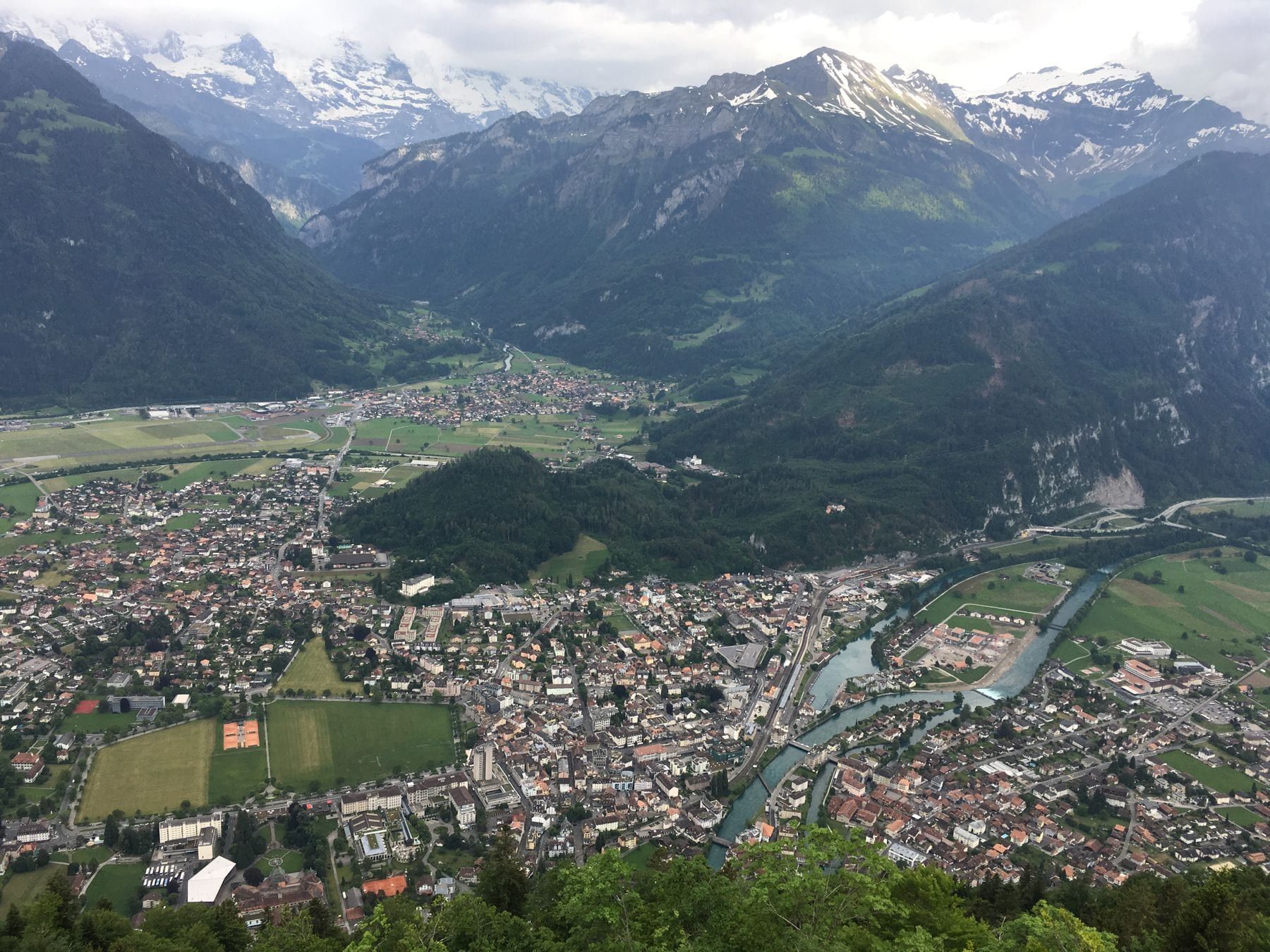
Interlaken means what it is: between the lakes. On the alluvial plain between Lake Thun and Lake Brienz, Augustinian canons founded a monastery around 1133, whose estates became the seat of the Bernese bailiff after the Reformation in 1528; the monastery church and the castle still stand next to the Höhematte park today. The town itself was called Aarmühle until 1891, and the name Interlaken was only adopted once the foreigners had long been travelling there under that name. For tourism began early: after 1800 painters and writers came, Byron and Mendelssohn raved about the Jungfrau, and from 1835 steamboats crossed Lake Thun, from 1839 Lake Brienz, before there was any railway at all. That came in 1872 with the Bödelibahn and in 1893 with the connection to the Bernese Oberland Railways network, and the Höheweg promenade with its grand hotels, the Victoria-Jungfrau at their head, was built in those decades for the English upper class. The Jungfraujoch is the work of the Zurich industrialist Adolf Guyer-Zeller, who had the idea on a hike in 1893 of boring the railway through the Eiger and the Mönch. Construction lasted from 1896 to 1912, cost 30 workers their lives and ended not on the Jungfrau summit as planned but on the saddle at 3,454 metres, to this day the highest railway station in Europe. The Sphinx research station was added in 1937, the Ice Palace as early as 1934. Since 2001 the Jungfrau-Aletsch region has been a UNESCO World Heritage site, and the Eiger Express of 2020 has shortened the trip to the Joch by 47 minutes. Today more than a million people a year visit the Jungfraujoch, half of them from Asia, and Interlaken, with around 5,700 inhabitants, is one of the most international small towns in Switzerland.

From Bern the IC reaches Interlaken Ost in 50 minutes, from Zurich in two hours, from Basel in 2 hours 10, direct every hour. With a Half Fare Card a Zurich return costs around CHF 70 (about EUR 75), supersaver tickets start at CHF 25 each way. Interlaken has two stations: West is closer to most hotels, Ost is the interchange for Grindelwald, Lauterbrunnen, Brienz and the Schynige Platte, and the boats leave from both. By car you are there from Zurich in two hours, vignette CHF 40, but parking in Interlaken itself costs CHF 20 to 30 a day, and the villages of Wengen and Mürren are car-free anyway. If you are only doing the Jungfrau region, leave the car at home; if you want to combine Lake Thun villages, the St Beatus Caves and the Brienzer Rothorn, a car gives you more freedom. The real decision is the rail ticket. The Berner Oberland Pass costs CHF 240 for three days in second class with a Half Fare Card (CHF 300 without) and covers boats, most mountain railways as far as Kleine Scheidegg and Mürren, and 50 per cent off the Jungfraujoch. The Jungfrau Travel Pass costs about the same and is tailored to the Jungfrau railways. With two mountain days the passes pay for themselves; if you only go up once, buy single tickets with the Half Fare Card. Hotel guests get the guest card with a free local bus.
The trip from Interlaken Ost to the Jungfraujoch and back costs around CHF 250 (about EUR 268) in summer without any discount, around CHF 125 with a Half Fare Card, and less with the Good Morning Ticket (first trains, return by 1 pm, low season only). On top comes the seat reservation for the section from Eigergletscher to the Joch, CHF 10, which you need in high season or you will queue for two hours. So for two people with Half Fare Cards expect CHF 270, without CHF 500, and for that you get the highest railway station in Europe, the Sphinx terrace with a view of the 22-kilometre Aletsch Glacier, the Ice Palace and a snow area where in July East Asian visitors touch the first snow of their lives. It is impressive, and it is the most expensive thing you can spend in Switzerland in one day without sleeping. Our honest rule: only go up in clear weather, check the webcams in the morning; in cloud the Joch is a white nothing for CHF 250. If you are unsure, go up to the Schynige Platte instead (CHF 70 return, CHF 35 with Half Fare) or to Kleine Scheidegg (CHF 90) and see the Eiger, Mönch and Jungfrau from the front rather than from above. Take the altitude seriously: at 3,454 metres some people feel sick, so walk slowly, drink plenty, and do not bring small children.
A mid-range double room in Interlaken costs CHF 180 to 240 (about EUR 193 to 257) in summer, the grand hotels on the Höheweg CHF 400 to 800. The town has one of the highest hotel densities in Switzerland and is still full from June to September and between Christmas and New Year; book three months ahead. The price trap is "Jungfrau view" rooms on the Höheweg: you see the Jungfrau just as well from the Höhematte park, free. You stay cheaper and more pleasantly outside town. Wilderswil, five minutes by train, is a quiet village with hotels around CHF 140 and the station for the Schynige Platte. Bönigen and Iseltwald on Lake Brienz, Unterseen on the other side of the Aare with old town lanes and restaurants, Matten with hostels and the youth hostel. If you want the mountains, sleep in Grindelwald, Wengen or Mürren and do not come down to Interlaken at all; there you are first at the lifts in the morning and pay about the same. Interlaken is worth it as a base if you want to mix lakes and mountains and do not fancy moving every day. Hostels cost CHF 45 to 60 per bed and in summer are full of backpackers from all over the world, but come with a bar and an excursion desk.
The region lives off you not doing the maths. So we do the maths. The Half Fare Card (CHF 190 a year, about EUR 203) pays off with a single Oberland weekend, also for visitors from Germany and Austria, because every mountain railway then costs half. The boats on Lake Thun and Lake Brienz are covered by the GA, Half Fare and Berner Oberland Pass; otherwise a round trip costs CHF 60 to 70. The stretch from Interlaken Ost to Brienz or Thun is also a train line, so you can go out by boat and come back by train. Harder Kulm, the local mountain above Interlaken, costs CHF 44 return (Half Fare CHF 22) for eight minutes of funicular; the viewing platform is lovely, and the walk up on foot in two and a half hours is free. Food: on the Höheweg you pay CHF 25 to 30 for lunch and CHF 45 for fondue; in Unterseen and Matten CHF 20 to 25. Coop and Migros at the West station have takeaway, and a picnic on Lake Brienz is the cheapest lunch with the best view. The paragliding flights over the Höhematte (CHF 180 to 200 for 15 to 20 minutes) are reputable and safe, but booking through the hostel or directly with the operators at the landing field saves money compared with the hotel concierge.
July and August are the busiest months, with waiting times at the Jungfrau railways, hotel prices at the top end and thunderstorms in the afternoon. The best weeks are mid-June to early July (alpine flowers, long days, snow gone from the passes) and September to mid-October (stable high pressure, clear views, autumn colours, cattle descents). The Jungfraujoch is open year-round; in winter the visibility is often better than in summer, and half the visitors are missing. Between mid-October and mid-December and in April and May, many mountain railways and hotels are closed for maintenance, but Interlaken is then almost empty and the boats are still, or already, running. The Schynige Platte only runs from June to October. In winter Interlaken itself is not a ski resort but the base for Grindelwald-Wengen and Mürren, 30 to 40 minutes away; if you want to ski, you are better off staying there. Two fixed dates: the Unspunnenfest every twelve years (last in 2017, the next postponed to 2029) and the Tell plays in the open-air theatre in Matten, July and August, since 1912. Check the Jungfrau railways' webcams every morning, not the forecast: Interlaken in fog often means sunshine from 1,500 metres.
For us the Schynige Platte is the most beautiful viewpoint mountain in the region: a rack railway from 1893 puffs up from Wilderswil in 50 minutes to 1,967 metres, with an alpine garden of 650 species at the top, a hotel from 1899 and the classic panorama hike over the Faulhorn to First in six hours, or the Oberberghorn circuit in two. CHF 70 return (about EUR 75), CHF 35 with Half Fare, June to October only. On Lake Brienz lies Iseltwald, a fishing village that has charged admission for photos on the jetty (CHF 5) since a Korean television series; it is nicer to continue by boat to Giessbach, where 14 waterfall steps tumble into the lake next to the Grandhotel Giessbach of 1875; the funicular from the jetty costs CHF 6, and the terrace is public. Lake Thun has the castles of Oberhofen and Spiez, the St Beatus Caves (CHF 20) and the village of Spiez with its vineyard. On the Brienzer Rothorn the last steam rack railway in Switzerland runs daily (CHF 96 return, Half Fare CHF 48), and at Ballenberg 100 historic houses from all over Switzerland stand in the open-air museum (CHF 32). None of these places needs a reservation, and none costs more than a third of the Jungfraujoch.
By train from Bern in 50 minutes, from Zurich in two hours, from Basel in a good two hours, hourly and direct to Interlaken Ost. With a Half Fare Card a Zurich return costs around CHF 70 (about EUR 75). By car on the A8 from Zurich in two hours, parking in Interlaken CHF 20 to 30 a day. You do not need a car for the Jungfrau region, because Wengen and Mürren are car-free and everything leaves from Interlaken Ost; for the Lake Thun villages and the Brienzer Rothorn it is practical.
From Interlaken Ost and back around CHF 250 (about EUR 268) per person without discount in summer, around CHF 125 with a Half Fare Card, 50 per cent off from Grindelwald or Wengen with the Berner Oberland Pass or Jungfrau Travel Pass. Plus CHF 10 seat reservation, which you need from June to September. Children up to 15 travel free with a Junior Card. In winter and with the Good Morning Ticket in low season it is cheaper.
In clear skies yes, once in a lifetime: the Aletsch Glacier, the Sphinx terrace, the Ice Palace and the feeling of standing in a railway station at 3,454 metres. In cloud it is CHF 250 (about EUR 268) for a white nothing, so check the webcams in the morning and decide on the spot. If you want to protect the budget, the Schynige Platte, Kleine Scheidegg or Männlichen give you the better view of the trio of Eiger, Mönch and Jungfrau for a third of the price.
Three full days are a good measure: one day Jungfraujoch or Schynige Platte, one day Grindelwald or the Lauterbrunnen valley, one day on the lakes with a boat, Giessbach or Ballenberg. With the three-day Berner Oberland Pass that is also the most sensible length financially. Hikers stay a week and after two nights move up the valley to Wengen or Mürren.
With a Half Fare Card and two or more mountain days plus a boat trip, the Berner Oberland Pass for three days (CHF 240 with Half Fare, about EUR 257); it covers the lakes, Harder Kulm, Schynige Platte, Mürren, Kleine Scheidegg and gives 50 per cent off the Joch. If you only do the Jungfraujoch and Grindelwald, Half Fare plus single tickets is cheaper. Without a Half Fare Card, the card itself (CHF 190) pays off from the first weekend; visitors from abroad can buy it online.
Mid-June to early July and September to mid-October: railways open, stable visibility, fewer people than in August. July and August are crowded and stormy in the afternoon, so go up early. The Jungfraujoch is also worth it in winter, with clearer air and half as many visitors. Between mid-October and December and in April and May, many railways and hotels are closed for maintenance; check beforehand.
Zurich · Lucerne · Interlaken · Zermatt · Lausanne and Montreux · Bern · Basel
The official Grand Tour is 1,600 kilometres long and needs three weeks. This version takes the best 900 kilometres of it: lakes, the Matterhorn, wine terraces and two old towns in two weeks, with seven bases instead of packing up every day.
Lucerne · Interlaken · Aletsch · Lugano · St. Moritz
Seven passes, four language regions and not a single hotel: in a camper you drive from Lucerne over the great Alpine roads into Ticino and back into the Engadin, sleep on TCS sites and motorhome pitches and have breakfast with a glacier view.
Interlaken · Grindelwald · Lauterbrunnen · Gstaad
Four bases, seven day stages and the most famous mountain backdrop in Switzerland: you hike beneath the Eiger north face, above the Lauterbrunnen valley and finally through the quiet meadows of the Saanenland, with railways that carry you up so you only have to walk down.
Lucerne · Interlaken · Grindelwald
One week, three bases and every day something children really want: a cogwheel railway, a boat, a scooter bike downhill, a toboggan run and a museum you are allowed to touch. No car, because children travel free on the trains with the Junior Card.
What a weekend in the federal city really costs, why you pack swimming trunks in summer, and how to see Bern thoroughly in two days without spreading yourself thin.
What a week under the Eiger north face really costs in summer and winter, which mountain railway gives you which view, and why you take the First before 9 am.
What the valley of 72 waterfalls really costs, why you should sleep up in Mürren or Wengen rather than down in the village, and how to have Lauterbrunnen to yourself despite the Instagram rush.
What a week in the Saanenland really costs in summer and winter, why Gstaad can be cheaper than its reputation, and where you get the mountains without a fur coat.