Himeji

Japan · Kansai · Travel guide

Himeji

What Japan's most beautiful castle really costs, why you should be at the gate at 9 am, and how to turn the day trip into a day that is more than just a castle.

Photo: Lorenzo Castellino / Pexels

What does a trip to Himeji cost?

Adjust the values to your trip: the calculator updates live (EUR, converted from CHF estimates).

3,064 EUR
≈ 1,532 EUR per person
  • Flights 2,140 EUR
  • Accommodation 428 EUR
  • Food 428 EUR
  • Local transport 54 EUR
  • Himeji Castle & Koko-en (combination ticket) 15 EUR

Estimates for orientation, not booking prices. Flights and hotels vary strongly by season: current prices are behind the links below.

Money & payment: You pay in yen (JPY). 1,000 yen is roughly CHF 6 or EUR 6.50. Cards work in cities and hotels; small restaurants, temples and rural stations often want cash. An IC card (Suica or ICOCA) on your phone pays for trains, buses and convenience stores. Flight time: 12 to 14 hours, usually with one stop.

Recommended hotels

Nine options in three price ranges, each among the best-rated on Booking.com.

Budget

Toyoko Inn Himeji-eki Shinkansen Minami-guchi

Station south, Himeji

The chain's budget standard right at the south exit of the station, with small rooms and free breakfast. The castle is 20 minutes on foot through the station. Ideal for one night as a stopover.

from CHF 55 / night (about EUR 59) View →

Dormy Inn Himeji Natural Hot Spring

Station north, Himeji

Dormy Inn with an onsen bath on the roof, free ramen in the evening and a good breakfast, five minutes from the north exit towards the castle. For the price, the best overall package in Himeji.

from CHF 75 / night (about EUR 80) View →

Himeji 588 Guest House

Near the castle, Himeji

Small hostel in a converted house between the station and the castle with dorms and simple private rooms, a shared kitchen and bikes. Personally run, for solo travellers and couples on a budget.

from CHF 25 / night (about EUR 27) View →

Mid-range

Hotel Nikko Himeji

Station south, Himeji

The largest hotel in the city, right at the south exit of the station, with spacious rooms, several restaurants and castle views from the upper floors on the north side. Classic, reliable, good breakfast.

from CHF 110 / night (about EUR 118) View →

Daiwa Roynet Hotel Himeji

Station north, Himeji

Upscale business hotel on Otemae-dori, halfway between the station and the castle. Rooms with good beds and a desk, and from the upper floors you can see the main keep. A good no-frills mid-range choice.

from CHF 95 / night (about EUR 102) View →

Hotel Monterey Himeji

Station north, Himeji

European-style hotel of the Monterey chain right at the north exit, with rooms on the castle side, a spa in the building and breakfast with a view. From here you are at the castle gate in ten minutes, and on the avenue with the illuminated castle in the evening.

from CHF 120 / night (about EUR 128) View →

Luxury

Hotel Claire Higasa

Station north, Himeji

Small, modern hotel with large rooms on Miyuki-dori, the most upmarket option in central Himeji. Not luxury in the Tokyo sense, but peace, space and a restaurant with a view. Four minutes to Sanyo-Himeji station, and just under twenty minutes on foot to the castle.

from CHF 70 / night (about EUR 75) View →

Setre Highland Villa Himeji

Hiromine, Himeji

Boutique hotel on the slopes of Mount Hiromine north of the city, with views over Himeji, the castle and the Inland Sea, a pool and French-Japanese cooking. Only reachable by taxi or rental car, but with the view no hotel by the station can offer.

from CHF 280 / night (about EUR 300) View →

Nishimuraya Honkan

Kinosaki Onsen, Toyooka

One of the best ryokan in Japan, in the onsen village of Kinosaki, two hours north of Himeji: tatami rooms with garden views, kaiseki with Tajima beef and crab, and seven public baths in the village. For the one big ryokan night of your trip.

from CHF 550 / night (about EUR 589) View →

If you book through these links we earn a small commission, at no extra cost to you.

Experiences worth your time

Himeji Castle with a guide

The largest original castle in Japan, with six wooden storeys, admission CHF 6. Free English-speaking volunteers at the entrance or guided tours from CHF 40 explain the defensive maze. Be at the gate at 9 am.

View & book →

Koko-en garden

Nine themed gardens on the site of the old samurai residences, right next to the castle, admission CHF 2, or CHF 1 with the combination ticket. A teahouse with matcha for CHF 3, and lunch with anago above the pond. Never crowded, even on busy castle days.

View & book →

Mount Shosha and Engyo-ji

A 10th-century temple complex in mountain forest, a filming location for "The Last Samurai", 45 minutes away by bus and ropeway, CHF 10 in total. Allow three hours and wear sturdy shoes. Vegetarian monks' meal CHF 20 if ordered ahead.

View & book →

Day trip to Himeji from Osaka or Kyoto

Guided day tours combine the castle with Koko-en and often with Kobe or Mount Shosha, from CHF 90 including the train. On your own it is easy with the JR Special Rapid, CHF 18 return from Osaka.

View & book →

Castle illuminations in the evening

The white castle is floodlit until midnight, best seen from Otemae-dori, the castle bridge or the roof of the Egret cultural centre opposite (free, until 9 pm). Only possible if you stay overnight or take a late train, but worth it.

View & book →

Kimono try-on at the Hyogo History Museum

The prefectural museum next to the castle offers a free daily try-on of kimono or samurai armour for adults and children; sign up in the morning, places are limited. Admission to the permanent exhibition CHF 1.30. A good combination with the castle.

View & book →

Sake and soy sauce day in Tatsuno

The small castle town of Tatsuno, 20 minutes west, is the centre of light usukuchi soy sauce. Brewery museum CHF 0.60, somen noodles for lunch CHF 6, an old town without tourists. Take the JR Kishin line from Himeji.

View & book →

Himeji Central Park Safari

A drive-through safari zoo and amusement park 20 minutes out of town by bus, admission CHF 22 for adults and CHF 12 for children. For families who need an afternoon for the kids after the castle. With an ice rink in winter.

View & book →

If you book through these links we earn a small commission, at no extra cost to you.

Food & drink

In culinary terms Himeji is the province of Harima: conger eel and octopus from the Inland Sea, oden with ginger and soy instead of mustard, soy sauce from Tatsuno and a few quirks you only find here. None of it is expensive, and the best places are in the covered shopping streets south of the castle.

Himeji oden

Izakaya on Omizo-suji and Miyuki-dori

A stew of radish, egg, fish cake and konnyaku in dashi, eaten in Himeji with grated ginger and soy sauce instead of mustard. A plate CHF 5 to 8.

Tip:The ginger and soy version counts as Himeji's official speciality; ask for "shoga-joyu".

Anago-don

The restaurant in Koko-en or anago restaurants around the station

Grilled conger eel from the Seto Inland Sea with a sweet sauce on rice, softer and milder than unagi. CHF 12 to 20 at lunchtime.

Tip:At Koko-en you eat above the koi pond; no booking needed, but come before noon.

Ekisoba

Maneki Shokuhin, on the platform at Himeji Station

Himeji's station noodles since 1949: Chinese-style wheat noodles in Japanese soba broth with tempura crumbs, a post-war invention. CHF 3.50.

Tip:Eaten at a standing table on the platform, ready in three minutes, ticket from the machine.

Almond toast

Kissaten (old-style cafés) around the station, such as Hamamoto Coffee

Thick toast with almond butter, crispy outside, Himeji's coffee house invention from the 1950s. With coffee as a morning set CHF 5 to 7.

Tip:Order it as a "morning set" before 11 am, and the coffee is included in the price.

Tako (octopus) from Akashi

Fish restaurants on Miyuki-dori or Uontana market in Akashi

Octopus from the Akashi Strait is considered the best in Japan, as sashimi, grilled or in akashiyaki. As a lunch set CHF 10 to 15.

Tip:Akashi is on the way back to Kobe, and the market closes in the afternoon.

Harima sake

Honda Shoten brewery (Tatsuriki) in Aboshi, or sake shops on Miyuki-dori

Harima is home to the Yamada Nishiki sake rice, and the breweries around Himeji make clear, robust sake. Tasting CHF 3, bottles from CHF 8.

Tip:Tatsuriki is the city's house brand, also sold in small bottles at the station shop.

Tamatsubaki

Itoya Honten, Nishinimachi, or at the station shop

Himeji's traditional sweet since 1822: a ball of white bean paste in a thin yellow egg dough shell, elegant and not too sweet. A box CHF 6 to 10.

Tip:The souvenir from Himeji: it keeps well and survives the flight.

Book a food tour: Himeji

Through markets and eateries with a guide, tastings included.

View & book →

If you book through these links we earn a small commission, at no extra cost to you.

History & background

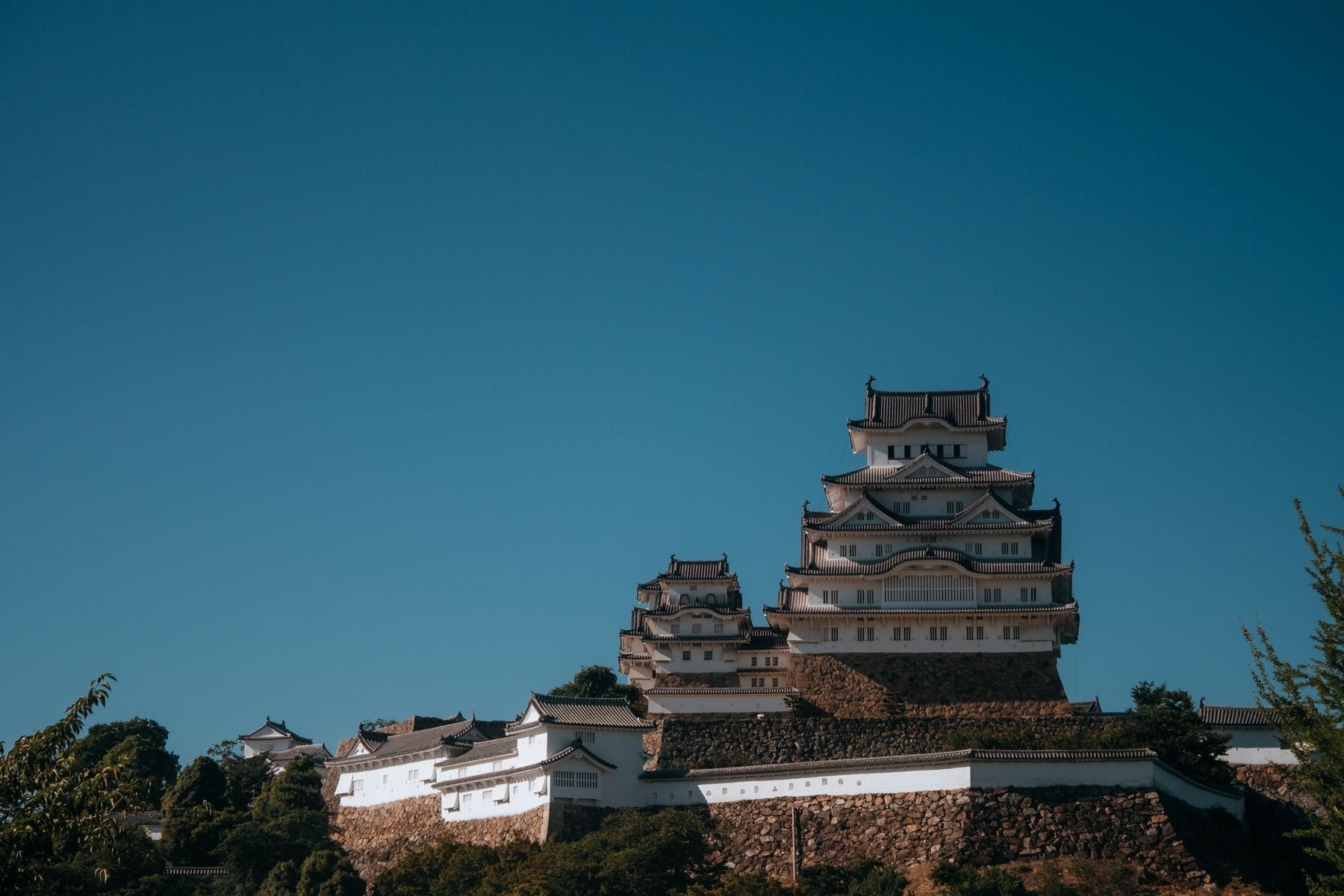
A fortification of the Akamatsu clan already stood on Himeyama hill in 1333, but the castle as you see it today is the work of Ikeda Terumasa. After the Battle of Sekigahara in 1600, Tokugawa Ieyasu gave him the province of Harima, as his son-in-law and as a guard against the not yet subdued lords of the west. From 1601 to 1609 Ikeda had the main keep built, with five visible storeys outside, six inside and a basement, plus three smaller keeps and a maze of gates, walls and spiralling paths designed to lead attackers in circles under fire. The castle was never attacked. The white plaster on every wall, which gave it the name "White Heron Castle" (Shirasagi-jo), was fire protection, not decoration. When the Meiji government abolished the domains in 1868, the castle was auctioned off: a local bought it for 23 yen but gave up on demolishing it, because removing the roof tiles would have cost more than he could have made from them. The army used the grounds, and in 1931 the main keep became a National Treasure. In the Second World War the city of Himeji burned down on 3 July 1945; an incendiary bomb hit the top floor of the keep and failed to ignite. In 1993 Himeji, together with Horyu-ji, became the first Japanese World Heritage Site. The last major renovation, from 2009 to 2015, cost 24 billion yen and left the plaster so white that for a while locals talked of a "white castle" that looked too new. By now it has its patina back.

Insider tips

Getting there and around: shinkansen or Special Rapid

Himeji is on the Sanyo main line and the shinkansen, and the castle stands at the end of a dead-straight avenue that you can see from the station. From Osaka the JR Special Rapid (shinkaisoku) takes 60 minutes for CHF 9 (about EUR 10), the shinkansen 30 minutes for CHF 20; from Kyoto it is 90 minutes by JR for CHF 14 or 45 minutes by shinkansen for CHF 32; from Kobe 40 minutes by JR for CHF 6. With the Japan Rail Pass every connection is free, and with JR West's Kansai Area Pass (1 day CHF 17) the Special Rapid is covered too, but not the shinkansen. From Hiroshima the Nozomi stops in Himeji, 60 minutes for CHF 50; if you are travelling from Hiroshima to Kansai, you can fit the castle in as a stopover with your luggage in a locker (CHF 3 to 5). From the station to the castle it is 15 minutes on foot along Otemae-dori, or two minutes on the loop bus (CHF 0.60). For Mount Shosha take bus 8 from the north side of the station (30 minutes, CHF 1.70) and then the ropeway (CHF 6 return). Bikes are available free for four hours at the station if you show ID.

The castle: when, how long, and what you miss

The castle opens at 9 am, admission CHF 6 (about EUR 6), or CHF 7 for a combination ticket with Koko-en. Here is the thing: at 9 am there are 50 people at the gate, at 11 am there are 500, and from midday the castle hands out numbered entry slips for the main keep, with waits of an hour or more during cherry blossom season, Golden Week and autumn weekends. On days like that, access to the keep is closed once 15,000 visitors have entered. So: come on the first train and head straight for the main keep; shoes off and into the plastic bag, six storeys up steep wooden stairs, and at the top a small shrine and a view over the city to the Seto Inland Sea. Then the west bailey (Nishi-no-maru) with Princess Sen's long corridor, which most people skip even though it is where the best photos are taken. Allow two hours for the whole complex. What you miss if you only take photos: the stone walls with gravestones and millstones built into them, the well from the Okiku ghost story, and the gun ports shaped as triangles and circles. An audio guide (CHF 1) or the free English-speaking volunteers at the entrance are worth it. No large backpacks in the keep; there are lockers at the entrance.

Where to stay: staying overnight pays off for early risers

Himeji does not have a big hotel scene, which keeps it cheap: business hotels by the station (Toyoko Inn, Daiwa Roynet, Dormy Inn) from CHF 55 to 80 (about EUR 59 to 86), and the Hotel Nikko Himeji right at the south exit from CHF 110. There is hardly any luxury in the strict sense in the city; if you are after a ryokan experience, go an hour to Kinosaki Onsen or book in Kobe and Arima. So why stay overnight? The castle is floodlit until midnight, and from the castle park or Otemae-dori you have the white keep in the spotlights practically to yourself. In the morning you are at the gate at 8.45 am, before the day visitors from Osaka arrive, and done by 11 am. Himeji is also a good stopover on the route from Kansai to Hiroshima: one night, the castle in the morning, onwards at midday. On location: anything within ten minutes of the station towards the castle (north exit). The south exit has the newer hotels but is on the wrong side of the tracks, even if it is only five minutes more.

Cost traps: few, and they are small

Himeji is one of the cheapest days of a trip to Japan. The castle costs CHF 6 (about EUR 6), with Koko-en CHF 7, the city art museum in the red-brick building next to the castle CHF 2, and Mount Shosha with bus and ropeway CHF 10 including the temple donation. The only real trap is the shinkansen: from Osaka you pay CHF 20 for 30 minutes instead of CHF 9 for 60 minutes on the Special Rapid, and the slower train runs every 15 minutes direct to the same station. Without a Rail Pass, the shinkansen only pays off from Kyoto or further. Second small thing: the rickshaws and costume photos at the castle entrance cost CHF 20 to 50 and add little. Third: the restaurants right on Otemae-dori cater to people passing through; you will find better food in the covered shopping streets Miyuki-dori and Omizo-suji, where a set lunch costs CHF 8 to 12. And if you take the combination ticket for the castle and Koko-en, you save CHF 2 and get the most beautiful garden in the area almost for free. The castle park and the view from outside cost nothing, and neither do the evening illuminations.

Timing: cherry blossom yes, but not at the weekend

Himeji in cherry blossom season (first week of April), with around 1,000 trees in the castle park, is one of the great images of Japan, and for exactly that reason impossible at weekends: the main keep closes from midday and picnic blankets cover the park. On weekdays and at 9 am it works. The alternative with the same picture: from mid to late November Koko-en changes colour and the castle gets autumn light, with fewer crowds. In summer the castle is a sauna, with no air conditioning on the wooden floors, but there is a programme of its own with the Yukata Festival (22 to 24 June, with discounts for anyone wearing a yukata) and the illuminations. Winter is clear and cold, the keep is empty, and on the rare days with snow the white castle in the white park is a picture that photographers travel from all over the country for. Nothing important closes on Mondays; the castle is open all year except 29 and 30 December. Last entry is one hour before closing, 6 pm in summer, otherwise 5 pm. Golden Week is the one week to avoid here too.

Underrated: Koko-en, Mount Shosha and Tatsuno

Koko-en is a garden laid out in 1992 on the site of the former samurai residences west of the castle: nine themed gardens with ponds, koi, a teahouse and a restaurant above the water. Admission on its own is CHF 2 (about EUR 2), or CHF 1 more as a combination ticket with the castle. It is new, but so well made that it beats most historic gardens in Kyoto, and it is never crowded. Mount Shosha with Engyo-ji temple is the other Himeji: after the bus and ropeway you walk 20 minutes through forest to a 10th-century temple complex with three wooden halls on stilts that served as a set for "The Last Samurai" with Tom Cruise. Three hours, admission CHF 3, hardly any visitors, and a vegetarian monks' meal (shojin ryori) for CHF 20 if you order ahead. If you still have time: Tatsuno, 20 minutes west by JR, is a small castle town with soy sauce breweries (Higashimaru, the Usukuchi museum for CHF 0.60), somen noodles and an old town without tourists. And Ako, 30 minutes further on, is the home of the 47 Ronin, with castle ruins and salt fields.

Frequently asked questions about Himeji

Is a day trip to Himeji enough?

Yes, four hours including the journey from Osaka or Kobe is enough for the castle and Koko-en. With Mount Shosha it becomes a full day from 8 am to 6 pm. Staying overnight is worth it for the evening illuminations of the castle and the empty keep at 9 am, or as a stopover on the way to Hiroshima. From Kyoto, with 90 minutes of travel each way, it is a long day but doable.

When should you be at the castle?

At 9 am for opening, 10 am at the latest. From midday on busy days there are numbered waiting slips for the main keep, and during cherry blossom season and Golden Week access is closed completely once 15,000 visitors have entered. On weekdays in May, June, September, October or in winter it is relaxed even in the afternoon. The main keep first, then the west bailey, then Koko-en.

Is Himeji Castle original?

Yes, and that is the difference from Osaka, Nagoya or Hiroshima, whose keeps are 20th-century concrete reconstructions. Himeji's main keep dates from 1609; the wood, stone and plaster are largely original, and only the roof and the plaster were renewed from 2009 to 2015. Twelve castles in Japan still have original main keeps, and Himeji is the largest and best preserved.

Shinkansen or regular train from Osaka?

Without a Rail Pass, the regular train: the JR Special Rapid runs every 15 minutes, 60 minutes direct from Osaka and Shin-Osaka for CHF 9 (about EUR 10). The shinkansen saves 30 minutes and costs CHF 20. With the Japan Rail Pass or the Sanyo-San'in Pass you take the Hikari or Sakura shinkansen; since 2023 the Nozomi is only covered by the pass with a supplement.

Is the castle manageable for children and older people?

The tour is long (two hours), and the main keep has six storeys of steep, narrow wooden stairs with no lift, which is difficult with small children in your arms or with knee problems. The park, the west bailey and Koko-en are flat and fine with a pushchair. If you skip the keep, you still see the castle from every side and mainly miss the view.

What else is there to do in Himeji?

Koko-en garden (CHF 2, about EUR 2), Mount Shosha with Engyo-ji (three hours, CHF 10), the Hyogo Prefectural Museum of History next to the castle with kimono try-ons, Himeji Central Park with its safari, and the aquarium on Tegarayama. Go to Tatsuno for soy sauce and somen, to Ako for the 47 Ronin, and to Kinosaki (two hours) for onsen.

More destinations in Kansai