Super Hotel Lohas JR Nara Eki
Business hotel right at the JR station with a natural onsen bath in the building and a free breakfast that is surprisingly good for the chain. The park is a 20-minute walk or two stops by bus.
Japan · Kansai · Travel guide
What Japan's first capital really costs, why you should stay longer than the four hours the tour groups give it, and how to feed the deer without getting bitten.
Photo: Jenny Mavimiro / Pexels
Adjust the values to your trip: the calculator updates live (EUR, converted from CHF estimates).
Estimates for orientation, not booking prices. Flights and hotels vary strongly by season: current prices are behind the links below.
Money & payment: You pay in yen (JPY). 1,000 yen is roughly CHF 6 or EUR 6.50. Cards work in cities and hotels; small restaurants, temples and rural stations often want cash. An IC card (Suica or ICOCA) on your phone pays for trains, buses and convenience stores. Flight time: 12 to 14 hours, usually with one stop.
Nine options in three price ranges, each among the best-rated on Booking.com.
Budget
Business hotel right at the JR station with a natural onsen bath in the building and a free breakfast that is surprisingly good for the chain. The park is a 20-minute walk or two stops by bus.
A newer property of the reliable chain opposite the JR station, rooms larger than in a typical business hotel, good breakfast with Nara dishes. At the upper end of the budget segment for Nara.
Hostel in an old Japanese house with a garden, ten minutes north of the Kintetsu station. Dorms and private tatami rooms, a shared kitchen, bikes for rent. Simple and quiet, ideally placed for the park.
Mid-range
Large, classic city hotel right at the JR station with spacious rooms, several restaurants and a breakfast buffet that is worth it. Not by the park, but the most convenient choice for arriving and leaving with luggage.
Small inn above the visitor centre at Sarusawa Pond, directly below Kofuku-ji. Modern rooms with a tatami corner, with the park and Naramachi on your doorstep. In the evening you sit by the pond and look at the illuminated pagoda.
The ryokan-style hotel concept of the Dormy Inn group: tatami in all the corridors, shoes off at the entrance, a large onsen bath and free noodles in the evening. Near the JR station, a good middle ground between hotel and ryokan.
Luxury
Grand hotel from 1909 on a hill above Ara-ike pond, with wood panelling, high ceilings and a guest book full of emperors and state guests. The main building is the experience, the new wing is cheaper. Five minutes to the park.
Small design hotel in Naramachi with large, quiet rooms, a library and a restaurant that works with Nara vegetables and local sake. For couples who want to experience the old town once the day visitors have left.
The first international luxury hotel in Nara, opened in 2020, with a spa, a pool and large rooms in Nara-period style. It is at Shin-Omiya station, one Kintetsu stop before the park. World-class comfort, in a location that is more practical than pretty.
If you book through these links we earn a small commission, at no extra cost to you.
The largest bronze statue in the country inside one of the largest wooden buildings in the world, admission CHF 4. At opening time, 7.30 am in summer, you have the hall almost to yourself. Afterwards, take the steps up to Nigatsu-do for the view.
Three to four hours with a local guide through Kofuku-ji, Todai-ji and Kasuga Shrine, from CHF 50 per person. Worth it, because without explanation the history of the Nara period just rushes past the buildings. Deer crackers usually included.
The Fujiwara shrine with 3,000 stone and bronze lanterns in primeval forest, outer area free, inner area CHF 3. On two evenings a year (February, August) all the lanterns are lit. Go in the morning, when the path is quiet.
A stroll garden from the Edo and Meiji periods with borrowed scenery: the gate of Todai-ji and Mount Wakakusa are part of the composition. Admission CHF 8, with a teahouse in the garden. Far fewer visitors than any garden in Kyoto.
The old merchant town with its machiya, Gango-ji and the Harushika brewery, where you can taste five sakes for CHF 3. Guided from CHF 40, or easy on your own with a map from the visitor centre.
The oldest wooden buildings in the world, from the 7th century, 12 kilometres southwest, admission CHF 10. Take JR to Horyuji and walk 20 minutes or take the bus. Half-day tours from Nara combine it with Toshodai-ji and Yakushi-ji.
Nara has produced ink (sumi) and brushes for 1,300 years. Workshops in Naramachi show you how to grind the ink and write your first characters, 60 to 90 minutes from CHF 30. A good plan for a rainy afternoon.
The grassy hill behind the park, admission CHF 1, a 30-minute climb and a view over Nara as far as Osaka. Deer here too, but hardly any people. In January it is set alight for the Yamayaki festival.
If you book through these links we earn a small commission, at no extra cost to you.
In culinary terms Nara is more modest than Osaka and Kyoto, but it has a few things you only find here: sushi wrapped in persimmon leaves, vegetables pickled in sake lees, and sake itself, which was supposedly invented in Nara. Plus the best mochi show in Japan.
Pressed sushi with mackerel or salmon, wrapped in a persimmon leaf that preserves and flavours it. A box of eight pieces CHF 8 to 12.
Tip:You do not eat the leaf, but it makes perfect food for the train.
Mugwort rice cakes with bean paste, pounded at breakneck speed with wooden mallets and served still warm. CHF 1.20 each.
Tip:The pounding happens several times a day; if there is a crowd, you are in the right place.
Wafer-thin wheat noodles from the village of Miwa south of Nara, served cold with a dip in summer and in hot broth (nyumen) in winter. CHF 6 to 10.
Tip:Miwa is considered the birthplace of all somen noodles in Japan.
Cucumbers, melons and radish pickled in sake lees for years, dark, sweet and slightly alcoholic. A jar CHF 6 to 10.
Tip:Tasting samples are everywhere, and the warning about driving afterwards is not a joke.
Rice porridge cooked in tea, the monks' breakfast in Nara since the Nara period. As a set with side dishes CHF 10 to 18.
Tip:Have it for breakfast: light and warming, ideal after an early temple visit.
Nara calls itself the birthplace of clear sake, brewed at Shoryaku-ji temple in the 15th century. A tasting of five sakes CHF 3, bottles from CHF 8.
Tip:You get to keep the tasting glass.
Yamato beef is the local wagyu breed, cheaper than Kobe and very good. A yakiniku lunch set CHF 15 to 25.
Tip:Everywhere in Japan, wagyu is much cheaper at lunchtime than in the evening.
Through markets and eateries with a guide, tastings included.
If you book through these links we earn a small commission, at no extra cost to you.
From 710 to 784 Nara was Japan's first permanent capital, then called Heijo-kyo and laid out on the model of the Chinese capital Chang'an. In those 74 years Japan became a state on the Chinese pattern, with officials, laws, writing and Buddhism as the state religion. From 743 Emperor Shomu had Todai-ji built, and at its consecration in 752 an Indian monk "opened the eyes" of its Great Buddha, cast from 500 tonnes of bronze, with envoys from all over Asia in attendance. The project is said to have employed half the population of the time and nearly ruined the state. The powerful family of the era were the Fujiwara, whose family shrine Kasuga Taisha, with its 3,000 lanterns, still stands today. When the monasteries grew too powerful, Emperor Kanmu moved the court to Nagaoka in 784 and to Kyoto in 794. Nara remained a religious centre and was revered as the "Southern Capital". Todai-ji burned down twice, in 1180 during the Genpei War and in 1567 during the civil war; the current Great Buddha Hall dates from 1709 and, although smaller than the original, is still one of the largest wooden buildings in the world. For more than a thousand years the deer have been regarded as messengers of the Kasuga gods; until 1637, killing a deer was punishable by death. Today around 1,300 animals roam freely in the park, and since 1998 eight sites in and around Nara have been UNESCO World Heritage.

Two railways run to Nara, and the choice matters. The private Kintetsu line ends at Kintetsu-Nara station, right on the edge of the park: from Osaka-Namba it takes 40 minutes for CHF 4 (about EUR 4) on the rapid express with no surcharge, and from Kyoto 35 minutes on the limited express for CHF 8 or 50 minutes on the express for CHF 4.50. JR Nara station is a 20-minute walk further west, but the Japan Rail Pass is valid there: 45 minutes from Kyoto on the Miyakoji Rapid for CHF 4.50, 50 minutes from Osaka. From Kansai Airport a limousine bus runs to Nara in 90 minutes for CHF 13. Once there you do not need transport: from the Kintetsu station it is 5 minutes to Kofuku-ji, 20 minutes to Todai-ji and 30 minutes to Kasuga Shrine. The city bus (loop line, CHF 1.50 per ride) helps tired legs and takes you to Toshodai-ji and Yakushi-ji in the west, where hardly anyone goes. A bike costs CHF 6 a day and is the best choice for the western temples and Horyu-ji.
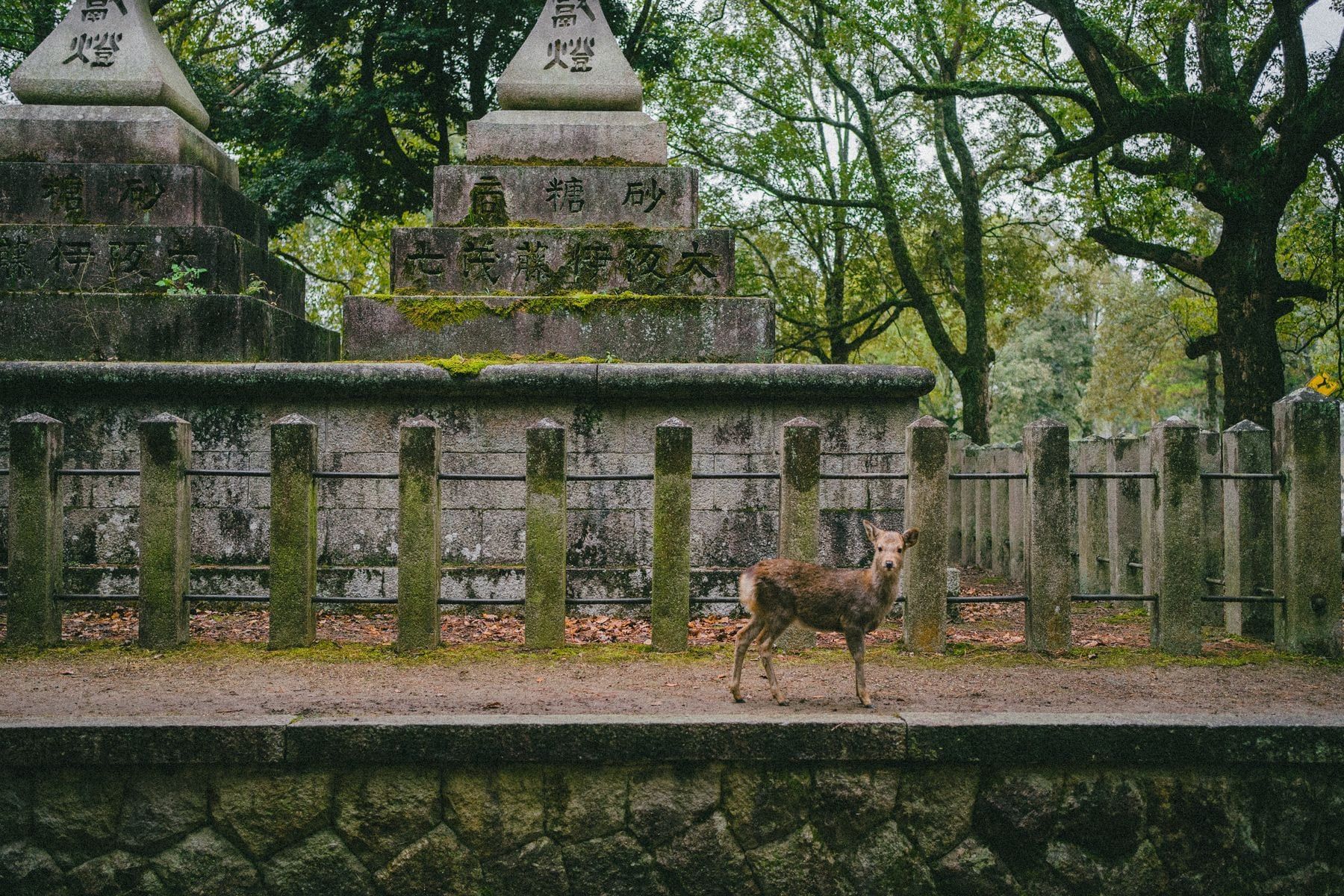
The roughly 1,300 sika deer in Nara Park are free-roaming wild animals, not zoo animals. You buy the deer crackers (shika senbei) at the stalls for CHF 1.30 (about EUR 1.40) a bundle; the proceeds go to the deer foundation, and the animals know exactly what the packaging looks like. As soon as you have them in your hand, you have five deer around you. The rules, which are on signs at ground level: do not tease them, do not hold the crackers out and pull them away, or you will get a shove or a bite in the backside. Show empty hands and they will leave you alone. The deer really do bow when you bow; it is learned behaviour and works best with the animals in front of Todai-ji. In autumn (September to November) the stags are in rut and more aggressive, so the city saws off their antlers as a precaution. In early summer the fawns arrive and the mothers are sensitive. Keep plastic and paper bags away from their mouths; deer die from swallowed bags. You will find calmer deer and fewer people on the Tobihino meadow and along the path to Kasuga Shrine.
Nara has fewer hotel beds than Kyoto, and that is an advantage: at 5 pm the day-trippers leave, and you have the illuminated Kofuku-ji and the park with its deer at dusk to yourself. Hotels cost much less than in Kyoto: business hotels (Super Hotel, Daiwa Roynet) from CHF 60 (about EUR 64), mid-range from CHF 90. The Nara Hotel from 1909 is a Meiji-era building with parquet floors and a view of the pond, from CHF 220. Naramachi, the old merchant town south of the park, has a few converted machiya and small ryokan where you sleep in tatami rooms with a garden view, from CHF 120. On location: anywhere between the Kintetsu station and the park is ideal; around the JR station it is cheaper but 20 minutes from the park. With a night in Nara you can do Todai-ji the next morning at opening time, 7.30 am (April to October), with almost nobody there, and still have time for the west with Horyu-ji afterwards.
Nara is a cheap day out. The park is free, the deer too, and at the temples you only pay for the interiors: Todai-ji Great Buddha Hall CHF 4 (about EUR 4), Kofuku-ji Eastern Golden Hall and treasure house together CHF 5, Kasuga Shrine outer area free and inner area CHF 3, Isuien Garden CHF 8 (the most expensive item and the most beautiful garden in the city), Nara National Museum CHF 4. All together in one day, under CHF 25. The trap is the food around the Kintetsu station: the restaurants on the Higashimuki shopping street are fine but charge CHF 15 to 20 for sets that cost CHF 10 in Naramachi. The second trap is the rickshaw drivers at the park entrance, 30 minutes for CHF 60 per couple. Third trap: deer crackers in department store packaging as a souvenir for CHF 8, when the same crackers cost CHF 1.30 at the stall. Souvenirs that are worth it: nara-zuke (vegetables pickled in sake lees, CHF 6 to 10), brushes and ink (Nara is the centre for both) and kakinoha sushi as a lunchbox for the train.
Between 10 am and 3 pm the route from Kofuku-ji to Todai-ji to Kasuga Shrine is a procession of school classes and tour groups. Reverse the route: first take the bus to Kasuga Shrine, then walk through the forest and past Nigatsu-do with its view down to Todai-ji, and in the afternoon go to Isuien Garden and Naramachi. Todai-ji opens at 7.30 am in the summer half of the year and at 8 am in winter, and the first 60 minutes are the best. Cherry blossom in early April is lovely in the park and manageable, because the park is huge. Autumn in mid-November brings momiji on Tobihino and around the Ukimido pavilion. Two dates are worth planning a trip around: at Omizutori at Nigatsu-do (1 to 14 March), monks swing huge torches over the balustrade at night, and at Yamayaki on the fourth Saturday in January the grassy Wakakusa hill is set alight, preceded by fireworks. In August thousands of candles are set out in the park for the Tokae festival. Summer is hot and humid, and as everywhere, Golden Week and Obon are best avoided.
Naramachi is the district Kyoto would like to be: a web of narrow lanes with Edo-period merchant houses, sake breweries, mochi shops and cafés, ten minutes south of Kofuku-ji. Koshi-no-Ie is a restored merchant house with free admission, and Gango-ji next door is a UNESCO World Heritage Site that never has queues. The red cloth monkeys hanging from the eaves (migawari-zaru) are good luck charms. Nigatsu-do, a subsidiary hall of Todai-ji on the hillside, is free, open around the clock and has the best view over Nara, especially at sunset. Two kilometres west are Toshodai-ji and Yakushi-ji, two 8th-century temples with the oldest surviving temple hall (the Toshodai-ji Kondo), admission CHF 6 (about EUR 6) each, and hardly any visitors. And 12 kilometres southwest on the JR line stands Horyu-ji, founded in 607, with the oldest wooden buildings in the world. Admission CHF 10, an hour to get there, and you are standing in front of a pagoda that has stood for 1,300 years.
For Todai-ji, Kasuga Shrine, the deer and Naramachi a full day is enough if you arrive before 9 am. The usual four hours of the tour groups are only enough for the Buddha and the crackers. If you want to see Horyu-ji and the western temples, or experience the park in the evening without people, stay a night. After 5 pm Nara is a different city.
Both work well. From Osaka-Namba the Kintetsu line is the fastest and cheapest, 40 minutes for CHF 4 (about EUR 4). From Kyoto you need 35 to 50 minutes on Kintetsu (CHF 4.50 to 8) or 45 minutes on JR (CHF 4.50, free with a Rail Pass). If you have the choice, always get off at Kintetsu-Nara station, which is right next to the park.
Normally not, but they are wild animals. Around 200 injuries are reported every year, almost all of them minor bites and shoves, because visitors hold out crackers and pull them away. Hand over the crackers immediately, show empty hands, do not leave children alone with crackers, and keep your distance from stags in autumn. Then it is a pleasure, not a risk.
Not much compared with Kyoto. Return train CHF 8 to 16 (about EUR 9 to 17), admissions CHF 10 to 25 depending on how many temples, deer crackers CHF 1.30, lunch CHF 10 to 15, coffee and mochi CHF 5. With CHF 40 to 60 per person you get through the day, without an overnight stay. A hotel room costs CHF 60 to 120, a ryokan from CHF 200 per person including meals.
Yes, photography is allowed in the Great Buddha Hall of Todai-ji, without flash and without a tripod. The Buddha is 15 metres tall, and with a wide-angle lens you can fit the whole figure in. Behind the Buddha is a pillar with a hole the size of the Buddha's nostril; whoever squeezes through is promised enlightenment in the next life. For adults it gets tight.
Absolutely, for anyone interested in architecture and history: the five-storey pagoda and the main hall date from the 7th century and are the oldest wooden buildings in the world. From Nara it takes an hour by JR plus bus or bike, admission is CHF 10 (about EUR 11), and you need about two hours there. If you only have one day, stay in Nara Park.
Tokyo · Hakone · Kyoto · Nara · Osaka
Big city, first ryokan night, temples, deer and street food in twelve days: the route for a first visit to Japan, entirely by train and with no backtracking.
Tokyo · Yokohama · Kyoto · Nara · Osaka
Robots, a noodle museum, deer, Super Nintendo World and konbini food that children love: the Golden Route in its family version, with fewer temples and more breaks.
Osaka · Kobe · Kyoto · Nara
Japan's kitchen in 60 kilometres: street food in Osaka, beef and sake in Kobe, kaiseki in Kyoto and rice cakes in Nara, all by suburban train and without the hassle of moving on.
What a week in the old imperial city really costs, when you need to be at which temple to actually see it, and why a bike beats the bus here.
What a few days in Japan's kitchen really cost, why Osaka is a better base for Kansai than Kyoto, and how to eat takoyaki, kushikatsu and okonomiyaki in the right order.
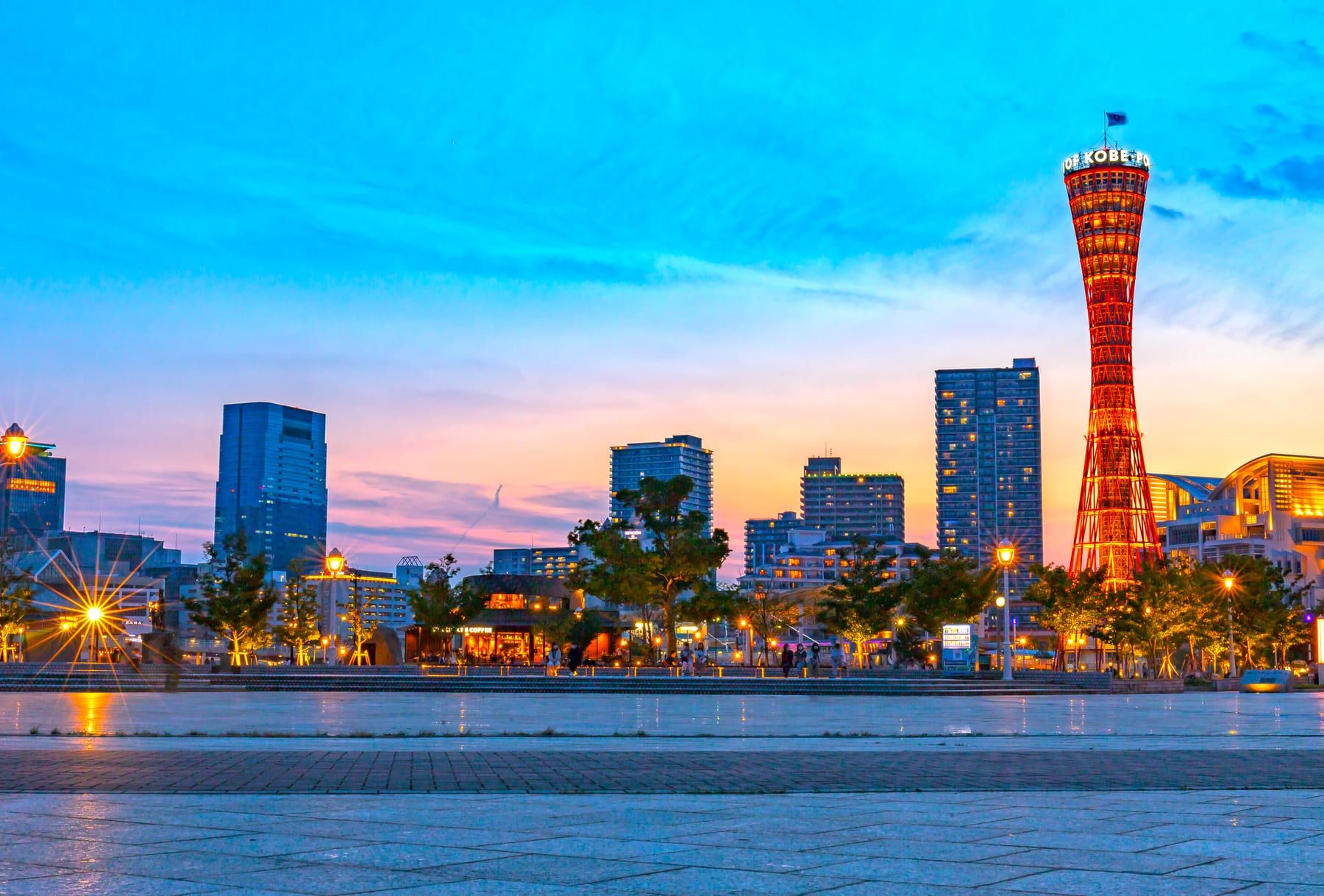
What the port city between mountains and sea really costs, how to eat Kobe beef without paying CHF 200, and why Arima Onsen is the best bathing day in all of Kansai.
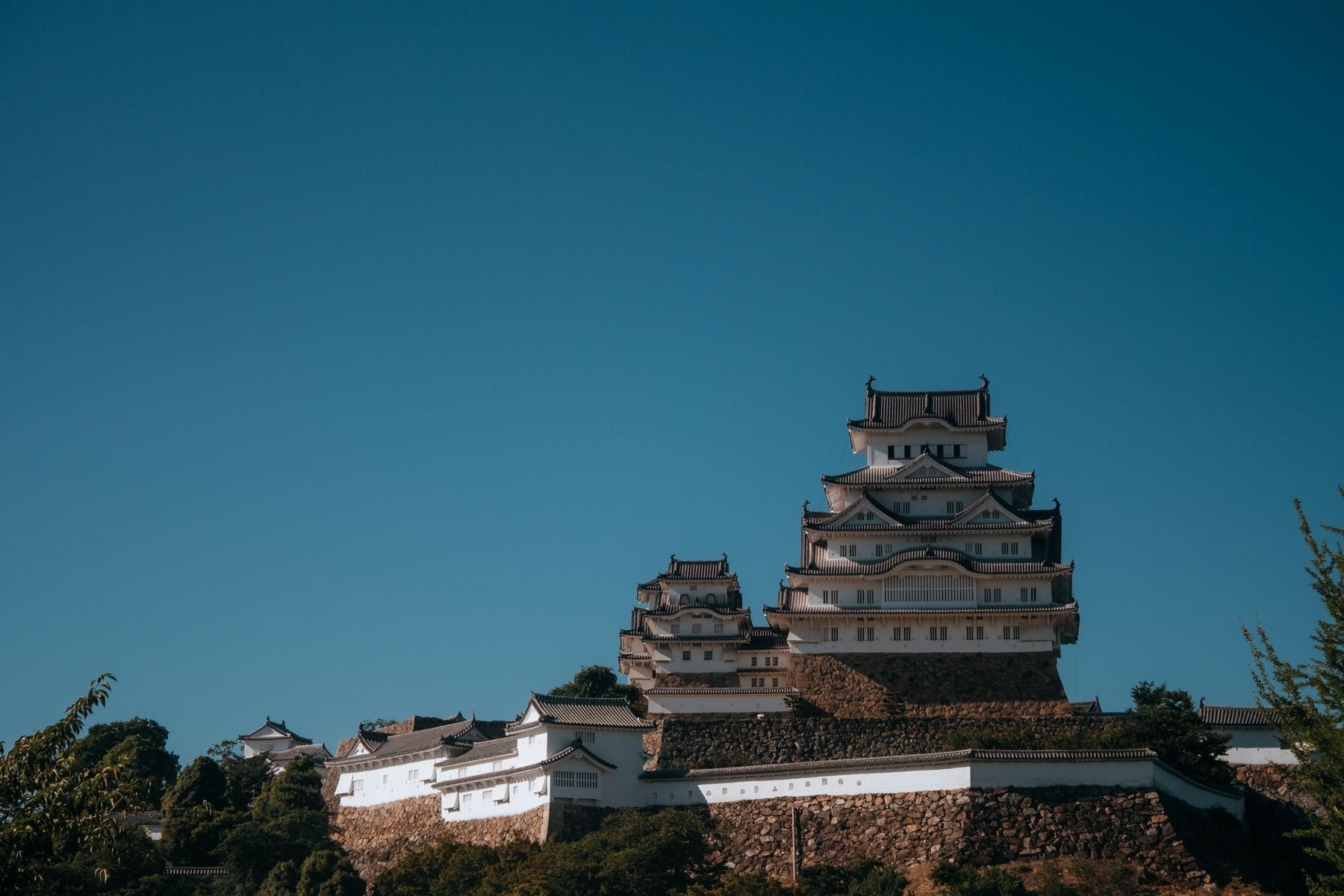
What Japan's most beautiful castle really costs, why you should be at the gate at 9 am, and how to turn the day trip into a day that is more than just a castle.