Motel One Linz-Hauptplatz
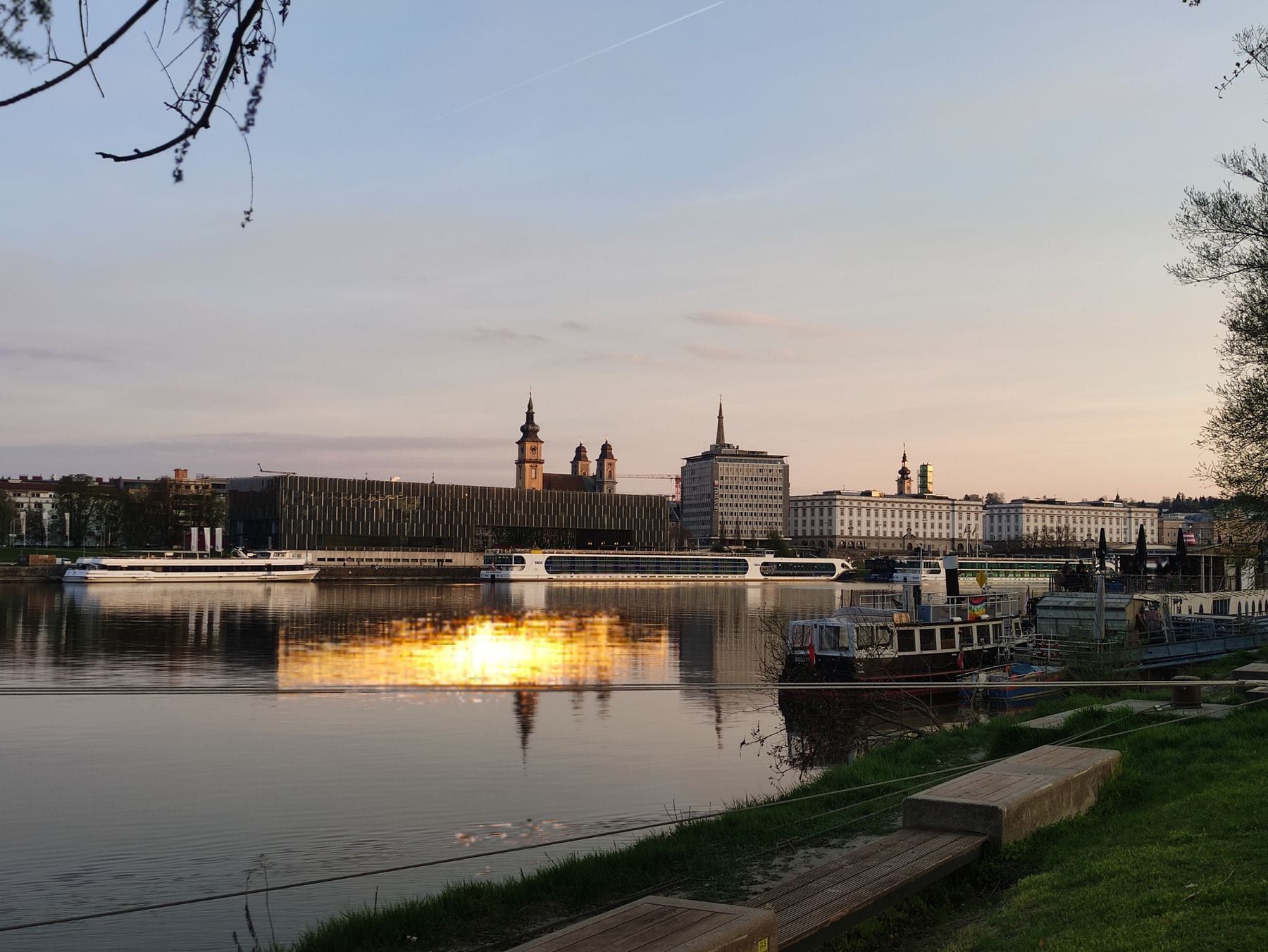
The budget design chain right on the Hauptplatz with a view of the Trinity Column, tram and Pöstlingbergbahn at the door. Small, well-made rooms, a bar in the lounge. For the location and the price the first choice in Linz.
Austria · Vienna, Danube & Burgenland · Travel guide
What one or two days in the underrated city on the Danube really cost, why you should get off here on the way to Vienna and where the Linzer Torte tastes best.
Photo: Erika Hierschlaeger / Pexels
Adjust the values to your trip: the calculator updates live (EUR, converted from CHF estimates).
Estimates for orientation, not booking prices. Getting there means train or car from Switzerland, return, per person. Hotels vary strongly by season: current prices are behind the links below.
Money & payment: You pay in euros (EUR). Cards work almost everywhere; mountain huts and sausage stands often want cash. Tipping is expected: 5 to 10 percent, by naming the rounded total when you pay. In ski resorts a visitor tax of EUR 2 to 4 per night is added to the hotel price. Getting there: By train (ÖBB Railjet), car or a flight to Vienna, 2 to 8 hours.
Nine options in three price ranges, each among the best-rated on Booking.com.
Budget
The budget design chain right on the Hauptplatz with a view of the Trinity Column, tram and Pöstlingbergbahn at the door. Small, well-made rooms, a bar in the lounge. For the location and the price the first choice in Linz.
Functional chain hotel five minutes from the Hauptbahnhof, clean rooms, breakfast for an extra charge, parking. Ideal for a stopover with luggage or a late arrival; the centre is 20 minutes on foot or three tram stops away.
Simple, quiet house on Gesellenhausstrasse between the Landstrasse and the Volksgarten, close to the Musiktheater, with a good breakfast for a surcharge and friendly management. For travellers on a small budget who want to stay centrally without a hostel atmosphere.
Mid-range
Large house of the Austrian chain on the Landstrasse, between the Hauptbahnhof and the Hauptplatz, with a casino in the building and decent rooms. Often considerably cheaper at weekends. For anyone who wants to stay centrally and without fuss.
Modern glass design hotel right next to the Mariendom, bright rooms, a sauna with a view of the cathedral, good breakfast. Quiet setting, five minutes to the Landstrasse and ten to the Hauptplatz. For lovers of architecture and design the right address in Linz.
Chain hotel near Hessenplatz and the Landstrasse with large rooms, a gym and a breakfast that is better than the chain name suggests. Ten minutes on foot to the Hauptplatz. For families and business travellers who book cheaply at the weekend.
Luxury
High-rise right on the Danube next to the Brucknerhaus, rooms with river views, pool and sauna on the top floor, a terrace above the water. Not classic luxury, but the best hotel with a Danube view in the city, ten minutes on foot to the Hauptplatz.
Traditional house in the Herrenstrasse where the tenor Richard Tauber was born, with individually furnished rooms, the restaurant Lubitsch and a location between the cathedral and the Hauptplatz. For anyone who wants history instead of chain standard, at a moderate price.
Newer hotel of the Marriott group near the Hauptbahnhof and the Design Center with large rooms, a gym and a restaurant, the most upmarket of the chain hotels in Linz. Ten minutes by tram to the centre. For comfort travellers with an early train.
If you book through these links we earn a small commission, at no extra cost to you.
The museum of the future on the north bank: AI, robotics, biolab and hands-on media art, admission around CHF 13 (about EUR 14), children CHF 10. Deep Space 8K is included in the price, and the shows run at fixed times. Allow three hours; closed on Mondays.
A glass bar on the Danube bank with Klimt, Schiele, Kokoschka and contemporary art, admission around CHF 10. The facade glows in changing colours at night, and the café has a terrace facing the river. 90 minutes to two hours, closed on Mondays, open until 8 pm on Thursdays.
Up the city's local mountain in 20 minutes on the steep tram from the Hauptplatz, return around CHF 7.50. At the top the basilica, a view as far as the Alps and the Grottenbahn through the dwarves' kingdom for children (CHF 7, March to November and Advent). Two to three hours including the ride.
More than 300 murals on silos and warehouses, accessible only with a guide: on foot around CHF 20, by boat CHF 25, two hours each and with your own spray can. April to October, book ahead, bus 27 or tram from the centre.
The 13,000 square metre Hauptplatz with the Trinity Column, the lanes up to the castle and the Schlossmuseum with regional history and a viewing terrace for CHF 7. Guided city walks from CHF 10 per person, 90 minutes. In the evening the lanes around the Alter Markt are full of life.
The largest church in Austria, neo-Gothic, with room for 20,000 people and stained glass windows showing Linz around 1900. Admission free, the tower for CHF 6 with a guide, 395 steps. One hour, and the tower tours run at fixed times.
An interactive exhibition about the steel that made Linz big, with a bus tour through the works site; exhibition around CHF 10, with tour CHF 15 to 20, tour only by prior booking. Three hours, for anyone interested in technology and for families with older children.
The former concentration camp 25 kilometres downstream, admission free, audio guide CHF 3, tours for groups and individual visitors from CHF 5. By train to Mauthausen and bus or taxi, or from Linz as a guided excursion. Allow half a day; not for small children.
In summer the Linzer Stadtschifffahrt runs one-hour round trips for around CHF 15 and day trips to Passau or the Schlögener Schlinge for CHF 30 to 40 one way. From the water you see the Lentos, the Ars Electronica Center and the harbour in one line.
If you book through these links we earn a small commission, at no extra cost to you.
Linz eats Upper Austrian: dumplings in every form, roast pork, Most and beer, and with it the cake that carried the city's name into the world. Prices are around 20 per cent below Vienna, portions above. You find the best addresses in the old town between the Hauptplatz and the castle, at the Südbahnhofmarkt and in the inns of Urfahr.
Shortcrust pastry with hazelnuts, cinnamon and cloves, filled with redcurrant jam, the pastry lattice on top, and by a recipe from 1653 the oldest cake recipe in the world. A slice CHF 4 to 5 (about EUR 4 to 5), with coffee CHF 7 to 9, a small cake in a wooden box to take away from CHF 12.
Tip:The cake tastes better after two or three days than fresh, which is why it is the ideal souvenir; the Hofbäckerei has the prettier parlour.
Potato dumplings filled with Grammeln, the roasted pork cracklings, on warm sauerkraut, CHF 12 to 15. The national dish of Upper Austria, hearty and honest.
Tip:One dumpling is enough for lunch; two are an afternoon with nothing else planned.
Roast pork with crackling, caraway, dark gravy, bread dumplings and bacon cabbage salad, compulsory on Sundays in Upper Austria, CHF 14 to 18. In the beer gardens in summer the dish to go with a Krügerl.
Tip:Sunday at noon without a reservation is hopeless; at 1.30 pm you will find a table.
Fermented apple or pear juice at 5 to 7 per cent, dry and tart, a quarter litre CHF 3, with bacon, cheese and bread on a board for CHF 9 to 12. The drink of the farmers west and south of Linz.
Tip:Most tastes sour rather than sweet; if you expect cider, you are better off ordering a "Gespritzter" with mineral water.
The Südbahnhofmarkt is the prettiest market in the city, with farm stalls, cheese, fish and snack stands; a pair of Bratwürstel with cabbage and mustard costs CHF 5 to 6, Leberkäse in a bread roll CHF 4.
Tip:Come on Saturday before 10 am, when the farm stalls are full and all of Linz is there.
Linz has a number of small breweries and brewhouses with their own beers; a Krügerl costs CHF 4 to 5, which makes it cheaper than in Vienna. In summer in the beer gardens on the Hauptplatz or on the Donaustrand.
Tip:A "Seidl" is a small beer of 0.3 litres, a "Krügerl" half a litre, so order the right one.
Linz has coffee house culture like Vienna, only without the queues: apple or quark strudel with vanilla sauce CHF 5 to 7, Kaiserschmarrn CHF 10 to 13, Melange CHF 4.50. The confectioners on the Landstrasse and the Hauptplatz are full of locals in the afternoon.
Tip:Traxlmayr has newspapers, billiard tables and waiters in bow ties; two hours with one Melange are expressly welcome.
Through markets and eateries with a guide, tastings included.
If you book through these links we earn a small commission, at no extra cost to you.
To the Romans Linz was Lentia, a fort on the Danube limes, and since the Middle Ages the city has been the trading hub between Bohemia, Bavaria and the Danube. From 1489 to 1493, under Emperor Frederick III, Linz was even the residence city of the Holy Roman Empire; the emperor died here, and the core of Linz Castle dates from that time. Johannes Kepler taught at the Landschaftsschule from 1612 to 1626 and wrote his Harmonices Mundi in Linz, Anton Bruckner was cathedral organist in the 19th century, Adalbert Stifter a school inspector. The 20th century shaped the city brutally twice: Hitler, who had gone to school here, declared Linz the "Führer's patron city" in 1938 and had the Hermann Göring Works built, today the voestalpine steelworks, using forced labourers from the nearby Mauthausen concentration camp. After 1945 the demarcation line between the American and Soviet zones ran right through the city, along the Danube. From the 1970s the steel city with its bad air turned into a city of culture: the first Klangwolke in 1974, the first Ars Electronica Festival in 1979, the Lentos Kunstmuseum as a glass bar on the river in 2003, European Capital of Culture in 2009 with the new Ars Electronica Center on the north bank, and in 2013 the Musiktheater by the Volksgarten, the most modern opera house in Europe. Since 2014 Linz has been a UNESCO City of Media Arts. The Linzer Torte, incidentally, is the oldest known cake recipe in the world, written down in 1653, and the Pöstlingbergbahn has been climbing the city's local mountain since 1898 as one of the steepest adhesion railways in the world.

Linz Hauptbahnhof lies on the Westbahn line, and that is the argument: the Railjet from Zurich takes just under 6 hours to Linz, then another 1 hour 15 minutes to Vienna. With the Sparschiene you book Zurich to Linz from CHF 25 to 35 (about EUR 27 to 37) one way; the standard fare is around CHF 95. From Linz the Railjet and the Westbahn (the private competitor, often cheaper and with tickets available on the train) run to Vienna every half hour for CHF 15 to 30. A stopover is not possible with the Sparschiene because it is tied to a specific train, so book two tickets, Zurich to Linz and Linz to Vienna, which in total is often the same price. From Munich it is 2 hours, from Salzburg 1 hour 10 minutes. By car it is 560 kilometres from Zurich via Bregenz, Munich and Passau or via Salzburg, 5 to 6 hours, plus the vignette at CHF 11 for 10 days; a multi-storey car park in the centre costs CHF 15 to 25 a day. Linz-Hörsching airport has hardly any scheduled connections from Switzerland, so forget it. From the Hauptbahnhof you reach the Hauptplatz in seven minutes on tram 1, 2 or 3, or you walk 20 minutes down the Landstrasse, the pedestrian zone and shopping street, and you have arrived.
Linz is a trade fair and business city, and that determines the prices: during the week the hotels are full of business travellers and cost CHF 110 to 150 (about EUR 118 to 161), at weekends prices drop to CHF 80 to 120 for a mid-range double room. That is the reverse of Vienna and Salzburg, and a stroke of luck for city travellers. The centre between the Hauptbahnhof and the Hauptplatz is compact and everything is within walking distance; hotels on the Landstrasse are central and busy by day, quiet in the evening. Around the Hauptplatz and in the old town you stay most beautifully, with views of the Danube and the Pöstlingberg. Urfahr, the district on the north bank, is studenty and a few francs cheaper, with the Ars Electronica Center and the valley station of the Pöstlingbergbahn on the doorstep, and you are in the old town in five minutes across the Nibelungenbrücke. The hotels at the Hauptbahnhof are practical for a stopover with luggage, but without charm. Booking: during the Ars Electronica Festival in early September, for the Klangwolke and for the Linzer Krone-Fest the city is full, so book early. Otherwise a week ahead is enough. The local tax is around CHF 3 per person per night.
Linz is not an expensive city, but the museums add up: Ars Electronica Center around CHF 13 (about EUR 14), Lentos CHF 10, Schlossmuseum CHF 7, Pöstlingbergbahn return CHF 7.50 plus the Grottenbahn CHF 7. The Linz Card for one day (around CHF 28) or three days (around CHF 38) includes all the museums, city transport and the Pöstlingbergbahn, and it pays off from two museums plus the mountain railway in one day, which means for most people. The 24-hour ticket from Linz AG Linien costs CHF 5.50, a single ride CHF 2.70, but you walk the centre anyway. The Westbahn sells tickets to Vienna and Salzburg on the train without a surcharge and has a lounge class that costs less than ÖBB first class. Lunch menus in the centre cost CHF 11 to 15, considerably less than in Vienna, and a slice of Linzer Torte CHF 4 to 5, or CHF 12 to 25 as a souvenir depending on size and confectioner. Deep Space 8K in the Ars Electronica Center is included in the admission, but the shows run at fixed times, so check the programme beforehand or you will be standing in front of a closed door. And the Höhenrausch site on the rooftops of the city centre has not existed as a permanent installation since 2021; old guidebooks lead you to nothing there.
Linz has two weeks a year when the world looks on, and 50 when the city belongs to the people of Linz. In early September the Ars Electronica Festival takes place, five days of media art in the Postcity, in the Center and across the whole city, with day passes from CHF 30 (about EUR 32); alongside it the Klangwolke in the Donaupark, a free open-air spectacle of music and light with a hundred thousand spectators on the bank, and the Brucknerfest running until October. If you want that, book the hotel in spring. The Linz Advent market on the Hauptplatz and in the Volksgarten is smaller and quieter than those in Salzburg and Vienna, with punch for CHF 4.50 and no coaches. The Pöstlingbergbahn runs all year, the Grottenbahn is open from March to early November and in Advent. Summer brings the Pflasterspektakel at the end of July, a street art festival with performers from all over Europe, free, and long evenings on the Danube beach in Urfahr. For a stopover any day is good, with two caveats: on Mondays the Lentos, the Nordico and the Schlossmuseum are closed, and the Ars Electronica Center is open Tuesday to Sunday. And at weekends the city is empty and cheap, which is an advantage.
In the Linz harbour, 15 minutes by bus from the centre, the Mural Harbor has become one of the largest graffiti galleries in Europe: more than 300 murals on warehouses and silos, visible only with a guided tour, on foot for around CHF 20 (about EUR 21) or from a boat for CHF 25, spray can for your own attempt included. You have to book ahead, and the tours run from April to October. The voestalpine Stahlwelt on the works site explains the city better than any museum with an exhibition and a plant tour (CHF 15 to 20), because Linz cannot be understood without the steel. The Mauthausen Memorial lies 25 kilometres downstream, admission free, audio guide CHF 3, reachable in an hour by train and bus or taxi; it is not an excursion but a visit that needs half a day and some quiet afterwards, and it belongs to Linz. The Mariendom is the largest church in Austria, bigger than St Stephen's Cathedral, with a tower climb for CHF 6. On the Danube bank in Urfahr lies the Donaustrand with deckchairs and a bar in summer, and upstream the Linzer Stadtschifffahrt runs round trips for CHF 15. If you stay longer, take the boat or the train to Passau or to the Schlögener Schlinge, where the Danube makes a complete hairpin turn.
The Linzer Torte is shortcrust pastry with nuts, cinnamon and cloves, redcurrant jam and the lattice on top, and every confectioner has its own recipe. Jindrak has the reputation and the largest production, the k.u.k. Hofbäckerei in the Pfarrgasse with its old workshop is the prettier address, and both sell cakes in wooden boxes that keep for a year. A slice with coffee costs CHF 7 to 9 (about EUR 7 to 10). Upper Austria is dumpling country: in a Gasthaus you get Grammelknödel, Speckknödel and Fleischknödel with sauerkraut for CHF 12 to 16, with Most, the fermented pear or apple juice, a quarter litre for CHF 3. The people of Linz drink beer from the small breweries of the region and eat Bratwürstel with cabbage on the Hauptplatz; the Linzer Krone-Fest and the Urfahraner Markt in May and October are folk festivals with a beer tent, not a tourist programme. The centre between the old town and the Landstrasse has a dense restaurant scene with inns, student Beisln and new places, with prices about 20 per cent below Vienna. You only need to reserve at weekends, and kitchens close earlier in Linz than in Vienna, around 9 pm.
The Railjet runs direct from Zurich to Linz, just under 6 hours, Sparschiene from CHF 25 to 35 (about EUR 27 to 37) one way, standard fare around CHF 95. From Linz it is another 75 minutes to Vienna by Railjet or Westbahn for CHF 15 to 30. Because Sparschiene tickets are tied to a specific train, you book two tickets: Zurich to Linz and Linz to Vienna. By car it is 560 kilometres and 5 to 6 hours, and you do not need a car in Linz.
For a stopover five to six hours is enough: luggage in a locker at the Hauptbahnhof (CHF 3 to 5, about EUR 3 to 5), tram to the Hauptplatz, Ars Electronica Center or Lentos, Pöstlingberg, Linzer Torte, back. A full day with an overnight stay allows both museums, the Hauptplatz in the evening and a Gasthaus. You need two days for Mural Harbor, Stahlwelt or Mauthausen. Hardly anyone stays longer, and that is fine.
Linz is the cheapest of the three cities: a mid-range double room at the weekend CHF 80 to 120 (about EUR 86 to 128), during the week CHF 110 to 150, lunch menu CHF 11 to 15, beer CHF 4.20, museums CHF 7 to 13, the Linz Card with everything for CHF 28 a day. Expect CHF 90 to 110 per person per day excluding travel. Salzburg costs around 30 per cent more, Vienna 20 per cent.
Yes, it is the museum that sets Linz apart from every other city: artificial intelligence, biotechnology, robotics and media art to touch, plus Deep Space 8K, a room with a 16 by 9 metre projection on wall and floor, where shows run from space flights to paintings in gigapixel resolution. Admission around CHF 13 (about EUR 14), allow three hours, check the Deep Space times beforehand. For children from eight upwards one of the best museums in Europe, and in the evening the facade glows in colours.
With the Pöstlingbergbahn from the Hauptplatz, a tram that climbs 255 metres in 20 minutes with gradients of up to 11.6 per cent, return around CHF 7.50 (about EUR 8), included in the day ticket or the Linz Card. At the top are the pilgrimage basilica, the Grottenbahn with the dwarves' kingdom for children (CHF 7) and a viewing terrace over the city, the Danube and as far as the Alps. On foot the climb takes 45 minutes; the path is steep but lovely. One to two hours at the top is enough.
For a stopover any day except Monday, because the Lentos and the Schlossmuseum are closed then. In early September with the Ars Electronica Festival and the Klangwolke the city is at its liveliest and fullest, so book the hotel months ahead. May to September have the best evenings on the Donaustrand and the Hauptplatz, July brings the Pflasterspektakel. Advent is quiet and lovely, January and February are grey, but museums always work.
What four days in the imperial city really cost, why the night train is the best way to get there and how to stand in the State Opera for CHF 15 instead of sitting for CHF 200.
What two or three days between Melk and Krems really cost, why you take the cycle path and not the car, and how to see Dürnstein before the boats tie up.
What three or four days on the steppe lake really cost, why the cycle path round the lake beats any beach and how to see the storks in Rust before the coaches arrive.