Nuremberg

Germany · Bavaria & the Alps · Travel guide

Nuremberg

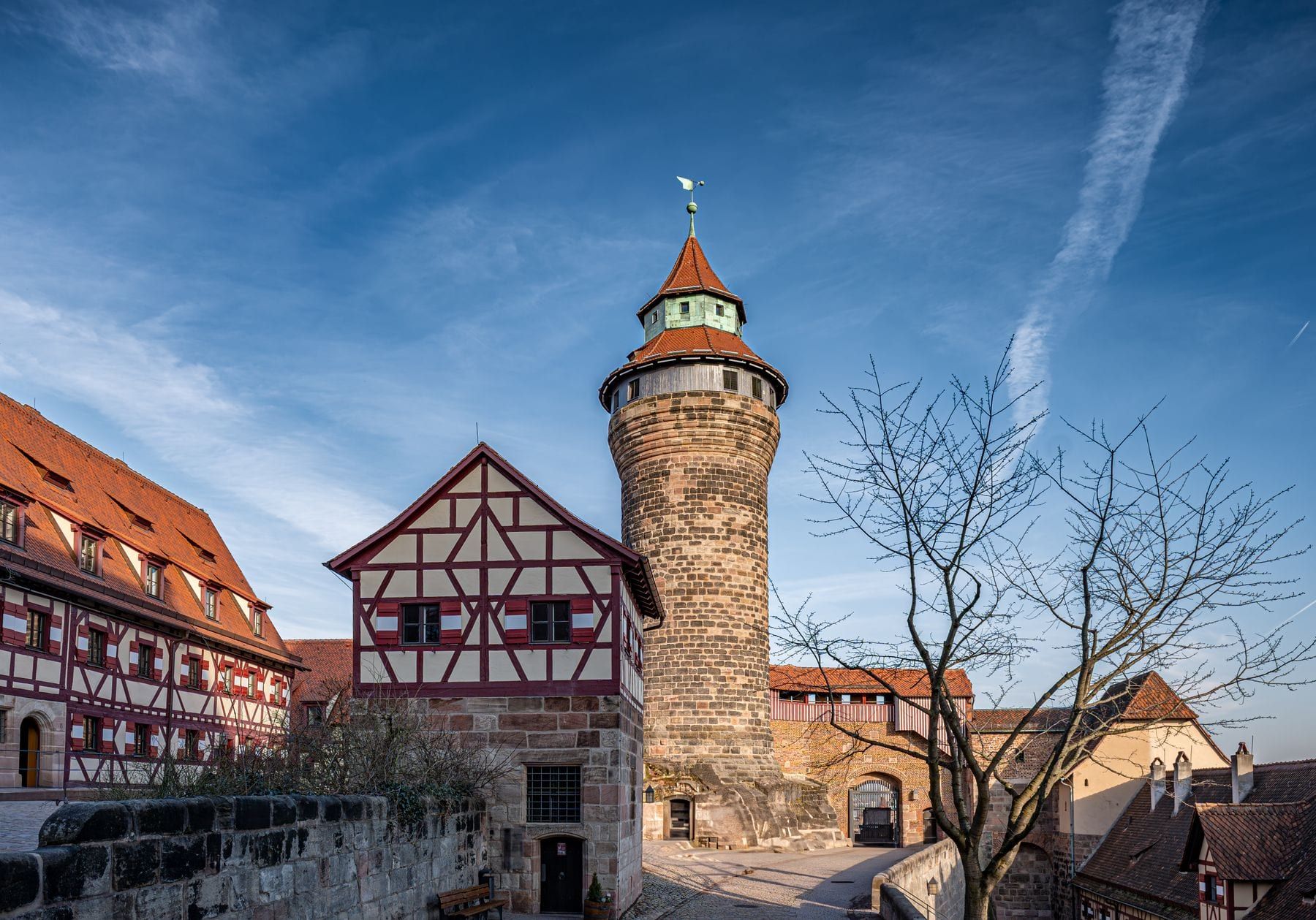
What a weekend in the city of emperors, gingerbread and the Nuremberg trials really costs, why the old town is smaller than you think, and where the Rostbratwürste are still grilled over beechwood.

Photo: Sabine Freiberger / Pexels

What does a trip to Nuremberg cost?

Adjust the values to your trip: the calculator updates live (EUR, converted from CHF estimates).

1,515 EUR
≈ 758 EUR per person
  • Getting there 278 EUR
  • Accommodation 642 EUR
  • Food 482 EUR
  • Local transport 43 EUR
  • Nürnberg Card (48 hours, museums and public transport) 71 EUR

Estimates for orientation, not booking prices. Getting there means train or car from Switzerland, return, per person. Hotels vary strongly by season: current prices are behind the links below.

Money & payment: You pay in euros (EUR). Germany is fonder of cash than Switzerland: bakeries, kiosks and small restaurants often say "cash only", though cards work almost everywhere from about EUR 10. Tip 5 to 10 percent by rounding up and naming the total when you pay. Getting there: By train (DB), car or plane, 1 to 8 hours depending on the destination.

Recommended hotels

Nine options in three price ranges, each among the best-rated on Booking.com.

Budget

a&o Nürnberg Hauptbahnhof

Station district, Nuremberg

Large hostel-hotel behind the Hauptbahnhof with double rooms, family rooms and dorms. Sober and clean, ten minutes' walk to the Lorenzkirche. For budget travellers and groups who just need a base.

from CHF 60 / night (about EUR 64) View →

Motel One Nürnberg-City

Station district, Nuremberg

Design-budget hotel on Bahnhofsplatz, opposite the Handwerkerhof, with a view of the city wall. Small rooms, good beds, bar with Franconian beer. For couples who want to sleep central and cheap.

from CHF 95 / night (about EUR 102) View →

B&B Hotel Nürnberg-Hbf

Station district, Nuremberg

Functional chain hotel right by the Hauptbahnhof, plain, with good soundproofing and breakfast at a fair price. For travellers with an early train and anyone who would rather spend their money on sausages.

from CHF 70 / night (about EUR 75) View →

Mid-range

Hotel Drei Raben

Lorenz old town, Nuremberg

Themed hotel on Königstrasse where every room tells a Nuremberg story, from Dürer's hare to the first railway. Personally run, with a bar and good breakfast, five minutes from the Hauptbahnhof. For anyone who wants a hotel with character.

from CHF 140 / night (about EUR 150) View →

Sorat Hotel Saxx Nürnberg

Hauptmarkt, Nuremberg

Modern hotel right on the Hauptmarkt with a view of the Frauenkirche and the Schöner Brunnen, in Advent right in the middle of the Christkindlesmarkt. Bright rooms, breakfast with a view of the market. For anyone who wants the old town on the doorstep and can take a bit of bustle.

from CHF 130 / night (about EUR 139) View →

Hotel Victoria Nürnberg

Königstor, Nuremberg

Traditional house from 1896 right at the Königstor, between the Hauptbahnhof and the old town, family-run with modern furnishings behind the old facade. Good breakfast, quiet courtyard rooms. For city travellers who value solid quality without a chain feel.

from CHF 125 / night (about EUR 134) View →

Luxury

Le Méridien Grand Hotel Nürnberg

Bahnhofsplatz, Nuremberg

The city's grand hotel from 1896, opposite the Hauptbahnhof, with an Art Nouveau lobby, brasserie and rooms where the prosecutors of the Nuremberg trials once stayed. Classic, not hip. For anyone who wants history in the hotel too.

from CHF 200 / night (about EUR 214) View →

Sheraton Carlton Nürnberg

Station district, Nuremberg

Dignified five-star house on Eilgutsteig next to the Hauptbahnhof with pool, spa and one of the better hotel restaurants in the city. Rooms large and classically furnished. For business travellers and couples who put comfort above design.

from CHF 190 / night (about EUR 203) View →

Park Plaza Nuremberg

Station district, Nuremberg

Modern design hotel on Bahnhofsplatz with rooms designed by Nuremberg artists, a rooftop bar and spa. More upper mid-range than classic luxury, but with fair prices and a very good location. For anyone who likes it contemporary.

from CHF 170 / night (about EUR 182) View →

If you book through these links we earn a small commission, at no extra cost to you.

Experiences worth your time

Kaiserburg with the Deep Well and Sinwell Tower

Palas, Imperial Chapel and castle museum for around CHF 9, the Deep Well only with a guided tour (every 30 minutes, included in the ticket). Allow two hours; the castle courtyard and the Freiung with the city view are free.

View & book →

Old town walk from the Lorenzkirche to the castle

Guided in two hours through the Hauptmarkt, Sebalduskirche, Burgstrasse and Tiergärtnertorplatz, from CHF 15; the walks by Geschichte für Alle are the best. On your own free, half a day with breaks.

View & book →

Documentation Centre Nazi Party Rally Grounds

Interim exhibition in the Kongresshalle for around CHF 6, then with the audio guide along the Grosse Strasse and across the Zeppelinfeld. Three hours, tram 8 or S2 to Doku-Zentrum. Guided tours with a historian from CHF 20 are particularly worthwhile here.

View & book →

Memorium Nuremberg Trials

Courtroom 600 in the Palace of Justice, where the major war criminals were tried in 1945, with an exhibition on the history of international criminal law. Around CHF 7.50 with audio guide, two hours, U1 to Bärenschanze.

View & book →

Historic rock-cut cellars with beer tasting

Guided tour through the medieval beer cellars under the castle hill, around CHF 15 including a tasting of red beer from the Altstadthof brewery. 75 minutes, a constant 8 degrees, bring a jacket. The best rainy-day programme in the city.

View & book →

Albrecht Dürer House

The artist's home and workshop by the Tiergärtnertor, with a reconstructed printing workshop and demonstrations. Around CHF 7.50, one hour, tour with "Agnes Dürer" in costume on Saturdays. The originals hang in the Germanisches Nationalmuseum.

View & book →

Germanisches Nationalmuseum

The largest museum of cultural history in the German-speaking world, with the Behaim globe, Dürer paintings and medieval sculpture, around CHF 10, free on Wednesdays from 5.30 pm. Three hours are the minimum; the Way of Human Rights in front is free.

View & book →

Christkindlesmarkt on the Hauptmarkt

From the Friday before the first Sunday of Advent to 24 December, free entry, mulled wine CHF 4 to 5. Best on weekday mornings; guided walks with gingerbread and mulled wine tasting from CHF 25, Advent only.

View & book →

Gingerbread baking class

Make Elisenlebkuchen yourself, with wafers, nuts and spices, in a bakery or pastry shop in the old town, two to three hours from CHF 45, with your own batch to take home. Offered mainly in autumn and Advent.

View & book →

If you book through these links we earn a small commission, at no extra cost to you.

Food & drink

Franconian is not Bavarian, and you can tell on the plate: the bratwurst is small and seasoned with marjoram, the beer is red or cellar-cloudy, the wine comes in a Bocksbeutel. Nuremberg eats hearty and cheap, and the best addresses are the sausage kitchens where they have grilled over beechwood for centuries.

Nürnberger Rostbratwürste

Bratwursthäusle by St. Sebald, Historische Bratwurstküche Zum Gulden Stern, Bratwurst Röslein on Rathausplatz

Finger-length pork sausages with marjoram, grilled over beechwood, protected designation of origin. Six with sauerkraut or potato salad and horseradish cost CHF 12 to 14, twelve CHF 20. On the street they are called "Drei im Weggla" (three in a roll) for CHF 4 to 5.

Tip:The Gulden Stern has been in business since 1419 and is said to be the oldest sausage kitchen in the world. Order horseradish with it, that is Franconian.

Schäufele

Inns around the Weinmarkt and on the castle hill

Roast pork shoulder with the shoulder blade bone in, crackling like glass, with a dumpling and dark gravy. The Franconian Sunday meal, CHF 16 to 20.

Tip:You do not have to share a Schäufele between two, but afterwards you are done for the day.

Blaue Zipfel

Bratwursthäusle by St. Sebald

Bratwurst poached raw in a vinegar stock with onions and juniper, served cold or lukewarm. Sounds odd, tastes wonderful, CHF 10 to 13.

Tip:With farmhouse bread and a Kellerbier, not with sauerkraut.

Elisenlebkuchen

Lebkuchen-Schmidt factory outlet on Zollhausplatz, Konditorei Neef on Winklerstrasse, Wicklein on the Hauptmarkt

Gingerbread with at least 25 per cent almonds, hazelnuts or walnuts and almost no flour, on a wafer, with chocolate or sugar glaze. From the factory outlet or pastry shop CHF 1.50 to 3 each, in a tin double that.

Tip:Gingerbread is available all year, the best quality from October, "Bruch" (broken pieces) at half price.

Fränkischer Sauerbraten

Traditional inns on the Sebald side

Beef marinated for days in vinegar and wine, braised and served with gingerbread sauce, dumplings and red cabbage. CHF 17 to 21.

Tip:The sauce is thickened only with gingerbread, that is the difference from Rhineland Sauerbraten.

Rotbier and Kellerbier

Hausbrauerei Altstadthof on the castle hill, Biergarten Kettensteg on the Pegnitz

Nuremberg's own beer is red and malty, matured in the rock cellars since the Middle Ages. A half litre CHF 4 to 5. Alongside it the cellar-cloudy Franconian country beer from the Bamberg region.

Tip:At the Altstadthof have the red beer with the rock-cellar tour, at the Kettensteg at sunset.

Candied almonds and Zwetschgenmännla

Christkindlesmarkt on the Hauptmarkt, all year in the Handwerkerhof

The sweets of the Christkindlesmarkt: almonds in a sugar crust for CHF 4 per 100 grams, and Zwetschgenmännla, little figures made of dried prunes and walnuts from CHF 5, for display, not for eating.

Tip:Buy the almonds fresh from the kettle while they are still warm.

Franconian wine from the Bocksbeutel

Wine bars around the Weinmarkt and on Unschlittplatz

Silvaner and Müller-Thurgau from Franconia in the flat Bocksbeutel bottle, dry and mineral. A glass in a wine bar CHF 5 to 7, a bottle in the shop from CHF 10.

Tip:Order Silvaner instead of Riesling, that is the Franconian grape.

Book a food tour: Nuremberg

Through markets and eateries with a guide, tastings included.

View & book →

If you book through these links we earn a small commission, at no extra cost to you.

History & background

Nuremberg first appears in a document in 1050, when Emperor Henry III held court on the castle rock, and for the next 500 years the city remained closely tied to the Empire. The Golden Bull of 1356 laid down that every newly elected king had to hold his first imperial diet in Nuremberg, and from 1424 the imperial regalia, meaning crown, sceptre and orb, were kept here. In the 15th and 16th centuries the Free Imperial City became one of the richest in Europe: here Peter Henlein built the first portable watches, Martin Behaim the oldest surviving globe, and Albrecht Dürer painted in his house by the Tiergärtnertor the pictures that still shape our idea of the Renaissance north of the Alps. The city's craftsmen were so famous that "Nürnberger Tand geht durch alle Land" (Nuremberg trinkets travel through every land) became a proverb, and gingerbread came about because the spices of the long-distance traders met the honey of the beekeepers in the imperial forest. The decline began with the Thirty Years' War and the shift of trade to the Atlantic coasts; in 1806 the indebted city fell to Bavaria. That the Nazis chose this symbol of the old Empire of all places for their party rallies was no coincidence but staging: on the grounds in the south-east rose the Zeppelinfeld and the never-completed Kongresshalle, and in 1935 the race laws were proclaimed here. The Allies answered in 1945 with bombs that destroyed 90 per cent of the old town, and with the Nuremberg trials in Courtroom 600 of the Palace of Justice, the beginning of modern international criminal law. The old town was rebuilt in its structure, with sandstone and pitched roofs, but many houses are plainer than before the war. Today Nuremberg has 520,000 inhabitants, is the second-largest city in Bavaria, home of the toy fair and has grown together with Fürth and Erlangen into a metropolitan region.

Insider tips

Getting there: ICE via Stuttgart or Munich, the car stays outside the wall

From Zurich the best way is the IC to Stuttgart (3 hours) and from there the ICE to Nuremberg (2 hours 15), around 5 hours 30 in total with one change. The alternative via Munich takes about as long: EC to Munich 3 hours 30, then an hour on the ICE along the high-speed line through the Hallertau. Saver tickets start at CHF 40 (about EUR 43) each way, the full fare with the Half Fare Card is CHF 70 to 80. From Basel you are there in around 5 hours via Karlsruhe and Stuttgart. By car it is 450 kilometres from Zurich via Schaffhausen, Stuttgart and Heilbronn on the A6, just under 5 hours without traffic, with no vignette and no toll. In Nuremberg itself the car is a millstone: the old town inside the city wall is largely a pedestrian zone, the car parks charge CHF 20 to 30 a day, and everything important is within 20 minutes' walk of the Hauptbahnhof. To the Nazi party rally grounds you take the S-Bahn S2 or tram 8 (stop Doku-Zentrum) in 15 minutes; a single ticket costs CHF 3.50, the day ticket CHF 9. The Nürnberg Card for CHF 33 covers all museums for two days, including the Kaiserburg, the Documentation Centre and the Dürer House, plus all local transport, and pays off from three museums.

Where to stay: Sebald or Lorenz, and when the city is booked out

The Pegnitz divides the old town into the northern Sebald side with the castle, the Dürer House and the prettiest half-timbered lanes, and the southern Lorenz side with the Hauptbahnhof, Königstrasse and the shopping zone. If you want the Nuremberg feeling, stay on the Sebald side around the Weinmarkt or on the castle hill, but you pay CHF 20 to 40 (about EUR 21 to 43) more per night for it and haul your suitcase uphill. More practical and cheaper are the hotels around the Hauptbahnhof and on Frauentorgraben, from where you reach the Hauptmarkt in ten minutes. A mid-range double room costs CHF 100 to 140, noticeably cheaper than Munich and roughly half of Zurich. Three dates make the city full and expensive: the toy fair at the end of January or beginning of February, when every room within 50 kilometres is taken, the Advent weekends with the Christkindlesmarkt, and the Rock im Park festival in early June. For Advent you book in September, for the rest of the year two to three weeks are enough. Hostels and budget chains (a&o, B&B, Motel One, Ibis) abound near the station, double rooms from CHF 70. Fürth, ten minutes on the U1, is a lovely alternative with a Gründerzeit old town and lower prices.

Nazi party rally grounds and Courtroom 600: history without whitewash

Nuremberg deals with its role in National Socialism as openly as hardly any other city, and you should set aside half a day for it. The Documentation Centre in the unfinished Kongresshalle has been under reconstruction since 2021 and, until the permanent exhibition reopens, shows a compact interim exhibition "Nürnberg. Ort der Reichsparteitage" for around CHF 6 (about EUR 6), which explains the site, the staging and the perpetrators clearly. With the audio guide you then walk across the grounds: the Grosse Strasse, the Zeppelinfeld with the grandstand Hitler spoke from, and the Dutzendteich. The Zeppelinfeld is freely accessible, is crumbling and is currently being secured with taxpayers' money, not restored, a deliberate decision. The walk takes two to three hours, and the free guided walks by the association Geschichte für Alle are better than any app. The second site is the Memorium Nuremberg Trials in the Palace of Justice on Fürther Strasse (U1, stop Bärenschanze): Courtroom 600, where Göring, Hess and Speer were tried in 1945 and 1946, has not been used as a courtroom since 2020 and is always accessible, admission CHF 7.50 with audio guide, two hours. Both in one day is a lot, but doable; a beer garden is then the right answer in the evening. Children under twelve are better taken only into the old town.

Cost traps and savings: castle ticket, gingerbread, rock-cut cellars

The Kaiserburg is the city's most important ticket and costs around CHF 9 (about EUR 10) for the Palas, the Imperial Chapel, the castle museum, the Deep Well and the Sinwell Tower; the castle courtyard, the Freiung with the city view and the castle garden are free. If you only want the view, skip the ticket; if you want to go inside, join the tour of the Deep Well, because the 50 metres only impress with a burning candle. Gingerbread is the second trap: the tins with castle motifs on Königstrasse cost CHF 20 to 30 and contain mediocre goods. Real Elisenlebkuchen with at least 25 per cent nuts you buy at the factory outlet of Lebkuchen-Schmidt on Zollhausplatz or at Wicklein, as "Bruch" (broken pieces) for half the price, and at the Konditorei Neef or at Düll from the bakery, not from the tin. Third trick: the Historische Felsengänge under the castle hill, 20,000 square metres of medieval beer cellars, guided tour with beer tasting around CHF 15 and the best programme in the city when it rains; the Kunstbunker tour next door tells how the city hid its art treasures there during the war. The Germanisches Nationalmuseum, the largest museum of cultural history in the German-speaking world, costs CHF 10 and is free on Wednesday evenings from 5.30 pm. The zoo at the Schmausenbuck (CHF 20) is one of the most beautiful in Europe, but a whole day.

Timing and Christkindlesmarkt: when the city is at its best

The Christkindlesmarkt opens on the Friday before the first Sunday of Advent and runs until 24 December, with two million visitors on the Hauptmarkt. It is nicer than its reputation because the city regulates it strictly: no plastic garlands, no stalls selling chips, only wooden huts with red and white cloth, Zwetschgenmännla (prune figures), gold-foil angels and the Drei im Weggla. The opening by the Christkind from the balcony of the Frauenkirche on the Friday at 5.30 pm is an experience; the Saturdays after that are unbearably full. Come on a weekday morning or at the end of the working day at 5 pm, and for your mulled wine (CHF 4 to 5, about EUR 4 to 5, mug deposit CHF 3) go to the market of the twin towns on Rathausplatz or the children's Christmas market on Hans-Sachs-Platz, which are emptier. Outside Advent, Nuremberg is at its best from May to October, with beer gardens on the castle hill and by the Pegnitz and the Bardentreffen at the end of July, a free music festival with 200,000 visitors. The Altstadtfest in September brings Franconian sausage stalls and beer tents to the island of Schütt. From January to March the city is grey, cheap and empty, except during the toy fair. For the castle and the Dürer House the day of the week does not matter; for the Documentation Centre, Saturdays are full of school classes from all over Germany.

Dürer, Sebalduskirche and the Pegnitz: the walk that is worth it

Start at the top. From the Hauptbahnhof through the Handwerkerhof (pretty, but a tourist trap) up Königstrasse to the Lorenzkirche with the Annunciation by Veit Stoss and the tabernacle by Adam Kraft, then across the Museumsbrücke to the Hauptmarkt with the Schöner Brunnen: turn the golden ring in the railing, everyone does, and it costs nothing. On to the Sebalduskirche, where Peter Vischer's bronze tomb of the city's patron saint stands, then up Burgstrasse to the Fembohaus (city museum, CHF 7, about EUR 7) and the castle. From the castle garden you walk down to Tiergärtnertorplatz, the most beautiful square in the city, with the Albrecht Dürer House (CHF 7.50, tour with "Agnes Dürer" on Saturdays) and the Pilatushaus. In the evening hundreds sit here on the cobbles with a beer from the kiosk. Then down to the Pegnitz: Weinstadel, Henkersteg, Kettensteg and the island of Schütt, the best stretch for photos at sunset. The whole route takes four to five hours with breaks, without a single ticket. Less known and very beautiful is the Johannisfriedhof outside the city wall to the west, where Dürer, Veit Stoss and Willibald Pirckheimer lie under flat sandstone graves with bronze plaques, and next to it the Hesperidengärten, baroque gardens with citrus trees, free.

Frequently asked questions about Nuremberg

How do I get from Switzerland to Nuremberg, and what does it cost?

By train from Zurich via Stuttgart or Munich in 5 to 5 hours 30 with one change, saver ticket from CHF 40 (about EUR 43), full fare with the Half Fare Card CHF 70 to 80 each way. From Basel via Karlsruhe and Stuttgart in around 5 hours. By car it is 450 kilometres from Zurich via Stuttgart, just under 5 hours, no toll and no vignette. Flying to Nuremberg is not worth it from Switzerland, there is no direct connection. You do not need a car on site, the old town is a pedestrian zone and car parks cost CHF 20 to 30 a day.

How many days should you plan for Nuremberg?

Two full days: one for the old town with the castle, the Dürer House, the churches and the banks of the Pegnitz, one for the Nazi party rally grounds and the Memorium Nuremberg Trials, plus the Germanisches Nationalmuseum or the rock-cut cellars. With a third day you go to Bamberg (40 minutes, smoked beer, World Heritage old town), Rothenburg ob der Tauber (1 hour 15 with changes in Ansbach and Steinach) or Fürth and Erlangen. For a long weekend from Zurich, two nights are the minimum, three are more relaxed.

When is the best time to visit Nuremberg?

May to October for beer gardens and the Pegnitz banks, Advent for the Christkindlesmarkt. In Advent the weekday mornings are bearable, the Saturdays overcrowded, and hotels cost double, so book early. At the end of July is the Bardentreffen, a free music festival across the whole old town. Avoid the toy fair at the end of January or beginning of February, when there are no rooms. January to March outside the fair is cheap but cold and grey, though you have the castle almost to yourself.

Is the Nürnberg Card worth it?

From three museums in two days, yes. The card costs CHF 33 (about EUR 35) for 48 hours and covers the Kaiserburg (CHF 9), the Documentation Centre (CHF 6), the Dürer House (CHF 7.50), the Germanisches Nationalmuseum (CHF 10), the Memorium (CHF 7.50), the toy museum and the zoo, plus all buses, trams and underground lines in Nuremberg and Fürth. If you only want the castle and the old town, you do not need it; if you do the full programme with the rally grounds, you save CHF 15 to 25. You can get it online, at the tourist information on the Hauptmarkt and in many hotels.

What does Nuremberg cost compared with Switzerland?

Around 40 per cent less. Six Rostbratwürste with sauerkraut cost CHF 12 to 14 (about EUR 13 to 15), a Schäufele CHF 16 to 20, a half litre of beer CHF 4.50, a cappuccino CHF 3.50. A mid-range double room is CHF 100 to 140, museums CHF 6 to 10, the public transport day ticket CHF 9. With CHF 90 to 110 per day and person including hotel you travel comfortably, with CHF 60 frugally. Only in Advent and during the toy fair do hotel prices approach Swiss levels.

Is Nuremberg good for children?

Very. The toy museum on Karlstrasse (CHF 7.50, about EUR 8) has a play floor, the Kaiserburg has the Deep Well and the tower, the zoo at the Schmausenbuck (CHF 20, tram 5) is considered one of the most beautiful in Europe with a dolphin lagoon and polar bears, and the DB Museum (CHF 9) shows the Adler, the first German railway, which ran from Nuremberg to Fürth in 1835. In Advent there is the children's Christmas market on Hans-Sachs-Platz with a carousel and a bakery. The rock-cut cellars are exciting from about eight years, the Documentation Centre and the Memorium only from twelve to fourteen.

More destinations in Bavaria & the Alps