Garmisch-Partenkirchen and Zugspitze

Germany · Bavaria & the Alps · Travel guide

Garmisch-Partenkirchen and Zugspitze

What Germany's highest mountain really costs, why the Partnachklamm and the Wank save the day when the summit is in cloud, and whether the trip to Neuschwanstein is worth the stress.

Photo: Ahmed Kadri / Pexels

What does a trip to Garmisch-Partenkirchen and Zugspitze cost?

Adjust the values to your trip: the calculator updates live (EUR, converted from CHF estimates).

1,819 EUR
≈ 910 EUR per person
  • Getting there 214 EUR
  • Accommodation 803 EUR
  • Food 535 EUR
  • Local transport 107 EUR
  • Zugspitze return (cog railway and cable car) 161 EUR

Estimates for orientation, not booking prices. Getting there means train or car from Switzerland, return, per person. Hotels vary strongly by season: current prices are behind the links below.

Money & payment: You pay in euros (EUR). Germany is fonder of cash than Switzerland: bakeries, kiosks and small restaurants often say "cash only", though cards work almost everywhere from about EUR 10. Tip 5 to 10 percent by rounding up and naming the total when you pay. Getting there: By train (DB), car or plane, 1 to 8 hours depending on the destination.

Recommended hotels

Nine options in three price ranges, each among the best-rated on Booking.com.

Budget

Hostel 2962

Partenkirchen, Garmisch-Partenkirchen

Modern hostel in a converted hotel on the edge of Partenkirchen with double rooms, family rooms and dorms, shared kitchen and ski cellar. Clean, friendly, with mountain views. For hikers and skiers on a small budget.

from CHF 70 / night (about EUR 75) View →

Gasthof Fraundorfer

Ludwigstrasse, Partenkirchen

Painted inn on the historic Ludwigstrasse, family-owned for over a hundred years, with a tavern, Schuhplattler evenings and simple, rustic rooms. Loud in the evening, warm-hearted always. For anyone who wants Bavaria with a brass band.

from CHF 95 / night (about EUR 102) View →

Hotel Garmischer Hof

Garmisch centre, Garmisch-Partenkirchen

Family-run hotel in the pedestrian zone of Garmisch, five minutes' walk from the station and the Zugspitzbahn, with a garden, sauna and good breakfast. Rooms plain and clean, some with balcony. The most practical location for travellers without a car.

from CHF 110 / night (about EUR 118) View →

Mid-range

Mercure Hotel Garmisch-Partenkirchen

Garmisch, Garmisch-Partenkirchen

Larger chain hotel between the station and the centre with pool, sauna, restaurant and parking, within walking distance of the Zugspitzbahn. Rooms functional, many with mountain views. For families and skiers who want reliability and wellness at a fair price.

from CHF 140 / night (about EUR 150) View →

Reindl's Partenkirchener Hof

Bahnhofstrasse, Partenkirchen

Traditional hotel of the Reindl family opposite the station, with pool, roof terrace with a view of the Zugspitze and one of the best restaurants in town. Rooms classic, some in the older style. For food lovers who do not want to drive again in the evening.

from CHF 160 / night (about EUR 171) View →

Hotel Zugspitze

Klammstrasse, Garmisch-Partenkirchen

Four-star house in alpine style between Garmisch and Partenkirchen with indoor pool, sauna, garden and rooms with lots of wood and balconies. Quietly located, ten minutes on foot to both halves of town. For couples and families who want comfort without luxury prices.

from CHF 170 / night (about EUR 182) View →

Luxury

Schloss Elmau Luxury Spa Retreat & Cultural Hideaway

Elmau, Krün

The castle hotel in the high valley between the Wetterstein and the Karwendel, 20 minutes from Garmisch, with a concert hall, six spas, several restaurants up to the two-star Luce d'Oro and a programme of concerts and readings. The G7 summit met here. For anyone who wants to combine mountains with culture.

from CHF 550 / night (about EUR 589) View →

Eibsee Hotel

Eibsee, Grainau

The only hotel right on the Eibsee, with a jetty, bathing area, spa and rooms looking onto the lake and the Zugspitze above it; the cable car starts next door. In the evening, when the day visitors have gone, the lake is yours. For couples who want the postcard motif outside the window.

from CHF 280 / night (about EUR 300) View →

Werdenfelserei

Partenkirchen, Garmisch-Partenkirchen

Boutique hotel in Partenkirchen with modern alpine design, a rooftop spa with views of the Zugspitze and Alpspitze, a bar and a restaurant with regional cooking. Adults only, small house, personal service. For couples who want design instead of antlers.

from CHF 320 / night (about EUR 342) View →

If you book through these links we earn a small commission, at no extra cost to you.

Experiences worth your time

Zugspitze by cable car and cog railway

Ascent and descent for around CHF 75, both railways included, summit at 2,962 metres with the glacier plateau and a view into four countries. First train at 8.15 am, allow 4 to 5 hours, only in clear visibility, bring a jacket even in summer.

View & book →

Partnachklamm

Around CHF 7 for 700 metres of gorge with tunnels, galleries and waterfalls, open all year, in winter with curtains of ice. 25 minutes on foot from the Olympic ski stadium, almost alone before 9 am, as a loop via the Graseck two to three hours.

View & book →

Eibsee circuit with rowing boat

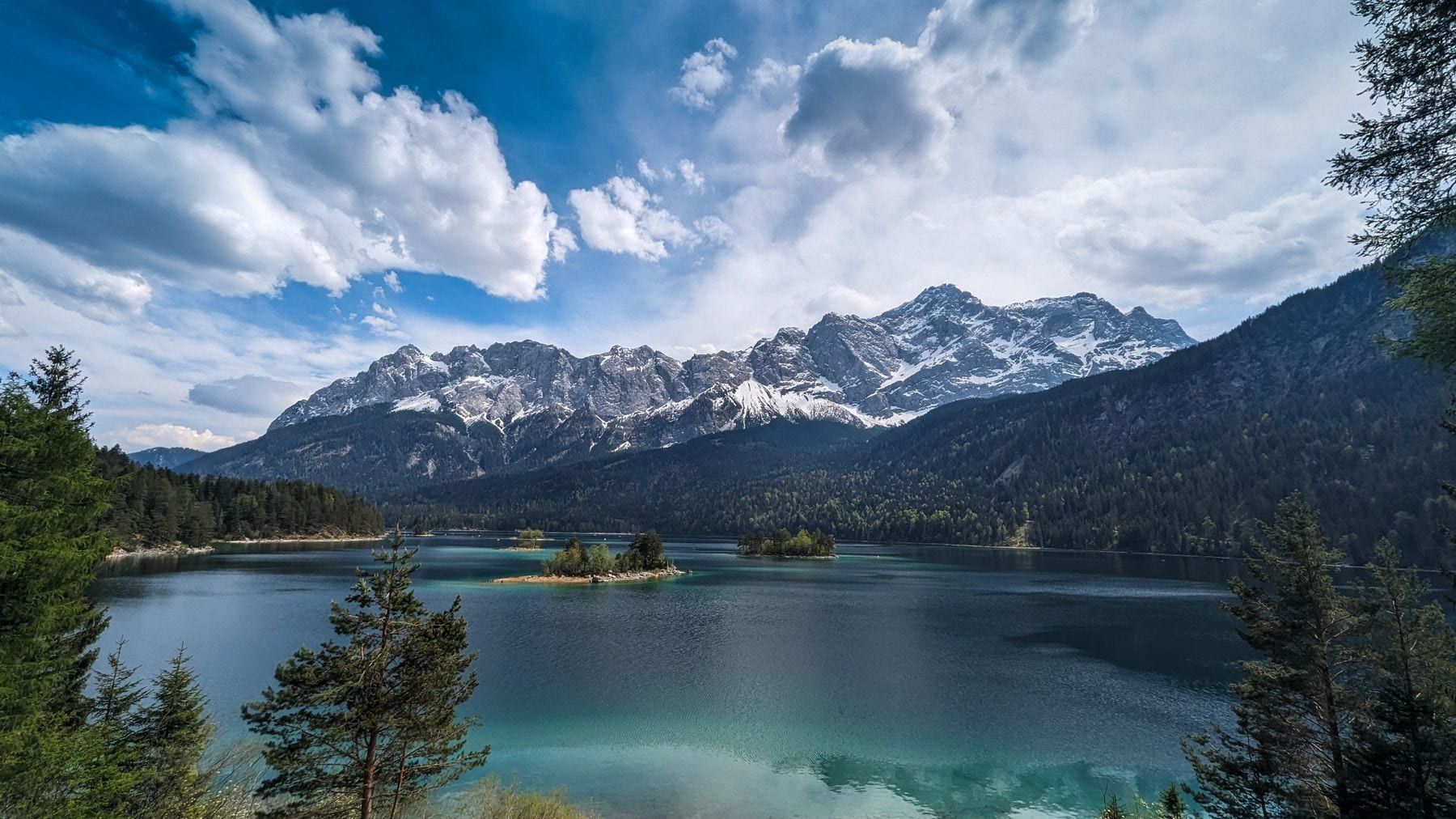
Two hours of flat path around the turquoise lake with eight islands at the foot of the Zugspitze, free, car park CHF 8, cog railway from Garmisch 40 minutes. Rowing boat or SUP CHF 15 to 20 an hour. Come early, full from 10 am at weekends.

View & book →

Wankbahn and Wankhaus

Around CHF 30 return up the 1,780-metre viewpoint above Partenkirchen with the best view of the Zugspitze and the Wetterstein wall, deckchairs at the Wankhaus, hardly any groups. Walk down in three hours.

View & book →

Alpspitzbahn and AlpspiX

Cable car up the Osterfelderkopf for around CHF 35, at the top the AlpspiX platform, two steel arms over a 1,000-metre drop with a glass floor. Magnificent with visibility, pointless in cloud. In winter part of the Garmisch-Classic ski area.

View & book →

Ski pass Garmisch-Classic and Zugspitze

Day pass for both areas around CHF 65, children CHF 35, 60 kilometres of pistes including the Kandahar run and the glacier plateau. Slightly cheaper online in advance; ski hire in town CHF 30 to 40 a day.

View & book →

Schloss Linderhof and Ettal Abbey

Ludwig's smallest and only completed palace with the Venus Grotto and park, admission CHF 10, tour without reservation, 30 minutes from Garmisch. On the way, Ettal Abbey with its brewery and liqueur distillery. Half a day, guided from Garmisch from CHF 60.

View & book →

Day trip to Neuschwanstein Castle

An hour by car, two by bus, ticket online around CHF 21 with a fixed entry time, 30-minute tour, Marienbrücke for the photo. Guided day tours from Garmisch with ticket from CHF 90 take the organisation off your hands.

View & book →

Mittenwald with the Karwendelbahn

20 minutes by train, a violin-making village with a painted main square, violin-making museum CHF 6 and the Karwendelbahn up to 2,244 metres for around CHF 40 with the telescope building over the abyss. The bus is free with the GaPa Card.

View & book →

If you book through these links we earn a small commission, at no extra cost to you.

Food & drink

Garmisch eats Upper Bavarian and at the hut: roast pork, Kässpatzen, Kaiserschmarrn and Brotzeit boards, with wheat beer that here almost counts as breakfast. Prices on the alpine pastures are a pleasant surprise for the Swiss, and fish from the lakes and streams of the region is served in the better houses.

Schweinsbraten with Knödel

Gasthof Fraundorfer on Ludwigstrasse, Bräustüberl Garmisch on Fürstenstrasse

Roast pork with crackling in dark beer sauce with a bread dumpling and cabbage salad, in Garmisch usually with a great deal of sauce. CHF 16 to 20 in a traditional inn, similar at a hut.

Tip:The Bräustüberl Garmisch still brews to an old recipe, and a half litre there is CHF 4.50.

Kässpatzen

Huts on the Wank, along the Partnach and on the Kreuzeck, such as the Partnachalm

Spätzle noodles baked in layers with mountain cheese and Emmental, topped with fried onions, from the neighbouring Allgäu and on every hut menu. One portion for CHF 12 to 15 fills you for the day.

Tip:Order a small salad with it, otherwise it is a wall of cheese.

Kaiserschmarrn

Berggasthof Eckbauer at the top of the Partnachklamm loop, Sonnalpin on the Zugspitzplatt

Shredded pancake with raisins, icing sugar and stewed plums or apple sauce, meant as a main course. CHF 11 to 14 at a hut.

Tip:At the hut order one portion between two, the pans are big.

Brotzeitbrettl

Alpine pastures on the way to the Partnachklamm, beer gardens in Partenkirchen

Wooden board with bacon, Pressack (brawn), mountain cheese, Obatzda, radishes and farmhouse bread, the Bavarian afternoon meal. CHF 12 to 16 for two.

Tip:Brotzeit is served all day, even when the kitchen is closed between 2 and 5 pm.

Renke and Saibling from the mountain lakes

Restaurants of the better hotels in Partenkirchen and the Eibsee Hotel on the lake

Renke is the whitefish of the Upper Bavarian lakes, Saibling (char) comes from the cold streams, both pan-fried with buttered potatoes. CHF 22 to 28 in a restaurant.

Tip:Ask about the origin, not every fish on the menu is from the region.

Weissbier and Ettaler Klosterbier

Klosterbräustüberl Ettal, Bräustüberl Garmisch, every beer garden in town

Wheat beer from a half-litre glass, in Garmisch at any time of day, CHF 4.50 to 5. Ettal Abbey brews dark Klosterbier and distils the Ettaler Klosterlikör from alpine herbs, a bottle from CHF 15.

Tip:A Russ is wheat beer with lemonade, the shandy of wheat beer drinkers, the sensible choice at a hut at midday.

Auszogne and Apfelstrudel

Cafés in the Garmisch pedestrian zone and on Ludwigstrasse in Partenkirchen

Auszogne are yeast doughnuts fried in lard with a thin base and thick rim; Apfelstrudel comes with vanilla sauce. CHF 4 to 7 in a café, at the hut with cream.

Tip:Auszogne are traditionally made on Sundays and at Kirchweih; they are best fresh.

Book a food tour: Garmisch-Partenkirchen and Zugspitze

Through markets and eateries with a guide, tastings included.

View & book →

If you book through these links we earn a small commission, at no extra cost to you.

History & background

Garmisch and Partenkirchen were two villages that did not like each other for a thousand years, and at heart still are. Partenkirchen is the older, a Roman road station called Partanum on the Via Raetia from Augsburg to Verona, along which Fugger merchants and Dürer later travelled to Venice; Ludwigstrasse with its Lüftlmalerei frescoes still follows the old route. Garmisch appears in 802 as a Bavarian settlement. From the 13th century until 1802 both belonged to the county of Werdenfels, a territory of the Prince-Bishop of Freising, whose castle ruin stands above Farchant; from this period date the witch trials to which more than 50 women fell victim around 1590. Tourism began with the railway in 1889 and with the summit: the Zugspitze, at 2,962 metres the highest point in Germany, was first climbed in 1820 by the survey lieutenant Josef Naus; in 1930 the Bavarian Zugspitzbahn ran as a cog railway through a 4.5-kilometre tunnel to the Platt, in 1963 the first cable car from the Eibsee followed, and in 2017 the new one with the tallest steel pylon in the world. In 1935 Hitler forced the two villages to merge by decree because he needed a venue for the 1936 Winter Olympics that sounded international; the ski jump, the ice stadium and the ski stadium date from this time, and the locals still say "Garmisch" or "Partenkirchen", never both. Richard Strauss lived in his villa in Garmisch from 1908 until his death in 1949 and composed the Alpine Symphony here; Michael Ende was born here. After the war the Americans were here, with a recreation centre for their soldiers that still exists. Today the market town has 27,000 inhabitants, hosts the New Year's ski jump of the Four Hills Tournament and the Kandahar World Cup race, and in 2015 it was the venue of the G7 summit at Schloss Elmau.

Insider tips

Getting there: via Innsbruck or Munich, vignette at the Fernpass, a car is useful

Two rail routes lead from Zurich to Garmisch, both around 5 hours. The first: Railjet to Innsbruck (3 hours 30), then the regional train via Seefeld and Mittenwald, which descends to Garmisch in 1 hour 20 along the Mittenwald railway with views into the Karwendel, one of the most beautiful lines in the Alps. The second: EC to Munich (3 hours 30), then the regional train through the Werdenfelser Land, 1 hour 20. Saver tickets from CHF 35 (about EUR 37), full fare with the Half Fare Card around CHF 65 each way. By car it is 260 kilometres from Zurich, 3 hours 30 via Bregenz, the Arlberg feeder road, Reutte and the Fernpass; the last stretch through Tyrol needs the Austrian vignette (10 days CHF 12), and the Fernpass jams on winter weekends and at the start of the holidays. Without a vignette you drive via Memmingen, Kempten and Füssen, 4 hours. In Garmisch itself a car is useful for the Eibsee, the Partnachklamm car park, Ettal and Linderhof, but not essential: the local buses are free with the GaPa Card, which you get with every overnight stay, the Zugspitzbahn starts at the station, and the Eibsee is 40 minutes away by cog railway. At the Eibsee car park you pay CHF 8 a day and on summer weekends you will not find a space after 10 am.

Zugspitze: cog railway or cable car, weather window and what it costs

A Zugspitze ticket for the ascent and descent costs around CHF 75 (about EUR 80) in summer, a little less in winter as a ski pass, and it is valid for both routes, so you take one up and the other down. The cog railway runs from Garmisch in 75 minutes via Grainau and the Eibsee through the tunnel to the Zugspitzplatt at 2,600 metres, where the glacier ski area and the Sonnalpin inn are, then on with the glacier cable car to the summit. The Zugspitze cable car from the Eibsee takes 10 minutes and climbs 1,945 metres on a single pylon, a feat of engineering and a test for anyone with a fear of heights. At the top you stand at 2,962 metres with a view of 400 peaks in four countries and can walk across the border to the Tyrolean side. The honest rule: the summit is only worth it under a clear sky, in cloud you see fog for CHF 75. Check the webcam in the morning and go on the first clear day, not the last, with the first train at 8.15 am, because in summer it often clouds over towards midday and from 10 am the groups from Munich arrive. Allow 4 to 5 hours including the Platt, where it is only 5 to 10 degrees even in August. The GaPa Card gives no discount on the Zugspitze, but there are combined tickets with the Garmisch-Classic lifts that pay off over two mountain days.

Where to stay: Garmisch or Partenkirchen, guest card, Christmas skiing

The two halves of town are separated by the railway line and connected on foot in 20 minutes. Partenkirchen is the prettier village with Ludwigstrasse, the painted houses and the old inns; Garmisch is bigger, has the pedestrian zone, the Kurpark and the Zugspitzbahn. For mountain railways and trains you are better off in Garmisch, for evenings in traditional inns in Partenkirchen, and the two are ten minutes apart by local bus. A mid-range double room costs CHF 130 to 180 (about EUR 139 to 193), an inn with breakfast CHF 100 to 130, plus the visitor's tax of around CHF 3 per person and night, for which you get the GaPa Card: free local buses and regional buses as far as Mittenwald and Oberammergau, reduced admission to pools and museums, guided hikes in summer. Grainau at the foot of the Zugspitze with its own cog railway station is quieter and cheaper; Mittenwald 20 minutes further on is the prettier village. It is expensive and full at New Year (New Year's ski jump), in the Bavarian Christmas and carnival holidays, on the Kandahar race weekends at the end of January and in August. Then you book two to three months ahead. Low season here means April to mid-May and November, when the lifts are being serviced; rooms are then 30 per cent cheaper, but some hotels are closed. Holiday flats are often cheaper for families than two rooms, but many are let only from three nights.

Partnachklamm, Eibsee and Wank: the programme for every weather forecast

The Partnachklamm is the best piece of nature in town and costs around CHF 7 (about EUR 7): a 700-metre gorge with 80-metre walls, through which you walk on a path blasted into the rock with tunnels and galleries, water from above and from the side, in winter with curtains of ice. From the Olympic ski stadium it is 25 minutes on foot to the entrance. The trick against the crowds: go before 9 am or after 4 pm, and do not turn round at the top but come back via the Partnachalm or the Eiserne Brücke and the Graseck, a loop of two to three hours with a stop at a hut. The Eibsee at the foot of the Zugspitze is the turquoise postcard motif and overrun at weekends; the circuit takes two hours on an almost flat path past eight small islands, loveliest early in the morning going clockwise, when you have the sun at your back. Rowing boats and SUPs cost CHF 15 to 20 an hour, and the lake is cold even in July. The Wank at 1,780 metres is the underrated mountain: the Wankbahn (around CHF 30 return) climbs from Partenkirchen in 20 minutes to a grassy summit with a view of the whole Wetterstein massif and the Zugspitze head-on, deckchairs at the Wankhaus, hardly anyone there. In rain the Partnachklamm is still doable; the AlpspiX on the Osterfelderkopf (Alpspitzbahn around CHF 35) is only worth it with visibility.

Skiing in Garmisch: honestly rated by Swiss standards

Garmisch has two ski areas that are not connected. Garmisch-Classic with Hausberg, Kreuzeck and Alpspitze offers 40 kilometres of pistes between 700 and 2,050 metres, among them the Kandahar run, where the World Cup races are held and which, with a 92 per cent gradient at its steepest point, counts among the hardest pistes in the Alps. The Zugspitze has 20 kilometres on the glacier plateau between 2,000 and 2,720 metres, snow-sure from November to May, gentle, wide slopes, but no run down to the valley. The day pass for both areas costs around CHF 65 (about EUR 70), children up to 15 pay around CHF 35. For comparison: in Zermatt you pay CHF 100, in Laax CHF 90, in Engelberg CHF 80. In return you get less in Garmisch: Garmisch-Classic is often green at the bottom in warm winters, some of the lifts are older, and at weekends the crowds from Munich are large. Honestly, Garmisch is a good ski area for two to three days and for families, not a substitute for a week in the Engadin or in Ischgl. If you want a week, combine it with the Tyrolean side at Ehrwald and Lermoos (Top Snow Card, which links all the areas around the Zugspitze) or go cross-country skiing on bad-weather days: the trail network between Garmisch, Kaltenbrunn and Mittenwald is excellent and free. Ski hire costs CHF 30 to 40 a day, and ski lessons are considerably cheaper than in Switzerland.

Neuschwanstein, Linderhof, Ettal and Mittenwald: excursions honestly rated

Neuschwanstein lies 60 kilometres to the west near Füssen, an hour by car via Ettal and Oberammergau, two hours by bus 9606 from Garmisch, usually free with the GaPa Card. The honest balance: 1.4 million visitors a year, tickets only online and weeks ahead in high season (around CHF 21, about EUR 22), a fixed entry time, a 30-minute tour through 15 finished rooms, and queues before and after on the way up and at the Marienbrücke, which on some days is closed because of overcrowding. The castle is magnificent from outside, interesting inside, but not an experience that justifies the stress. If you do go, take the first ticket at 9 am and combine it with Schloss Hohenschwangau next door, which is more personal. The better alternative: Schloss Linderhof, 30 minutes from Garmisch, Ludwig's only completed palace, small, playful, with the Venus Grotto and a park where you have room, admission CHF 10, tour without reservation. On the way lie Ettal Abbey with its baroque basilica, brewery and liqueur distillery, and Oberammergau with its painted houses and the Passion Play theatre, whose next performances take place in 2030. Mittenwald in the other direction you reach in 20 minutes by train or bus: a violin-making village with the most beautiful main square in Upper Bavaria, the violin-making museum (CHF 6) and the Karwendelbahn up to 2,244 metres (around CHF 40) with the telescope-shaped building over the abyss.

Frequently asked questions about Garmisch-Partenkirchen and Zugspitze

How do I get from Switzerland to Garmisch-Partenkirchen, and what does it cost?

By train from Zurich in around 5 hours, either via Innsbruck and the Mittenwald railway (more scenic) or via Munich, saver ticket from CHF 35 (about EUR 37), full fare with the Half Fare Card around CHF 65 each way. By car it is 260 kilometres and 3 hours 30 via Bregenz and the Fernpass, for which you need the Austrian vignette for CHF 12; via Füssen without a vignette 4 hours. On site a car is useful for the Eibsee, Linderhof and Neuschwanstein, but with the GaPa Card all buses in the region are free, and the Zugspitzbahn starts at the station.

How many days should you plan for Garmisch and the Zugspitze?

Three nights is right: one day for the Zugspitze with the Eibsee, one for the Partnachklamm and the Wank, one for Linderhof and Ettal or Mittenwald. Because the summit depends on the weather, you need the leeway to move the Zugspitze day. For a long weekend from Zurich, two nights with the Zugspitze and the gorge are enough. Skiers stay four to five days; longer is not worth it for experienced skiers. Hikers can fill two weeks here, from the Kramerplateauweg to the hut tour via the Reintalangerhütte up the Zugspitze.

When is the best time to visit the Zugspitze?

For the summit view, September and October: stable high-pressure weather, clear long-distance views, few thunderstorms, fewer people than in summer. June to August is warmest, but it often clouds over in the afternoon and the Munich day-trippers arrive from 10 am. Winter is snow-sure and beautiful on the Platt, but in a storm the cable car stands still. The Partnachklamm and the Eibsee are worth it at any time of year, the gorge especially in January with ice. Avoid the Christmas and carnival holidays if you want peace, and November when the lifts are being serviced.

Cog railway or cable car up the Zugspitze?

Both; the ticket for around CHF 75 (about EUR 80) is valid for both routes. Up by cable car from the Eibsee (10 minutes, spectacular, empty in the morning), summit at the top, then by glacier cable car to the Platt and from there a leisurely 75 minutes down by cog railway. If you have a fear of heights, take the cog railway both ways, it covers the biggest height difference in the tunnel. With children and older people the cog railway up is better, because the altitude gain comes more slowly. The first train at 8.15 am is the best advice on this page.

What does Garmisch cost compared with a Swiss mountain resort?

Around 30 per cent less, for mountain railways often more. Zugspitze CHF 75 (about EUR 80) against Gornergrat CHF 130, ski pass CHF 65 against CHF 90 to 100, mid-range double room CHF 130 to 180 against CHF 180 to 250 in Zermatt, roast pork at a hut CHF 16 against CHF 28 for Rösti. The visitor's tax of CHF 3 a night comes on top, but the GaPa Card offsets it with free buses. With CHF 120 to 150 per day and person including hotel and one mountain railway you are doing well, in winter with a ski pass CHF 180.

Is the trip from Garmisch to Neuschwanstein worth it?

Only with preparation and honest expectations. You need an online ticket for around CHF 21 (about EUR 22) with a fixed time, weeks ahead in high season, then an hour's drive or two hours by bus, a 40-minute climb or shuttle, a 30-minute tour through 15 rooms and queues at the Marienbrücke. From outside and from the bridge the castle is magnificent, the rest is mass processing. Most people who see it and come back say: beautiful, once, never again. Linderhof, 30 minutes away, is the more personal Ludwig palace without a reservation, and Ettal and Oberammergau are on the way.

Itineraries with this destination

Activities in the region

More destinations in Bavaria & the Alps