Berlin

Germany · Berlin & the North · Travel guide

Berlin

What a long weekend in the German capital really costs, why you can take the night train to Berlin instead of flying, and which neighbourhood to stay in so you are not spending half an hour on the U-Bahn every evening.

Photo: Ch Jawad / Pexels

What does a trip to Berlin cost?

Adjust the values to your trip: the calculator updates live (EUR, converted from CHF estimates).

1,637 EUR
≈ 819 EUR per person
  • Getting there 385 EUR
  • Accommodation 642 EUR
  • Food 482 EUR
  • Local transport 64 EUR
  • Museum Pass Berlin (3 days) 64 EUR

Estimates for orientation, not booking prices. Getting there means train or car from Switzerland, return, per person. Hotels vary strongly by season: current prices are behind the links below.

Money & payment: You pay in euros (EUR). Germany is fonder of cash than Switzerland: bakeries, kiosks and small restaurants often say "cash only", though cards work almost everywhere from about EUR 10. Tip 5 to 10 percent by rounding up and naming the total when you pay. Getting there: By train (DB), car or plane, 1 to 8 hours depending on the destination.

Recommended hotels

Nine options in three price ranges, each among the best-rated on Booking.com.

Budget

a&o Berlin Mitte

Mitte (Köpenicker Strasse), Berlin

Large hostel and budget hotel between Kreuzberg and Mitte, five minutes from Heinrich-Heine-Strasse U-Bahn station. Dorms from CHF 25, simple double rooms with bathroom from CHF 70, breakfast buffet at extra cost. For anyone who would rather spend the budget on museums and nights out.

from CHF 70 / night (about EUR 75) View →

MEININGER Hotel Berlin Hauptbahnhof

Moabit (at the Hauptbahnhof), Berlin

A hybrid of hostel and hotel directly opposite the Hauptbahnhof, ideal for early-morning night train arrivals. Clean rooms, guest kitchen, Reichstag and Tiergarten ten minutes on foot. The area is quiet in the evening, and Mitte is one S-Bahn stop away.

from CHF 80 / night (about EUR 86) View →

Motel One Berlin-Hackescher Markt

Mitte (Hackescher Markt), Berlin

The reliable budget chain at the best address for first-time visitors: Museum Island, the Hackesche Höfe and Alexanderplatz on foot, S-Bahn outside the door. Small, well-designed rooms, bar in the lobby. Book early, the hotel is often full at weekends.

from CHF 100 / night (about EUR 107) View →

Mid-range

Michelberger Hotel

Friedrichshain (Warschauer Strasse), Berlin

Berlin's hotel for the club generation, opposite the Oberbaum Bridge and next to Warschauer Strasse station. Rooms from cubbyhole to loft, inner courtyard, good restaurant with produce from its own farm. For anyone out at night in Friedrichshain and Kreuzberg.

from CHF 130 / night (about EUR 139) View →

25hours Hotel Bikini Berlin

Charlottenburg (Zoo), Berlin

In the Bikini building between the Zoo and the Memorial Church, with views into the monkey enclosure or over the City West. Monkey Bar on the 10th floor, Neni restaurant, bikes to borrow. The best choice if you want the west and the KaDeWe as your base; Mitte is 15 minutes away by S-Bahn.

from CHF 150 / night (about EUR 161) View →

Hotel Oderberger

Prenzlauer Berg (Oderberger Strasse), Berlin

A listed public baths building from 1902 where the swimming hall is still in use and guests swim for free. Quiet rooms, Kastanienallee and Mauerpark around the corner. For anyone who wants Prenzlauer Berg with cafés and old buildings instead of Mitte.

from CHF 140 / night (about EUR 150) View →

Luxury

Hotel Adlon Kempinski Berlin

Mitte (Pariser Platz), Berlin

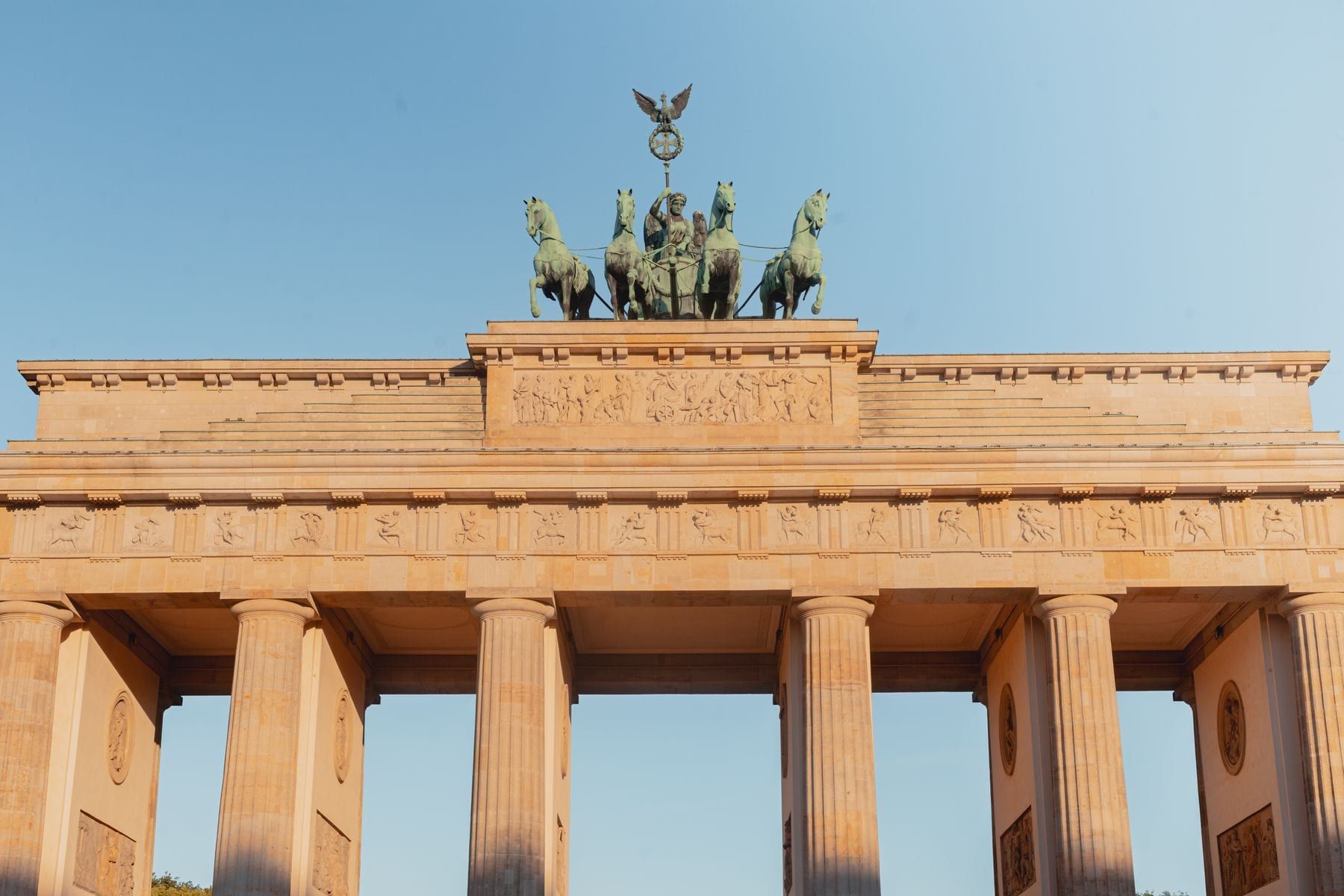
The grand hotel right next to the Brandenburg Gate, rebuilt in 1997 on the model of the 1907 original. Classic rooms, lobby with elephant fountain, two-star restaurant Lorenz Adlon. The address if you want to experience Berlin in full ceremony once; Unter den Linden starts outside the door.

from CHF 380 / night (about EUR 407) View →

Rocco Forte Hotel De Rome

Mitte (Bebelplatz), Berlin

Former head office of the Dresdner Bank on Bebelplatz, where the vault is now the pool. Quiet location next to the State Opera and Museum Island, roof terrace with views over Mitte, Italian restaurant. Less pomp than the Adlon, more restraint and design.

from CHF 350 / night (about EUR 375) View →

The Ritz-Carlton, Berlin

Tiergarten (Potsdamer Platz), Berlin

High-rise on Potsdamer Platz, completely renovated in 2019, with large rooms, a spa and the well-known Fragrances Bar. Philharmonie, Gemäldegalerie and Tiergarten on foot, though the surroundings are empty in the evening. For concert and museum travellers who want comfort.

from CHF 320 / night (about EUR 342) View →

If you book through these links we earn a small commission, at no extra cost to you.

Experiences worth your time

Museum Island: Neues Museum and Alte Nationalgalerie

Nefertiti in the Neues Museum, Caspar David Friedrich in the Alte Nationalgalerie, plus the Altes Museum and the Bode Museum. Single ticket CHF 14 to 22, area ticket for all buildings CHF 22 to 24, three-day Museum Pass CHF 30. Allow 90 minutes per building and book time slots online.

View & book →

Reichstag dome with registration

Norman Foster's glass dome above the Bundestag, audio guide included, free. Register online two weeks ahead with your passport details; sunset is the best slot. Allow 60 to 90 minutes including the security check.

View & book →

Wall tour: Bernauer Strasse and East Side Gallery

The Berlin Wall Memorial on Bernauer Strasse shows the only surviving death strip, free, viewing tower included. The East Side Gallery is 1.3 kilometres of painted Wall along the Spree. Guided bike tour of the Wall sites from CHF 30, three to four hours.

View & book →

Street food and neighbourhood tour of Kreuzberg

Markthalle Neun, Turkish bakeries, Döner and craft beer around Kottbusser Tor with someone who knows the neighbourhood. Three hours with food from CHF 60. On Thursday evenings the Street Food Thursday in the Markthalle is part of the tour.

View & book →

Topography of Terror and Holocaust Memorial

Documentation centre on the site of the Gestapo headquarters, free, two hours. The field of stelae of the Holocaust Memorial is ten minutes away, and the information centre beneath it is also free. Guided tour on Nazi-era history from CHF 20.

View & book →

Spree cruise through Mitte

An hour on the water from the Nikolaiviertel to the Hauptbahnhof, past Museum Island, the Reichstag and the Chancellery, CHF 20 to 25. A better perspective than any bus; the three-hour round trip via the Landwehr Canal is more worthwhile in summer.

View & book →

Tempelhofer Feld by bike

The disused airport is the largest inner-city park in the world, and you ride on the runways. Rental bike CHF 10 to 15 a day, admission free, sunset on the western edge. The guided tour of the airport building costs CHF 18 and shows the Nazi monumental building from the inside.

View & book →

Day trip to Potsdam and Sanssouci

40 minutes by S7 or regional train, ABC ticket CHF 4.50. Sanssouci Palace CHF 22 with a time slot; the park and the Dutch Quarter are free. Guided half-day tour from Berlin from CHF 50; on your own it takes a whole day.

View & book →

Berlin Philharmonie or State Opera

Tickets for the Berlin Philharmonic from CHF 30, for the Staatsoper Unter den Linden from CHF 20, remaining tickets often at the box office in the evening. The lunchtime concerts at the Philharmonie on Tuesdays at 1 pm are free; be there by 12 noon.

View & book →

If you book through these links we earn a small commission, at no extra cost to you.

Food & drink

Berlin does not cook fine food, Berlin eats on the street: Currywurst, Döner, Buletten, Schrippen. Add to that the best Turkish, Arab and Vietnamese food in Germany, a legacy of the guest workers and the GDR contract workers. Almost nothing here is expensive, and the places that give you the most often have neon lights and plastic chairs.

Currywurst mit Pommes

Konnopke's Imbiss under the elevated railway on Schönhauser Allee, or Curry 36 on Mehringdamm

Fried sausage cut into pieces, tomato sauce with curry powder on top, a cardboard tray, a wooden fork, served with chips. With or without skin is the Berlin question of faith. With chips CHF 6 to 8.

Tip:At Konnopke order "ohne Darm" (without skin), the original since 1960; Curry 36 is open until 5 am.

Döner Kebap

Mustafas Gemüse Kebap on Mehringdamm (long queue) or Imren Grill in Neukölln and Kreuzberg

Flatbread, meat from the spit, salad, sauce. Invented, or at least perfected, in Berlin-Kreuzberg in the Seventies. CHF 6 to 9; the vegetable version with sheep's cheese and fried vegetables is the Berlin speciality.

Tip:At Mustafas you queue 45 minutes, at Imren five, and Imren is better for meat eaters.

Königsberger Klopse

Max und Moritz on Oranienstrasse or Zur letzten Instanz in Mitte

Veal meatballs in a white caper sauce with boiled potatoes and beetroot, Prussian cooking from East Prussia. CHF 14 to 20 in a restaurant.

Tip:Zur letzten Instanz is the oldest inn in Berlin (1621): book ahead, high share of tourists, kitchen still good.

Eisbein mit Sauerkraut und Erbspüree

Traditional restaurants in Mitte and Charlottenburg, for example around Kantstrasse

Cured pork knuckle, boiled rather than roasted as in Bavaria, with pea purée and caraway sauerkraut. One portion feeds two, CHF 18 to 24.

Tip:Only order it if you have nothing planned afterwards.

Bulette mit Schrippe

Butchers and corner pubs in Prenzlauer Berg and Kreuzberg, or the stalls in the Markthalle Neun

The Berlin meat patty, cold or warm, with mustard and a bread roll, which here is called a Schrippe. CHF 3 to 5 at the counter, the snack between two museums.

Tip:In a corner pub the Bulette often sits in a glass case on the bar; just order it, cold is normal.

Berliner Pfannkuchen

Any Berlin bakery, traditionally in Charlottenburg and Schöneberg for example

What the rest of the world calls a Berliner: yeast dough fried in fat, filled with jam, sugared. CHF 1.50 to 2.50 at the bakery, filled with mustard as a prank at New Year.

Tip:Say Pfannkuchen, not Berliner, or you will get a look.

Hummus and falafel from Neukölln

Sonnenallee in Neukölln, between Hermannplatz and Sonnenallee S-Bahn station

Sonnenallee is the Arab high street of Berlin, with Syrian and Lebanese bakeries, hummus places and shawarma. A plate of hummus, falafel, bread and salad CHF 7 to 12.

Tip:The places without a menu in German are the better ones; ordering works by pointing.

Vietnamese pho and bun

Dong Xuan Center in Lichtenberg (wholesale market with canteens) or the restaurants around Rosenthaler Platz in Mitte

A legacy of the GDR contract workers: Berlin has one of the largest Vietnamese communities in Europe. Pho CHF 9 to 13, Bun Bo Nam Bo CHF 10 to 14.

Tip:The Dong Xuan Center is a tram ride away and feels like Hanoi; canteens in halls 1 and 2, cash only.

Markthalle Neun and Street Food Thursday

Markthalle Neun, Eisenbahnstrasse, Kreuzberg

Historic market hall in Kreuzberg with a bakery, butcher, cheese and a craft beer brewery. Thursday evenings from 5 pm street food from around the world, dishes CHF 7 to 12.

Tip:Come before 6 pm on Thursday, after that it is packed; on Saturdays there is a farmers' market with breakfast.

Book a food tour: Berlin

Through markets and eateries with a guide, tastings included.

View & book →

If you book through these links we earn a small commission, at no extra cost to you.

History & background

For a European capital, Berlin is young: the little fishing town of Cölln on the Spree is first mentioned in 1237, and Berlin on the opposite bank only a little later. The twin town rose with the Hohenzollerns, who resided here from 1415 as margraves and electors of Brandenburg and from 1701 as kings in Prussia. In the 18th century Frederick the Great made Berlin a city of the Enlightenment, of Huguenots and of barracks; Unter den Linden, the Forum Fridericianum and Charlottenburg Palace date from this period. In 1871 Berlin became the capital of the German Empire and grew within 40 years from 800,000 to almost four million inhabitants, with tenement blocks, back courtyards and factories that still shape the look of Kreuzberg, Neukölln and Prenzlauer Berg today. The Twenties brought cabaret, Bauhaus and Babylon Berlin; the Nazis from 1933 brought terror, war and the destruction of around a third of the city. In 1945 the Allies divided Berlin into four sectors, from 1948 to 1949 the Airlift kept West Berlin alive, and on 13 August 1961 the GDR began building the Wall, which ran straight through the city for 28 years. West Berlin became a subsidised island whose residents were exempt from military service, which drew artists, students and Turkish guest workers to Kreuzberg; East Berlin became the capital of the GDR, with the TV Tower and the Palace of the Republic. The fall of the Wall on 9 November 1989 and the government's move from Bonn in 1999 turned two half cities back into one. The empty buildings of the Nineties created the club culture Berlin is famous for today. Since then rents have been rising, the city is growing again, and in many places the scar of the Wall is just a line of cobblestones in the asphalt.

Insider tips

Getting there: flight, night train or the long ICE day

From Zurich, Swiss and easyJet fly several times a day to Berlin Brandenburg (BER), 1 hour 25 minutes, return fares from CHF 80 (about EUR 86) if you book early, realistically CHF 120 to 200. From BER the FEX airport express or the S-Bahn takes you to the Hauptbahnhof in 30 to 40 minutes, ABC ticket around CHF 4.50. easyJet also flies from Basel and Geneva. The relaxed alternative is the ÖBB Nightjet from Zurich HB and Basel: departure in the evening, arrival around 8 am at Berlin Hauptbahnhof, couchette from CHF 80, sleeper from CHF 150 per person each way, breakfast included in the sleeper. You save a hotel night and arrive in the middle of the city. By day the ICE runs from Basel or Zurich in 8 to 9 hours with a change, saver fares from CHF 40 each way if you book three months ahead; the Swiss Half Fare Card gives no discount on DB routes. By car it is 850 kilometres and 9 hours from Zurich with no motorway tolls, but you do not need a car in Berlin and will pay CHF 20 to 30 a day for a car park. In the city: BVG day ticket AB CHF 10, 4-trip ticket CHF 11, or the Deutschlandticket for around CHF 60 a month, which pays off from the sixth day and is also valid for Potsdam, Hamburg and Rügen. Rental bikes and e-scooters are everywhere, and Berlin is flat.

Where to stay: the neighbourhood decides, not the stars

Berlin has no old town where everything gathers. Mitte around Hackescher Markt and Rosenthaler Platz is central, well connected and quieter in the evening than you would think; most of the chain and design hotels are here. Prenzlauer Berg is the district for cafés, old apartment buildings and families, Kreuzberg around Bergmannstrasse and Oranienstrasse for bars, the canal and Turkish food, Neukölln on Weserstrasse for nightlife off the tourist track, Friedrichshain around Boxhagener Platz for clubs and the flea market. Charlottenburg in the west is bourgeois, has the KaDeWe and the Zoo, and is 15 minutes from Mitte by S-Bahn. The honest prices: hostel bed CHF 25 to 40 (about EUR 27 to 43), Motel One, Ibis and a&o CHF 80 to 130, mid-range in a good neighbourhood CHF 110 to 170, the Adlon and its peers from CHF 350. The price traps are the trade fair and marathon weeks (ITB in March, IFA in September, the marathon at the end of September), when rooms double in price. Book six to eight weeks ahead, earlier for weekends in May, June and September. Holiday apartments are tightly regulated in Berlin and many listings are not legal; stick to hotels or aparthotels. The city tax of 7.5 per cent is added to the room rate, and on Booking it is usually already included.

Cost traps and savings: Museum Pass, Reichstag, Currywurst

For the Swiss, Berlin is a price shock in the right direction: beer CHF 4 (about EUR 4), Döner CHF 7, lunch CHF 12 to 16, coffee CHF 3.50. The traps are elsewhere. Checkpoint Charlie is a replica guardhouse surrounded by souvenir shops; the Wall Museum next to it costs CHF 17 and is not worth the money, while the Berlin Wall Memorial on Bernauer Strasse is free and better. The TV Tower costs CHF 25 to 30 and has queues; the Reichstag dome is free, you just have to register online with your passport, ideally two weeks ahead, and sunset is the best slot. Hop-on-hop-off buses for CHF 30 show you nothing that bus line 100 from the Zoo to Alexanderplatz does not show for CHF 3.50. For museums the Museum Pass Berlin is worth it: three days, more than 30 museums including Museum Island, CHF 30, whereas Museum Island alone costs CHF 20 to 22 per building when bought separately. The first Sunday of the month is free in the state museums, but crowded. The Topography of Terror, the East Side Gallery, Tempelhofer Feld, the Holocaust Memorial and most parks cost nothing. Tip 5 to 10 per cent by stating the total you want to pay. Cards work almost everywhere, but Spätis (late-night corner shops), snack bars and some pubs want cash. Tap water in restaurants is unusual, and a bottle of water costs CHF 3 to 5, which adds up.

Timing and season: May, September and the cold months

The best time is May to June and September: 18 to 25 degrees, long evenings, and the city lives outdoors, by the canal, on the Spree and in the beer gardens. July and August are hot and dusty, many Berliners are away, the clubs run open airs, and hotel prices tend to be lower than in May. October brings golden leaves in the Tiergarten and the Festival of Lights; November to February is grey, 0 to 5 degrees with an icy east wind, but the museums are empty and rooms can be had from CHF 70 (about EUR 75). The Christmas markets at Gendarmenmarkt and in the Kulturbrauerei are lovely, the one at Alexanderplatz is a funfair. Berlin is a late-riser city: cafés open at 9 or 10 am, brunch runs until 3 pm, shops close at 8 pm, and on Sundays everything except Spätis, museums and restaurants is shut. The clubs only fill up after 1 am. If you want to see Museum Island, go Tuesday to Friday right at 10 am or after 4 pm; at weekends there are queues. The Pergamon Museum is closed for renovation until at least 2027; the Pergamon Panorama opposite shows the altar as a 360-degree painting, and the Neues Museum with Nefertiti is the more rewarding building anyway. The Berlinale in February and the Carnival of Cultures at Whitsun are the weekends that fill the hotels.

Kreuzberg, Neukölln, Prenzlauer Berg: how to walk the neighbourhoods

Take one neighbourhood per day. Prenzlauer Berg: start at Kollwitzplatz (Saturday farmers' market), walk down Kastanienallee to the Kulturbrauerei, then on Sunday the Mauerpark with its flea market and the karaoke in the amphitheatre from 3 pm, a thousand people in summer. Kreuzberg has two faces: the Bergmannkiez around Marheinekeplatz and Chamissoplatz is old apartment buildings, cafés and bookshops, with Tempelhofer Feld next door, a disused airport where Berliners roller-skate on the runway. The other Kreuzberg lies around Kottbusser Tor, Oranienstrasse and the Landwehr Canal: Turkish, punk, loud, with the Turkish market on Maybachufer on Tuesdays and Fridays and the Markthalle Neun with its Street Food Thursday. From the canal you walk into Neukölln: Weserstrasse for bars, Schillerkiez for cafés, Sonnenallee for Arab bakeries and the best hummus in the city, and the Klunkerkranich on the car park roof of the Neukölln Arcaden for sunset (CHF 5 to 8, about EUR 5 to 9, admission in the evening). You reach Friedrichshain over the Oberbaum Bridge with the East Side Gallery. For Potsdam with Sanssouci allow 40 minutes by S-Bahn, ABC ticket CHF 4.50, palace CHF 22, the park is free. And yes, Spreewald gherkins, the Wannsee and the Pfaueninsel are proper summer outings; the ferry to the Pfaueninsel costs CHF 6.

Clubs: Berghain, door policy and the honest bill

Berlin is the club capital of Europe, but the rules are its own. Berghain opens on Saturday night and runs until Monday morning, admission CHF 25 to 30 (about EUR 27 to 32), the queue takes one to three hours, and the door turns many people away. The honest tips: black, inconspicuous, sober, small group, no small talk with the bouncer, no phone. On Sunday afternoon the queue is short and the sound in the building is at its best. If you do not want the risk, go to Sisyphos in Lichtenberg (open-air grounds, Friday to Monday, CHF 20), Tresor on Köpenicker Ufer, ://about blank at Ostkreuz or Wilde Renate in Friedrichshain. KitKat is a fetish club with a dress code, read up before you go. Watergate closed at the end of 2024; the club closures are real, so check current programmes on Resident Advisor. In all clubs your phone camera gets taped over and photos are taboo. Drinks cost CHF 4 to 6 for a beer, CHF 10 to 14 for a long drink, cloakroom CHF 2 to 3, and clubs often take cash only. Before the club, Berlin means Späti: a beer for CHF 1.50 to 2.50 on the kerb, which is legal and normal. The night ends with the U-Bahn, which runs all night at weekends, or the night bus; taxis cost CHF 15 to 25 across the city.

Frequently asked questions about Berlin

How do I get from Switzerland to Berlin, and what does it cost?

Fastest by plane from Zurich to Berlin Brandenburg (BER), 1 hour 25 minutes, CHF 100 to 200 (about EUR 107 to 214) return with Swiss or easyJet, plus CHF 4.50 for the S-Bahn or FEX into the city. Nicest with the ÖBB Nightjet from Zurich or Basel: couchette from CHF 80 each way, arriving at the Hauptbahnhof in the morning. The ICE takes 8 to 9 hours by day. You do not need a car in Berlin; car parks cost CHF 20 to 30 a day.

How many days do you need for Berlin?

Three full days is the minimum: one day in Mitte with Museum Island, the Reichstag and the Brandenburg Gate, one day of Wall history with Bernauer Strasse, the Topography of Terror and the East Side Gallery, one day in the neighbourhoods with Kreuzberg and Neukölln. With Prenzlauer Berg, Potsdam, Tempelhofer Feld and a club night you will easily fill five days. Within its city limits Berlin is nine times the size of Paris, so allow 30 to 40 minutes for journeys.

When is the best time to visit Berlin?

May, June and September: mild, long evenings, beer gardens and canal banks full, but hotels also at their most expensive. July and August are hot, the city emptier and often cheaper. From November to February it is grey and cold with an east wind, but you get rooms from CHF 70 (about EUR 75) and empty museums. Avoid trade fair weeks (ITB in March, IFA in September) and the marathon weekend at the end of September, when prices double.

Which district should I stay in?

Mitte between Hackescher Markt and Rosenthaler Platz if it is your first visit and you want to reach everything on foot or within two stops. Prenzlauer Berg for cafés and quiet, Kreuzberg or Neukölln if you want to go out in the evening without riding the U-Bahn at night. Charlottenburg is refined and good value, but far from the east. Avoid hotels right on Alexanderplatz and Potsdamer Platz, both are dead in the evening.

How expensive is Berlin compared with Zurich?

Roughly half to two thirds. A beer in a bar CHF 4 (about EUR 4) instead of 7, lunch CHF 12 to 16 instead of 25, a mid-range double room CHF 110 to 150 instead of 200 to 250, a U-Bahn day ticket CHF 10. With CHF 90 to 120 per person per day including hotel you will get by comfortably, with a hostel and snack bars even on CHF 60. Museums and clubs are the biggest single items, both between CHF 20 and 30.

Is Berlin safe, and what about pickpockets?

For a city of millions Berlin is safe, but it is not Zurich. Pickpockets work on Museum Island, at Alexanderplatz, on Warschauer Strasse and in crowded U-Bahn trains: rucksack to the front, phone not in your back pocket. Around Kottbusser Tor, Görlitzer Park and Leopoldplatz drugs are dealt openly, which is unpleasant, but tourists are left alone. At night the U-Bahn and S-Bahn are busy and fine. Cyclists: Berlin drivers are rough and bike lanes end in nowhere, so ride defensively.

Itineraries with this destination

Activities in the region

Events

Feb 11

Berlinale (Berlin International Film Festival)

Culture

11 February 2027 Second half of February, eleven days; 2027: 11 to 21 February

Alongside Cannes and Venice, the Berlinale is Europe's most important film festival and the only one of the three that is explicitly aimed at the public: more than 300,000 cinema tickets are sold to ordinary viewers, the competition for the Golden Bear runs at the Berlinale Palast on Potsdamer Platz, and further programmes are shown in cinemas from Charlottenburg to Friedrichshain. Tickets cost around CHF 15 to 20 (EUR 15 to 20) and go on sale online three days before each screening; star premieres are gone within minutes, repeat screenings are usually easy to get. The red carpet is easy to see from behind a barrier, at Berlin February temperatures around freezing. Hotels around Potsdamer Platz are dearer, but the city as a whole is not sold out.

For travellers: Berlin is cheap in February anyway; set up an account on the ticket site in advance and look at side sections such as Panorama or Forum, where the more interesting films and spare seats often are.

Sep 26

Berlin Marathon

Sport

26 September 2027 Last Sunday in September; 2027 expected 26 September

The fastest marathon in the world: most of the world records of recent decades have been run on its flat course through the Tiergarten, Kreuzberg, Neukölln and Charlottenburg, around 50,000 runners take part, and more than a million people line the route. The atmosphere is loud and warm from the first runner to the last, with bands at every kilometre and the finish through the Brandenburg Gate. Places are allocated by ballot the previous autumn, with roughly a one-in-three chance and a fee of around CHF 150 to 200 (EUR 160 to 210); charity places or tour operators with guaranteed entries are the safer route. The inline skating marathon runs on the same course on Saturday, and on marathon Sunday half the city centre is closed to traffic. Hotels are full and dearer than usual this weekend, but the city is big enough that you will find something with a little lead time.

For travellers: As a spectator, Potsdamer Platz or Karl-Marx-Strasse are good spots, and the underground lets you switch between two sections of the course; if you are planning a day out in Berlin that Sunday, stay outside the S-Bahn ring.

More destinations in Berlin & the North