Toyoko Inn Yamagata-eki Nishi-guchi
A standard business hotel right at Yamagata station, breakfast included, with the Shinkansen and the Senzan line on the doorstep. The affordable base for Yamadera, Zao and the bus to Ginzan Onsen.
Japan · Tohoku · Travel guide
What a night in a wooden riverside ryokan really costs, why you have to book months ahead and how to combine Zao, Yamadera and cherries in June into one trip.
Photo: 家豪 陳 / Pexels
Adjust the values to your trip: the calculator updates live (EUR, converted from CHF estimates).
Estimates for orientation, not booking prices. Flights and hotels vary strongly by season: current prices are behind the links below.
Money & payment: You pay in yen (JPY). 1,000 yen is roughly CHF 6 or EUR 6.50. Cards work in cities and hotels; small restaurants, temples and rural stations often want cash. An IC card (Suica or ICOCA) on your phone pays for trains, buses and convenience stores. Flight time: 12 to 14 hours, usually with one stop.
Nine options in three price ranges, each among the best-rated on Booking.com.
Budget
A standard business hotel right at Yamagata station, breakfast included, with the Shinkansen and the Senzan line on the doorstep. The affordable base for Yamadera, Zao and the bus to Ginzan Onsen.
Slightly better equipped than Toyoko Inn, rooms of 18 square metres, good beds, three minutes to the station and ten minutes' walk to the Nanokamachi nightlife district. Often available for under CHF 70.
A simple chain hotel with free breakfast and coffee, five minutes from the station, rooms plain and clean. Perfectly adequate for one or two nights passing through.
Mid-range
The JR hotel in the station building: bigger rooms, a quiet setting, a good breakfast with imoni in autumn, and you walk with your suitcase straight to the Tsubasa Shinkansen. The most comfortable city address in Yamagata.
The largest place in Ginzan Onsen, a few hundred metres above the historic village, with a shuttle and the most generous baths, including a reclining pool with a view over the valley. Not the postcard scene, but easier to book and, with half board, cheaper than the houses on the river.
A solid onsen hotel in Zao village with its own spring, a wooden bath and an outdoor pool, 300 metres from the ropeway. Half board with Yamagata beef. Ski-in in winter, in summer a base for Okama and the Dai-Rotenburo.
Luxury
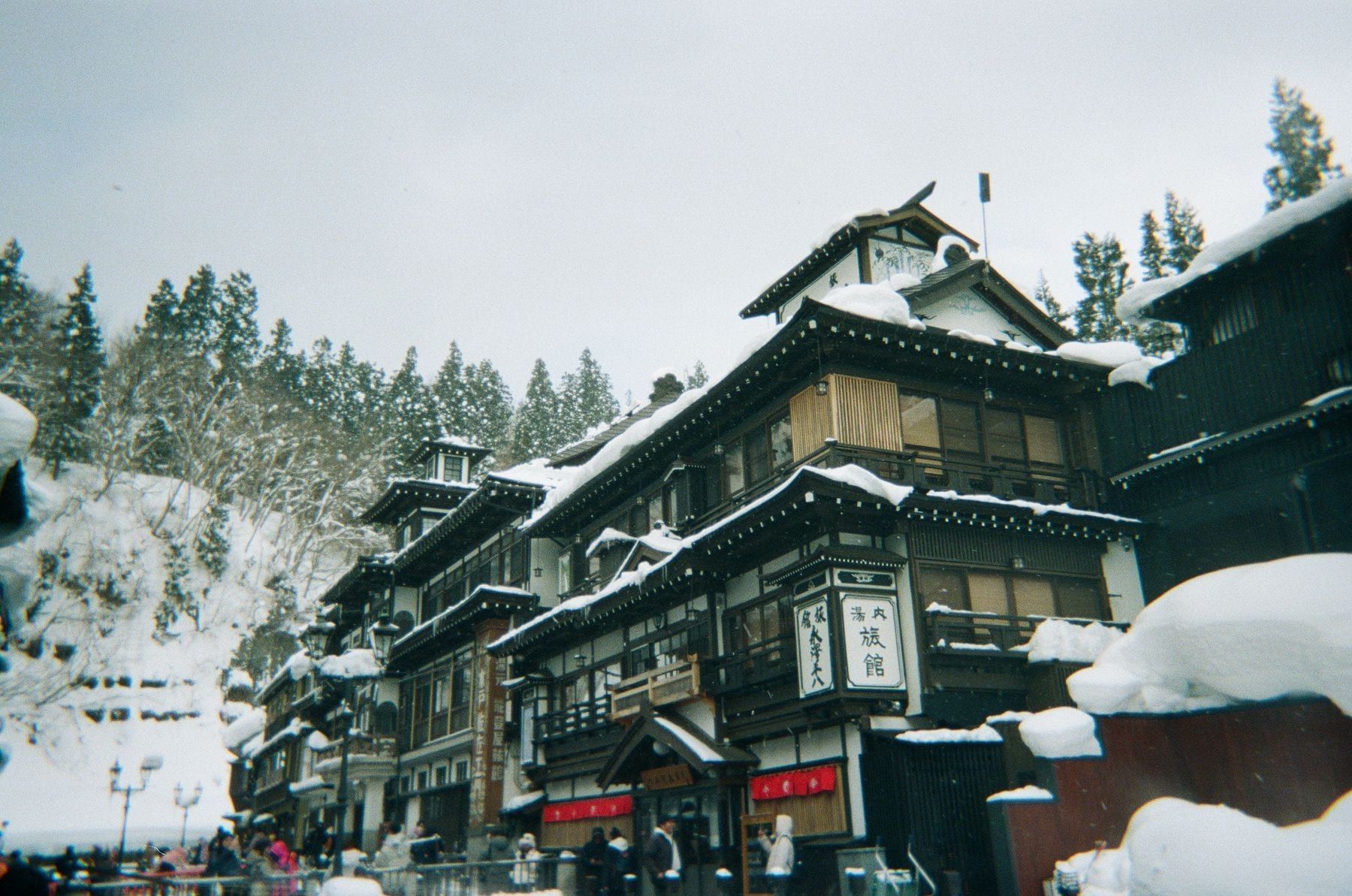
The 1921 building with the little tower that sits in the middle of every Ginzan photo, a registered cultural property. Wooden rooms with river views, a cave bath in the basement, a rooftop rotenburo, kaiseki with Yamagata beef. Booked out up to a year ahead.
Redesigned by Kengo Kuma in 2006: bamboo screens, glass and pale wood behind a historic façade, only eight rooms, five private baths, kaiseki in peace. The most modern and intimate place in the village, and correspondingly hard to get.
At the top end of the village by the Shirogane waterfall, a little away from the promenade and therefore quieter. Open-air bath with a view of the falls, rooms with cedar baths, very good food. The best choice when Notoya and Fujiya are full.
If you book through these links we earn a small commission, at no extra cost to you.
At 4.30 pm the gas lamps come on, the day coaches are gone and the wooden ryokan are reflected in the river. Free, 20 minutes, in a yukata and the ryokan's wooden sandals. In winter, with snow, it is the picture you came for.
Two ropeways take you up to 1,660 metres to the ice-covered firs, from mid January to early March, illuminated in the evening. Return 3,800 yen (CHF 23), closed in wind; check the webcam in the morning and bring warm shoes.
1,015 steps through cedar forest to the Godaido viewing hall above the valley, a temple since 860, celebrated by Basho in 1689. 20 minutes from Yamagata on the Senzan line, admission 300 yen; allow two to three hours.
50 kilometres of slopes on the volcano, powder snow, the run through the snow monsters and the sulphur bath afterwards. Day pass around 6,500 yen (CHF 39), rental CHF 30 to 40. Almost empty on weekdays, December to March.
The round acidic lake at 1,600 metres changes colour between turquoise and green, reachable from late April to early November by ropeway and hike or by bus and toll road. Windy and cold at the top, so bring a jacket even in August.
Yamagata is Japan's cherry prefecture, and in June the orchards open: 30 to 60 minutes of picking and eating as much as you like for CHF 15 to 25. Sato Nishiki is the variety, sweet and firm. 20 minutes by train from Yamagata to Sakuranbo-Higashine.
On the first or second Sunday in September, Yamagata cooks 30,000 portions of imoni in a six-metre pot, with an excavator as the cooking spoon. Free to watch, a portion 300 yen; come early, as the tickets are gone by noon.
Yamagata eats more soba than almost any other prefecture, and the "soba road" in Murayama and Obanazawa (near Ginzan) lines up one farmhouse soba restaurant after another. Ita soba on the board for two CHF 12 to 15, a cooking class CHF 30 to 50.
The castle park of the Mogami lords with its moat and 1,500 cherry trees (mid April), next to it the 1916 prefectural office building in English Renaissance style, free to visit inside. Free, two hours, walkable from the station.
If you book through these links we earn a small commission, at no extra cost to you.
Yamagata cooking is farmhouse food shaped by mountains, rivers and long winters: imoni with taro and beef, soba from the farm's own fields, cherries and grapes, pickled vegetables with every meal and a sake that ranks among the best in Japan. In a ryokan you get it as kaiseki, in town for a few francs in an izakaya.
A stew of taro (satoimo), thin slices of beef, leek and konjac in a soy broth, creamy from the taro, sweet and savoury. An autumn dish, CHF 8 to 12 (about EUR 9 to 13) in an izakaya, 300 yen a portion at the festival.
Tip:In autumn supermarkets lend out pots for free and the riverbanks are full of imoni groups; ask at your hotel about a spot, as some guests get invited along.
Thick, dark buckwheat noodles served cold on a long wooden board for two or three people, with a dip of soy and dashi. Robust and nutty. A board for two CHF 12 to 15 (about EUR 13 to 16).
Tip:At the end, pour the hot cooking water (soba-yu) into the dip and drink it; that is part of the meal.
One of the three great wagyu breeds of Japan, from the south of the prefecture, finely marbled and buttery. As a steak CHF 50 to 90 (about EUR 54 to 96), as sukiyaki from CHF 40, as a lunch set with meatballs CHF 15 to 20.
Tip:The lunch set is the affordable way in; in the evening you pay double for the same meat.
Soy broth with ice cubes, thin noodles, cucumber and chashu, invented in Yamagata in 1952 because the city holds Japan's heat records in summer. Refreshing and unusual, CHF 6 to 9 (about EUR 6 to 10).
Tip:Only from May to September; in winter it is not on the menu.
The queen of Japanese cherries: light red, firm and sweet, ripe in June. At the market CHF 8 to 15 (about EUR 9 to 16) for a punnet, in gift boxes CHF 50 and more. Pick your own for CHF 15 to 25.
Tip:The expensive gift boxes are sorted by size; at the stall you get the "unsorted" ones for half the price, just as good.
Not the broth, but finely chopped cucumber, aubergine, myoga, shiso and okra in soy, served cool on hot rice or tofu. The farmers' summer dish, CHF 3 to 5 (about EUR 3 to 5) as a side.
Tip:Almost always part of a ryokan breakfast; just spoon it over your rice.
Konjac balls simmered for hours in a soy broth, three to a skewer with mustard. Rubbery, almost calorie-free, a cult snack in Yamagata. 100 to 150 yen per skewer.
Tip:Eat it hot with a dab of karashi mustard, otherwise it tastes of very little.
Yamagata was the first prefecture with a protected designation of origin for sake: Juyondai (cult, rare), Dewazakura, Kudoki Jozu, Tatenokawa. In an izakaya from CHF 3 (about EUR 3) a glass, a tasting set in a ryokan CHF 8 to 12.
Tip:Ask for "Yamagata no jizake, karakuchi" (local, dry) and you get the good bottle instead of the well-known one.
Through markets and eateries with a guide, tastings included.
If you book through these links we earn a small commission, at no extra cost to you.
Ginzan means "silver mountain", and that is exactly what the place was: silver was found in the valley around 1456, and in the first half of the 17th century the Nobesawa mine was one of the three largest in Japan, with thousands of workers in a valley that today has 300 inhabitants. When the silver ran out around 1689, the hot springs remained, which the miners had long used for bathing. The village you see today took shape after a flood in 1913, when the Ginzan river burst its banks and destroyed almost every house. The innkeepers rebuilt their ryokan between 1915 and 1930, three and four storeys high in wood, with wooden balconies and kote-e plaster reliefs on the façades, in a style that reflects the Taisho era (1912 to 1926) with its mix of Japanese tradition and Western details. The gas lamps along the riverside promenade came later, and the cars stayed outside: the village is car-free to this day. In the 1980s the NHK series "Oshin", set here, made the place famous across Asia. The capital Yamagata, 50 kilometres to the south, was the seat of the Mogami lords, whose Kajo castle is now a park with cherry trees. The poet Basho climbed up to the mountain temple of Yamadera in 1689, and on the Zao volcano east of the city people have been skiing since the 1920s, on slopes full of ice-encrusted firs that the Japanese call "juhyo", ice trees, and the rest of the world calls "snow monsters".

The Yamagata Shinkansen Tsubasa runs from Tokyo to Oishida in about three hours, with a ticket costing around 13,000 yen (CHF 78, about EUR 83) including a reservation; to Yamagata city it is two and a half hours and 11,500 yen (CHF 69). From Oishida the Hanagasa bus takes you to Ginzan Onsen in 40 minutes for 720 yen (CHF 4.50), timed to meet the trains, and most ryokan will also pick you up from the station for free if you call or email ahead. There is no traffic within the village, which is 300 metres long. For Zao Onsen the bus from Yamagata station takes 40 minutes (1,000 yen), for Yamadera the Senzan line takes 20 minutes (240 yen). Coming from Sendai, you take the same Senzan line (one hour to Yamagata). The JR East Tohoku Area Pass (five days, 30,000 yen) covers the Tsubasa, the Senzan line and the Shinkansen to Sendai, but not the buses. A rental car is tricky in winter: the road to Ginzan is narrow, the car park is above the village, and snow chains are part of the deal.
Ginzan Onsen has around a dozen ryokan, all small, all with half board, CHF 250 to 500 (about EUR 268 to 535) for two per night. Notoya (the photo favourite with the little tower), Fujiya (redesigned by Kengo Kuma, only eight rooms), Ginzanso (larger, 300 metres above the village with a shuttle and the best baths) and Takimikan (by the waterfall, quiet) are the names that work. Book at least three to six months ahead, and for December to February and weekends more like a year; many places open bookings exactly six months in advance and the rooms are gone within hours. One night is enough: you arrive at 3 pm, bathe, eat kaiseki, walk through the empty village at 9 pm, bathe again, have breakfast and move on at 10 am. Spend the remaining nights in a business hotel in Yamagata city (CHF 55 to 110) or in Zao Onsen, where a simple ryokan with half board costs CHF 150 to 250 for two.
The first trap: coming without staying the night. During the day Ginzan Onsen is full of coaches, the public bath Shirogane-yu costs 500 yen and is tiny, and the scene with lanterns and snow only appears after 5 pm, when the coaches have gone. Since 2025, day visits in winter between 5 pm and 8 pm are only possible with a reservation and shuttle, and overnight guests have priority. Second trap: the cheapest ryokan rooms have no private bath and face the back; if you want to see the river you pay CHF 50 to 100 (about EUR 54 to 107) more, and here that is money well spent. Third trap: in Zao Onsen the ropeway to the snow monsters costs 3,800 yen (CHF 23) return, the evening illumination costs extra again, and in wind it does not run. Check the webcam in the morning. Fourth: the ryokan price is per person, not per room; solo travellers often pay a 30 percent supplement or cannot get a room at all.
The classic Ginzan image is winter: from late December to late February there is reliably a metre of snow, the river steams and the gas lamps come on at 4.30 pm. In return, everything is booked out and more expensive. The snow monsters in Zao are at their best from mid January to early March, with evening illumination until the end of February. If you want peace and quiet, come in May or June: a green valley, a full waterfall, ryokan half empty and 20 percent cheaper, and June is cherry season. Yamagata produces three quarters of all Japanese cherries (the Sato Nishiki variety), and in the orchards around Higashine and Sagae you can pick as many as you like for half an hour for CHF 15 to 25 (about EUR 16 to 27). From mid to late October the valley turns red. In September all of Yamagata cooks imoni, on the first or second Sunday in a giant pot on the Mamigasaki riverbank (free to watch, a portion 300 yen). Avoid Golden Week and Obon, when even the business hotels in Yamagata are full.
Zao Onsen is known as a ski resort with snow monsters. Yet the village at 880 metres is one of the best onsen in Tohoku all year round: the water is strongly sulphurous, milky and, with a pH of 1.5, so acidic that it blackens coins and leaves your skin as soft as after a peel. The big open-air bath Zao Onsen Dai-Rotenburo (700 yen, late April to early November) lies beside a stream in the forest and holds 200 people; in the morning you will have it almost to yourself. The three public communal baths in the village (Kami-yu, Shimo-yu, Kawarayu) cost 200 yen each, simple wooden tubs without showers, just right for an onsen stroll. In summer the ropeway runs to the summit and the Okama crater lake, whose colour shifts between turquoise and green (ropeway 3,800 yen or bus to the Okama road). Skiing in winter: a day pass costs around 6,500 yen (CHF 39, about EUR 42), 50 kilometres of slopes, lots of powder, slightly old-fashioned lifts, cheap by Swiss standards and empty on weekdays.
From Yamagata city you are in Yamadera in 20 minutes on the Senzan line (240 yen). The Risshaku-ji temple was founded in 860, and 1,015 steps lead through cedars and past rock niches to the Godaido hall with its view into the valley; allow an hour up with breaks, admission 300 yen. In winter the path is gritted but icy, so poles help. Down in the village you eat soba: the region is known for "ita soba", buckwheat noodles on a wooden board for two (CHF 12 to 15, about EUR 13 to 16), or Yamagata's cold "hiyashi ramen" in summer. Back in Yamagata city, go to an izakaya in the evening and order imoni: a stew of taro, beef, leek and konjac in a soy broth, the autumn dish of the region, CHF 8 to 12. Pair it with Yamagata sake (Juyondai is the most famous and hard to get, Dewazakura and Kudoki Jozu are good and affordable). The Nanokamachi district between the station and the castle park has the most restaurants.
For December to February and for weekends at least six months, better a year; many ryokan open bookings six months in advance and are full the same day. For May, June and September two to three months is often enough. Check Booking.com, the property's own website and Japanese portals (Jalan, Rakuten Travel), as the allocations differ. As a plan B there are ryokan in Oishida and Obanazawa, 15 minutes away.
Yes. The village is 300 metres long and you can see it in an hour. The appeal lies in the evening after 5 pm and the morning before 10 am, when there are no day visitors, and in the ryokan itself: bath, kaiseki, yukata, snow outside the window. Two nights are only worth it if you really want to switch off or are risking a winter storm. You are better off spending the rest of your time in Zao or Yamagata.
With dinner and breakfast, CHF 250 to 350 (about EUR 268 to 375) for two in a simple room without a river view, CHF 400 to 600 with a river view or for the best rooms at Fujiya and Notoya. On top comes the bathing tax of 150 yen per person. Compared with the price of two kaiseki dinners in a restaurant (CHF 120 to 160), that puts it into perspective. Drinks with dinner are extra, a sake set from CHF 8.
Technically yes, two hours from Yamagata or Sendai, but from Tokyo, at just under four hours each way, it is a very long day. You then see the village by day with tour groups, bathe in the small public bath Shirogane-yu (500 yen) or use the free footbath by the river. In winter, evening visits for day visitors have been regulated since 2025 (reservation, shuttle from the car park). If you want the lantern scene, stay the night.
As a ski area alone, no: 50 kilometres of slopes, several short lifts, few steep runs. As a combination, yes: a day pass costs CHF 39 (about EUR 42), there is powder almost every day, the run through the snow monsters on the Zangen slope is unique, and after skiing you soak in the sulphur bath. Two ski days with an onsen evening is the right amount, then move on. Renting equipment costs CHF 30 to 40 per day, and sizes above 44 are scarce.
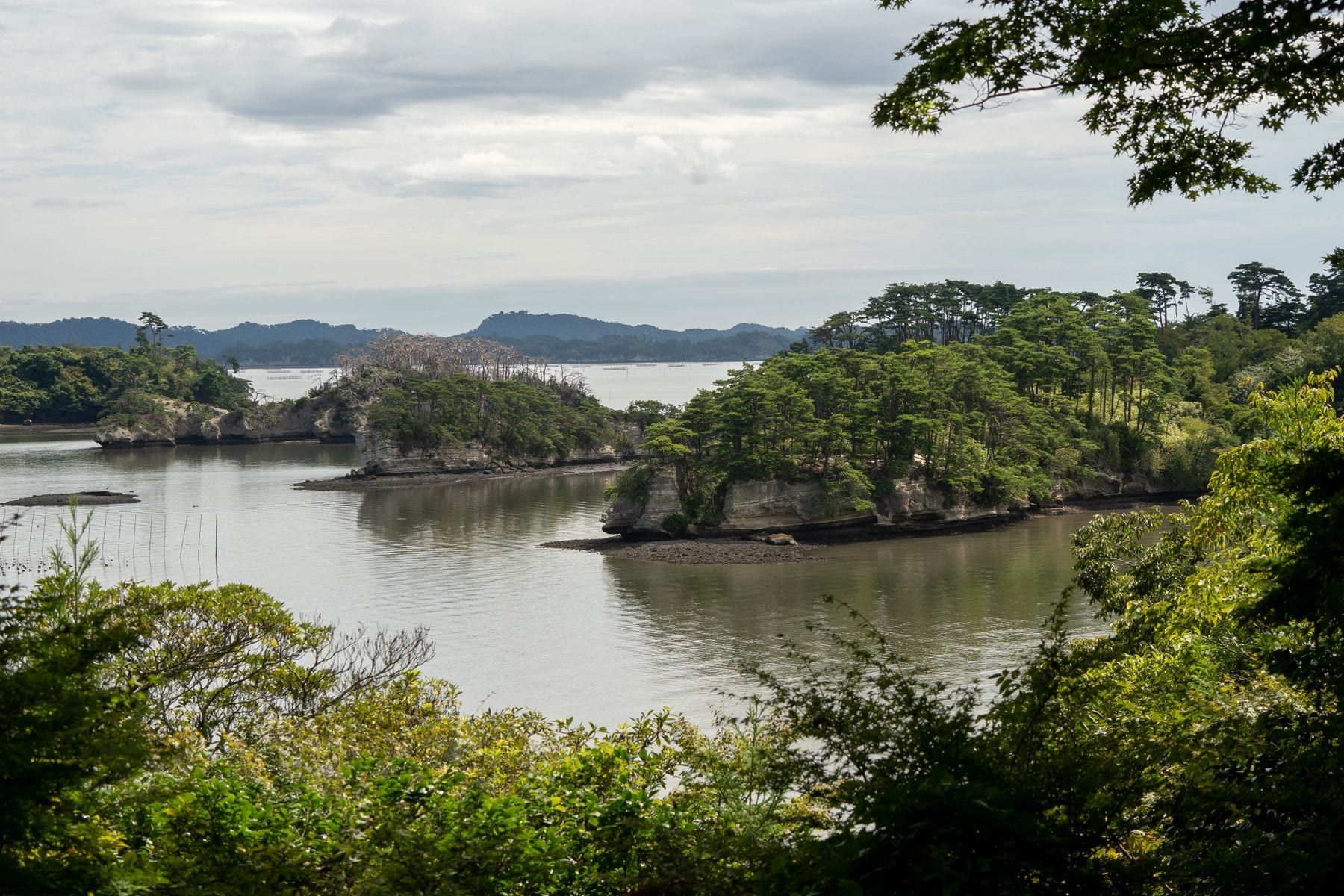
The easiest way is a loop from Tokyo: Shinkansen to Yamagata (two and a half hours), Zao, Yamadera, one night in Ginzan Onsen, then the Senzan line to Sendai (one hour) and Matsushima, and back to Tokyo in 90 minutes. Five to six days, all on the JR East Tohoku Area Pass (CHF 180, about EUR 193). If you want to go further north, travel from Sendai to Aomori or Hakodate.
What a few days in the big city of the north really cost, why you eat beef tongue here and how to see the 260 islands of Matsushima without a tour group.
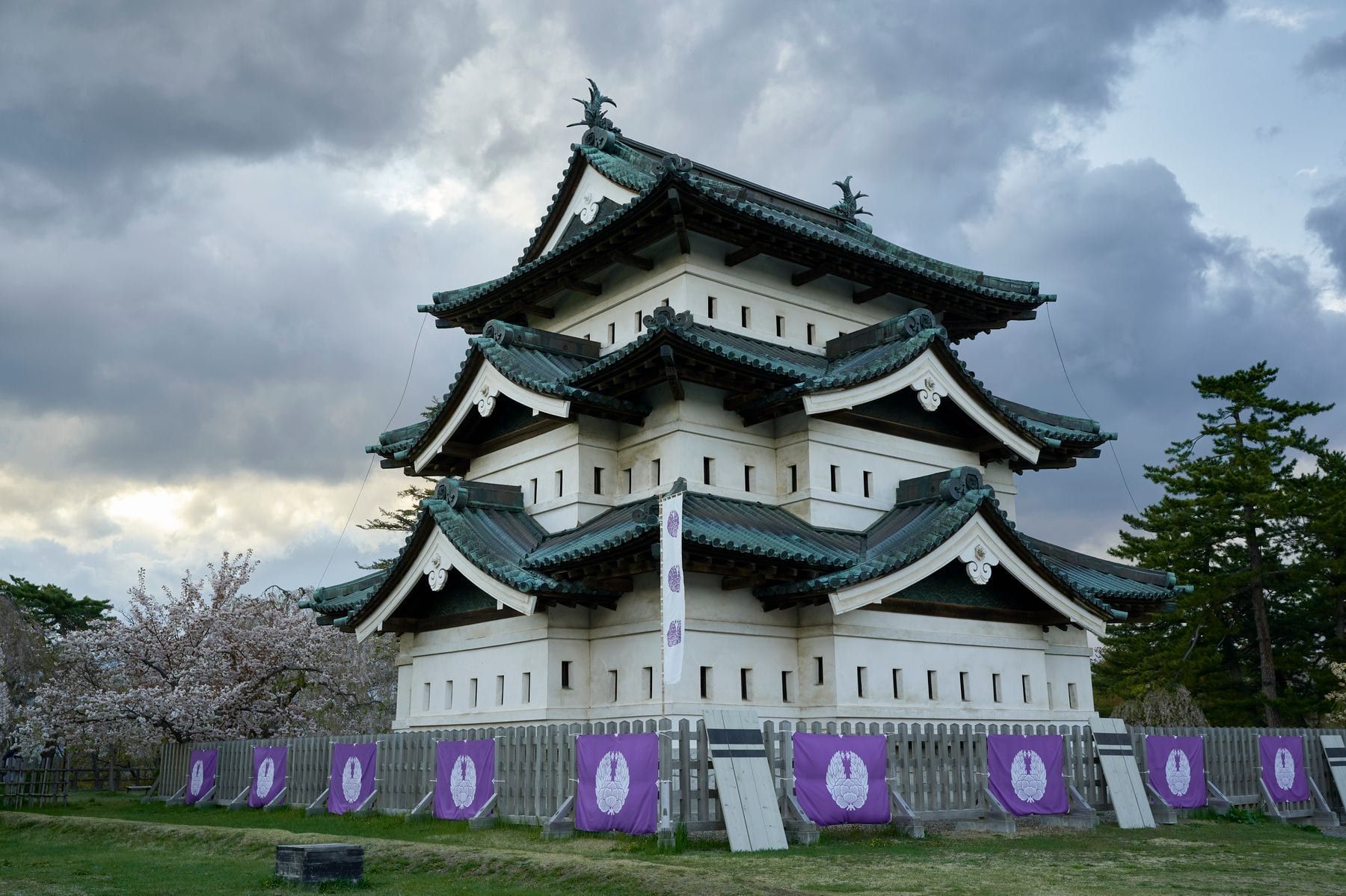
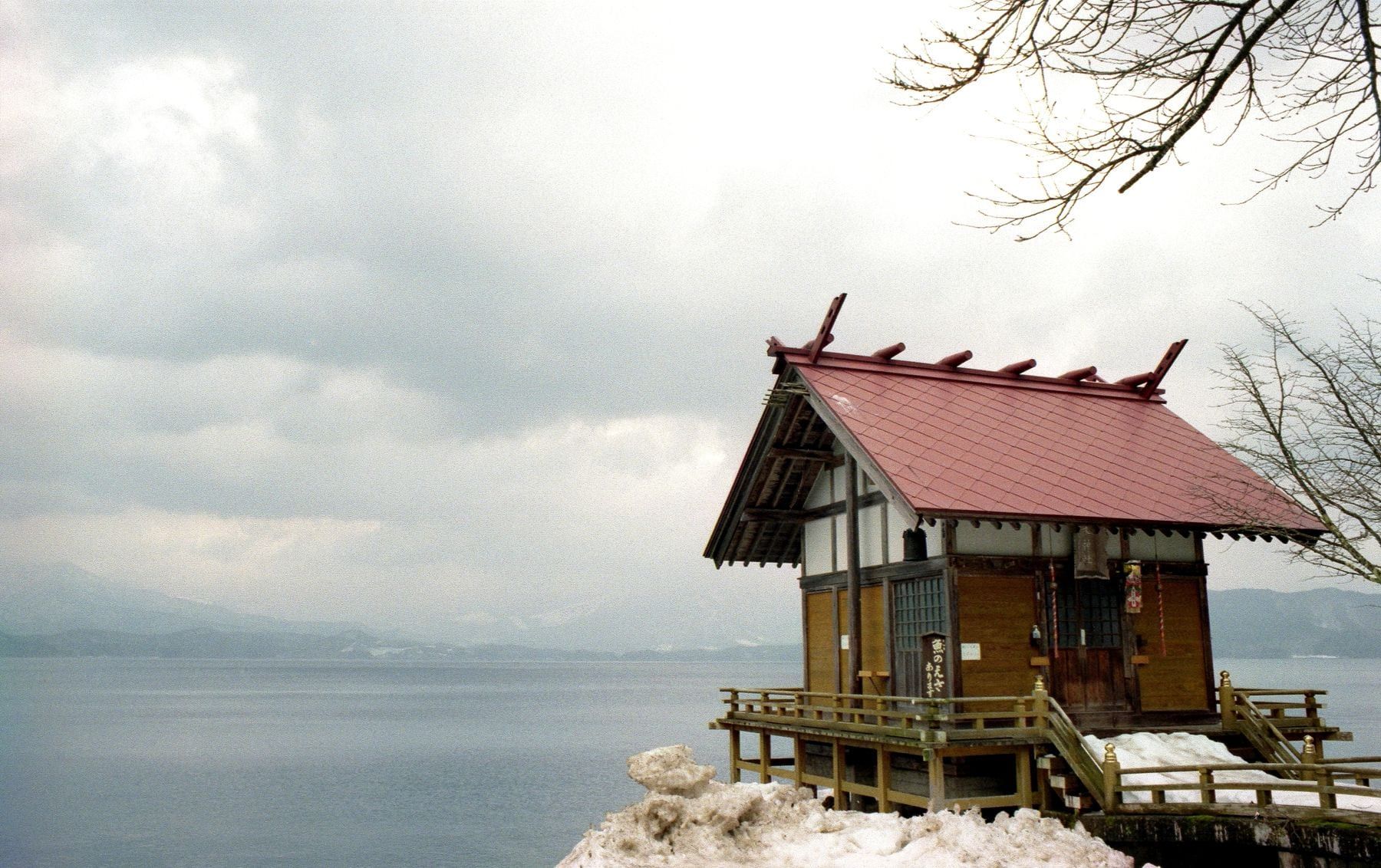
What the northernmost city on Honshu really costs, why the Nebuta festival in early August is worth the trip and how to combine Hirosaki, Oirase and Lake Towada in four days.
What a night in Akita's milky-white forest baths really costs, how to get there on the Akita Shinkansen and why Kakunodate in late April is the better cherry blossom.