Nyuto Onsen & Kakunodate

Japan · Tohoku · Travel guide

Nyuto Onsen & Kakunodate

What a night in Akita's milky-white forest baths really costs, how to get there on the Akita Shinkansen and why Kakunodate in late April is the better cherry blossom.

Photo: Alan Wang / Pexels

What does a trip to Nyuto Onsen & Kakunodate cost?

Adjust the values to your trip: the calculator updates live (EUR, converted from CHF estimates).

4,093 EUR
≈ 2,046 EUR per person
  • Flights 2,354 EUR
  • Accommodation 856 EUR
  • Food 375 EUR
  • Local transport 80 EUR
  • Akita Shinkansen from Tokyo (return) 428 EUR

Estimates for orientation, not booking prices. Flights and hotels vary strongly by season: current prices are behind the links below.

Money & payment: You pay in yen (JPY). 1,000 yen is roughly CHF 6 or EUR 6.50. Cards work in cities and hotels; small restaurants, temples and rural stations often want cash. An IC card (Suica or ICOCA) on your phone pays for trains, buses and convenience stores. Flight time: 12 to 14 hours, usually with one stop.

Recommended hotels

Nine options in three price ranges, each among the best-rated on Booking.com.

Budget

Dormy Inn Akita

Nakadori, Akita

Five minutes from Akita station, with an onsen bath and sauna on the top floor, free ramen in the evening and a breakfast with local fish. The best budget address for the night before or after Nyuto.

from CHF 60 / night (about EUR 64) View →

Richmond Hotel Akita Ekimae

Station, Akita

Right at Akita station, rooms of around 18 square metres, good beds, a breakfast buffet with kiritanpo soup. Often under CHF 65 on weekdays.

from CHF 60 / night (about EUR 64) View →

Toyoko Inn Akita-eki Higashi-guchi

Station east exit, Akita

The chain's standard business hotel at the east exit, with a simple breakfast, quiet and cheap. Perfectly fine for a night passing through, and nobody expects more here.

from CHF 50 / night (about EUR 54) View →

Mid-range

Ganiba Onsen

Nyuto Onsen, Semboku

A rustic ryokan by the stream with an open-air bath in the forest that you reach along a 50-metre path (in winter with snow up to your knees). Simple tatami rooms, good farmhouse food, clear water. Easier to book than Tsurunoyu and, for many, the more authentic house.

from CHF 170 / night (about EUR 182) View →

Hotel Folkloro Kakunodate

Station, Kakunodate

The JR hotel right next to Kakunodate station: plain Western-style rooms, breakfast, 15 minutes' walk to the samurai street. The practical base if you want to see Kakunodate empty early in the morning during cherry blossom.

from CHF 90 / night (about EUR 96) View →

Tamachi Bukeyashiki Hotel

Tamachi, Kakunodate

A small hotel in the style of the samurai residences, with a black wooden fence, tatami rooms and Western beds, on the edge of the samurai district. Quiet and personal, with a local dinner on request. The place where Kakunodate actually looks like Kakunodate.

from CHF 130 / night (about EUR 139) View →

Luxury

Taenoyu

Nyuto Onsen, Semboku

The most comfortable of the seven houses: rooms with beds and river views, two springs (brown iron-rich and clear), an open-air bath facing a waterfall, refined kaiseki. For anyone who wants the forest onsen without the rustic thatched-roof experience.

from CHF 320 / night (about EUR 342) View →

Hotel Mori no Kaze Tazawako

Tazawako Kogen, Semboku

A large onsen hotel on the plateau between Lake Tazawa and Nyuto, with open-air baths in the forest, spacious rooms and a buffet or kaiseki in the evening. More comfortable than the farmhouse baths further up; you visit Kuroyu and Tsurunoyu from here as day baths.

from CHF 200 / night (about EUR 214) View →

Kyukamura Nyuto-Onsenkyo

Nyuto Onsen, Semboku

The state-run holiday ryokan in the beech forest, four minutes' walk from the Nyuto springs: a timber building, its own indoor and outdoor pools, mountain cooking with wild vegetables, tatami and family rooms. Unlike Tsurunoyu, which can only be booked directly by phone or email, here you get a room without calling, and with the Yumeguri pass you still bathe at all seven houses.

from CHF 150 / night (about EUR 161) View →

If you book through these links we earn a small commission, at no extra cost to you.

Experiences worth your time

Yumeguri: a bathing tour of the seven houses

With the Yumeguri pass (2,500 yen, overnight guests only) you bathe at all seven Nyuto houses and take the shuttle between them. Tsurunoyu 10 am to 3 pm, Kuroyu only in the summer half of the year; bring a towel and cash.

View & book →

Kakunodate samurai street

Six preserved residences behind black wooden fences, Aoyagi and Ishiguro with admission (500 yen each), the rest free. Two to three hours on foot, under weeping cherries in late April, among red maples in October. Almost empty early in the morning.

View & book →

Cherry blossom on the Hinokinai river (late April)

Two kilometres of cherry tree tunnel along the river plus weeping cherries on the samurai street, usually from 25 April to 5 May, illuminated in the evening. Free, but it is Golden Week; book hotels in Kakunodate and Tazawako in winter.

View & book →

Lake Tazawa by bike

Japan's deepest lake, 20 kilometres of lakeshore road, bike rental at Tazawako station (CHF 8 to 12 for three hours), stops at the Tatsuko statue and the Gozanoishi shrine. Boats from late April to early November, 1,400 yen.

View & book →

Kabazaiku workshop in Kakunodate

Boxes and tea caddies made of cherry bark, a samurai craft since the 18th century. At the Denshokan museum (300 yen) a craftsman demonstrates the technique, and the shops sell boxes from CHF 15. Hands-on workshops CHF 20 to 40.

View & book →

Tamagawa Onsen spa

The most acidic and most abundant spring in Japan, with a stone field where spa guests lie in blankets. Day bath 800 yen, 40 minutes by bus from Tazawako, only April to November. Not a spa in the wellness sense, but a health resort with its own logic.

View & book →

Kanto Matsuri in Akita (3 to 6 August)

Twelve-metre bamboo poles with 46 lanterns, balanced on foreheads, shoulders and hips, more than 200 of them at once on Chuo-dori. Free from the roadside, grandstand CHF 15 to 25; book hotels in Akita early.

View & book →

Namahage museum on the Oga peninsula

The demon masks of the Oga peninsula, which frighten lazy children on New Year's Eve, in a museum with a performance in a farmhouse (1,100 yen combined). One hour from Akita by train and bus or rental car; best combined with the coast and the sunset.

View & book →

Make your own kiritanpo

Shape pounded rice around cedar sticks, toast it over charcoal and add it to a chicken hotpot: in Kakunodate and Akita, restaurants and farms offer workshops for CHF 15 to 30 including the meal. Come hungry, it is more than a snack.

View & book →

If you book through these links we earn a small commission, at no extra cost to you.

Food & drink

Akita is rice country with long winters, and you can taste it: toasted rice in hotpot, smooth udon, smoked pickled vegetables, fermented fish and a sake brewed from Akitakomachi rice. At the ryokan it all comes as a mountain menu from the hearth fire, and in Kakunodate and Akita city in down-to-earth restaurants at low prices.

Kiritanpo nabe

Restaurants in Kakunodate (Sotomachi) and the Kawabata nightlife district in Akita city; part of dinner at the Nyuto ryokan

Pounded rice wrapped around cedar sticks and toasted, then cut into pieces and added to a hotpot of Hinai chicken, burdock root, mushrooms and leek. Smoky and filling, the national dish of Akita. CHF 12 to 18 (about EUR 13 to 19).

Tip:The season is October to March after the rice harvest; in summer kiritanpo is often frozen.

Inaniwa udon

Sato Yosuke in Akita city (a maker since 1860 with its own restaurant) and udon restaurants in Kakunodate

Thin, smooth, hand-stretched udon from Inaniwa, one of the three great udon styles of Japan, cold with a dip or hot in a clear broth. Silky and springy. CHF 8 to 12 (about EUR 9 to 13).

Tip:Order it cold ("zaru") so you can taste the noodle; hot, it is almost too soft.

Hinai jidori

Yakitori restaurants in the Kawabata district of Akita city or as oyakodon in Akita station

Free-range chicken from northern Akita, one of the three famous chickens of Japan, firm to the bite and full of flavour. As oyakodon (chicken and egg on rice) CHF 10 to 15 (about EUR 11 to 16), grilled on a skewer CHF 3 to 4.

Tip:Oyakodon with Hinai jidori is the cheapest lunch in which you can taste the difference.

Iburigakko

Every izakaya in Akita, souvenir shops in Kakunodate, at breakfast in the ryokan

Radish smoked over the hearth fire and then pickled in rice bran: crunchy, smoky, salty. The snack to go with sake, CHF 2 to 4 (about EUR 2 to 4) as a side, from CHF 5 as a souvenir.

Tip:With cream cheese on a cracker, which is how modern bars in Akita serve it, and it works.

Hatahata

Fish restaurants at Akita harbour and at the Akita Shimin Ichiba market near the station

Sandfish from the Sea of Japan, grilled in winter, fermented as sushi or in shottsuru nabe, a hotpot with fish sauce. Small and oily, with roe that pops between your teeth. CHF 6 to 12 (about EUR 6 to 13).

Tip:The main season is December, when there is hatahata with "buriko" (roe), the sought-after version.

Yamanoimo nabe and mountain stew at the ryokan

Tsurunoyu (yamanoimo nabe by the hearth fire) and the other Nyuto houses

In the evening, Nyuto ryokan put a stew of mountain herbs (sansai), mushrooms, tofu and grated mountain yam on the fire, with grilled iwana char on a skewer. Included in half board, CHF 10 to 15 (about EUR 11 to 16) in a restaurant.

Tip:You eat the char head, bones and all, as it is grilled until crisp; if you do not fancy it, leave the head.

Babahera ice cream

Roadside stalls with parasols on country roads and at Lake Tazawa, June to September

Pink and yellow sorbet (strawberry and banana) that older women ("baba") shape into a rose with a spatula ("hera"). Sold at the roadside in summer, 300 yen, more cult than flavour.

Tip:Cash only, summer only, and ask for the rose shape, otherwise you get a scoop.

Sake from Akita

Sake bars in the Kawabata district, the shop in Akita station, the Akita Shurui Seizoh brewery (Takashimizu) with tours

After Niigata and Kyoto, Akita is the third-largest sake prefecture: Aramasa (cult, rare), Hiraizumi, Yuki no Bosha, Takashimizu. In an izakaya CHF 3 to 6 (about EUR 3 to 6) a glass, a tasting set in a ryokan CHF 8 to 12.

Tip:Aramasa No. 6 is open in hardly any bar; if you see it, order it by the glass and do not ask what the bottle costs.

Book a food tour: Nyuto Onsen & Kakunodate

Through markets and eateries with a guide, tastings included.

View & book →

If you book through these links we earn a small commission, at no extra cost to you.

History & background

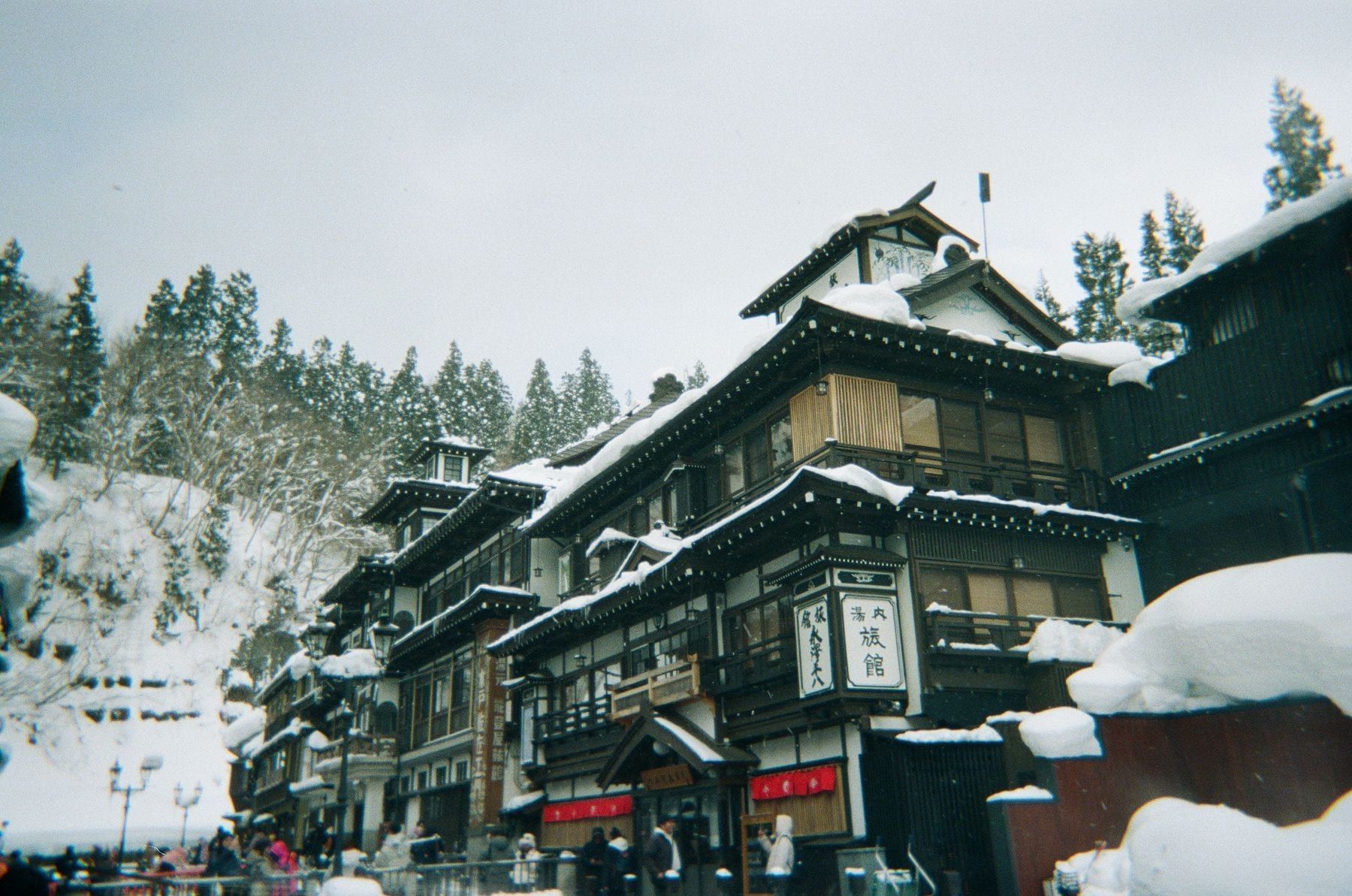
Nyuto Onsen is not a village but seven scattered bathhouses at the foot of Mount Nyuto ("nipple", because of its shape) in the beech forests of Towada-Hachimantai National Park. The oldest, Tsurunoyu, was first recorded in 1638, when the second lord of Akita, Satake Yoshitaka, came here to take the waters; legend has it that a hunter discovered the spring because a wounded crane (tsuru) was bathing its wounds in the water. The thatched longhouses of Tsurunoyu, where farmers used to move in for weeks with their own rice supplies, still stand today, with a hearth fire and no electricity in the oldest rooms. Kuroyu was founded in 1674, Taenoyu and Ganiba followed as farmers' baths, and until the 1970s the area was hard to reach. The water of all seven is different: milky white with sulphur at Tsurunoyu, brown and iron-rich at Taenoyu, clear at Ganiba, and the white colour only appears when the sulphur particles flocculate in the air. 30 kilometres to the south lies Kakunodate, founded as a castle town by Ashina Yoshikatsu in 1620 and later governed by the northern Satake branch. The Bukeyashiki samurai street, with its black wooden fences, gates and weeping cherry trees that a lord brought from Kyoto as a dowry in 1664, has been protected since 1976. In between lies Lake Tazawa, at 423 metres the deepest in Japan, which never freezes in winter and whose waters still inspire stories through the legend of Princess Tatsuko.

Insider tips

Getting there: Akita Shinkansen to Tazawako, then the bus into the forest

The Akita Shinkansen Komachi runs from Tokyo to Tazawako in about three hours, around 16,800 yen (CHF 100, about EUR 107) each way with a reservation; Kakunodate is 15 minutes further, Akita city four hours (18,000 yen). The Komachi is fully reserved, so book your seat in advance, especially at weekends. From Tazawako station the Ugo Kotsu bus runs towards Nyuto Onsen, 50 minutes to the last stop, 840 yen (CHF 5), roughly every hour until 6 pm; the ryokan will tell you which stop to use, and Tsurunoyu picks you up at the Alpa Komakusa turn-off. Between Tazawako and Kakunodate there is the train (15 minutes, 330 yen) or, around the lake, the bus. The JR East Tohoku Area Pass (five days, 30,000 yen) covers the Komachi but not the buses. A rental car from Tazawako (CHF 60 to 80 per day) pays off in summer for the lake, Kakunodate and a second onsen in a day; in winter there is a lot of snow, and while the road is cleared, you should have experience driving in snow.

Where to stay: which of the seven baths, and which you can actually book

The seven houses differ a lot. Tsurunoyu is the famous one with the thatched roofs and the big mixed open-air milky bath, CHF 160 to 250 (about EUR 171 to 268) for two with half board, but it can only be booked by phone or email, in Japanese or simple English, months in advance. Kuroyu is similarly rustic, thatched roof, wooden tubs, only open from mid April to mid November, CHF 180 to 260. Taenoyu is the most comfortable: rooms with Western beds, a bath overlooking a waterfall, good food, CHF 300 to 450. Ganiba sits by the stream, with an open-air bath in the forest that you reach along a short path, CHF 170 to 250. Ogama, Magoroku and Kyukamura Nyuto Onsenkyo (a large, simple holiday hotel, CHF 150 to 200, easy to book) round things off. All prices are per room for two including two meals. Our suggestion: one night at Tsurunoyu or Kuroyu for the experience, one night at Taenoyu or Ganiba for comfort, then a hotel in Kakunodate or Akita city for CHF 55 to 110.

Cost traps: the Yumeguri pass, day bathing hours and Komachi tickets

If you stay overnight in one of the seven houses, buy the Yumeguri pass for 2,500 yen (CHF 15, about EUR 16): with it you bathe at all the other six for free and ride the Yumeguri shuttle between the houses. Without the pass you pay 600 to 800 yen per day bath and walk or take a taxi. Trap number two: day bathing hours. Tsurunoyu is only open to day visitors from 10 am to 3 pm, the open-air bath is closed on Mondays, and Kuroyu is shut completely in winter. If you turn up at 4 pm, you are out of luck. Trap number three: the Komachi. Without a reserved seat you will not get on, and on Friday evenings and Sundays the trains are full; book online through JR East (Eki-net) up to three weeks ahead for a discount. Trap four: there is no konbini at the ryokan. Get drinks, snacks and cash (some of the old houses do not take cards) at Tazawako station. And: the mixed baths really are mixed; women have their own pools and their own times, and asking at check-in is perfectly normal.

Timing: cherry blossom in late April, autumn in October, snow until March

Kakunodate has two cherry blossoms: the weeping cherries above the samurai fences and a two-kilometre tunnel of Somei Yoshino along the Hinokinai river, both around 25 April to 5 May. That falls in Golden Week, when rooms are scarce and more expensive; weekdays in late April are fine. Nyuto Onsen is at its quietest and most beautiful in May with fresh beech leaves and in October with autumn colours, when Taenoyu and Ganiba have half-empty pools. Winter from December to March is the classic picture: two metres of snow, steam, the white water; on the other hand the bus runs less often, and Kuroyu and Ogama are closed. Lake Tazawa is for swimming and cycling in summer (bike rental at the station, 20 kilometres around the lake), but in winter it turns grey. The Kakunodate fire festival Hiburi Kamakura on 13 and 14 February, where burning straw bales are swung on ropes, is a good reason for winter. Avoid Obon in mid August: hot, busy, expensive.

Underrated: Lake Tazawa and Tamagawa Onsen

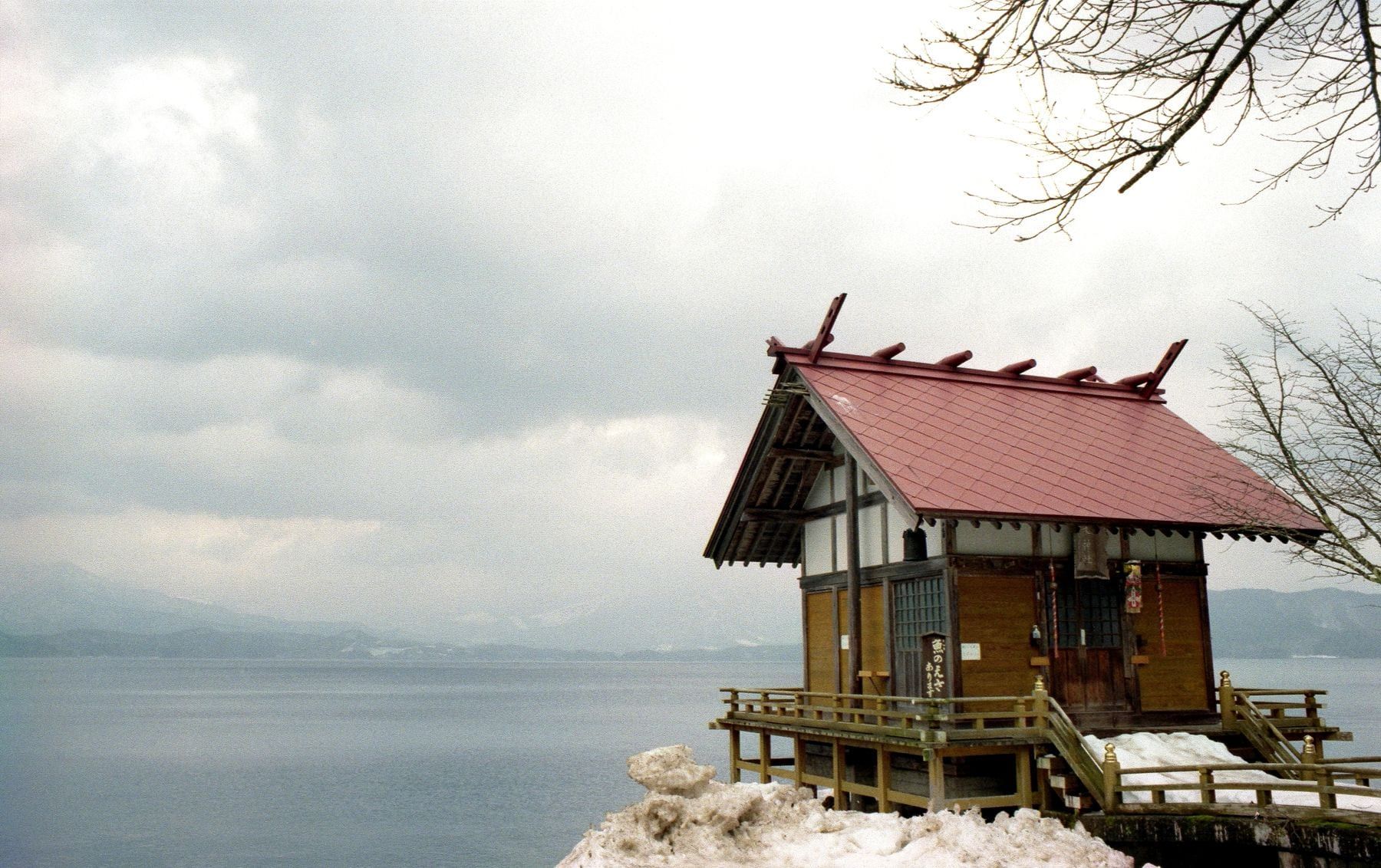
Between the train and the forest lies Lake Tazawa, which most people only see from the bus window. At 423 metres it is the deepest lake in Japan, perfectly round and sapphire blue, and on the west shore stands the golden statue of Tatsuko, who according to legend was turned into a dragon because of her vanity. A bike from the station (CHF 8 to 12 for three hours, about EUR 9 to 13) gets you round the shore in two hours, with a swimming spot at Shirahama and the Gozanoishi shrine with its red gate by the water. Sightseeing boats run from late April to early November (40 minutes, 1,400 yen). Even less known is Tamagawa Onsen, 40 minutes north by bus: the most acidic spring in Japan (pH 1.2), the most abundant at 9,000 litres per minute, and a stone field where Japanese visitors lie wrapped in blankets on the warm, slightly radioactive ground (ganbanyoku) as a cure for all sorts of ailments. Day bath 800 yen, reachable by bus only from April to November. Not a wellness spot but a spa resort with patients, yet a unique glimpse into Japanese bathing culture.

Day trip: Kakunodate, the samurai street on foot

Kakunodate is 20 minutes from the station and can be explored on foot in half a day. Uchimachi street, with six preserved samurai residences, is wide, lined with black wooden fences and weeping cherries, and has hardly any traffic. The Aoyagi house (500 yen) is the largest, with an armoury, a museum and a garden; the Ishiguro house (500 yen) is the oldest and still lived in by the family, who show you round. Iwahashi, Matsumoto and Kawarada are free. Allow two to three hours with breaks. Then walk along the Hinokinai river promenade and into the merchant quarter of Sotomachi, where you can buy kabazaiku: boxes, tea caddies and bowls covered in mountain cherry bark, a craft of impoverished samurai from the 18th century, from CHF 15 (about EUR 16) for a small box, with demonstrations at the Denshokan museum (300 yen). For lunch there is Inaniwa udon (thin, smooth noodles from Akita, CHF 8 to 12) or kiritanpo in autumn. During cherry blossom everything takes twice as long, but the promenade becomes a pink tunnel.

Frequently asked questions about Nyuto Onsen & Kakunodate

How many nights should I stay in Nyuto Onsen?

Two nights is ideal, preferably in two different houses: one rustic (Tsurunoyu or Kuroyu) and one comfortable (Taenoyu or Ganiba). With the Yumeguri pass you bathe at the other five on the day in between. One night works too, but then you will only arrive, bathe, eat, sleep and leave again. With Kakunodate and Lake Tazawa, count on three to four days in total.

How do I book Tsurunoyu Onsen?

Tsurunoyu is not on the big platforms. You book by phone (Japanese; simple English sometimes works) or through the form on its own website, and a reply by email takes a few days. Book three to six months in advance, earlier for winter weekends. Alternatively, take a room at another Nyuto house and bathe at Tsurunoyu during the day with the Yumeguri pass, between 10 am and 3 pm, not on Mondays.

Are the baths really mixed, and how does it work?

Tsurunoyu, Kuroyu and Ganiba each have a large mixed open-air bath (konyoku) plus separate pools. The water is so milky that you cannot see anything below the surface; women can walk to the edge wrapped in a bath towel and remove it there. Many houses also have women-only times in the evening. Nobody stares, nobody talks much, and if you only use the separate pools you miss little except the view.

What does a stay in Nyuto Onsen cost in total?

For two people, count on CHF 400 (about EUR 428) for the Komachi return from Tokyo (CHF 200 per person), two nights in a ryokan with half board (CHF 400 to 700), the Yumeguri pass (CHF 30), buses (CHF 30), and lunch and admissions in Kakunodate (CHF 60). Four days from Tokyo thus cost CHF 920 to 1,220 for two, around CHF 115 to 150 per person per day, for an experience that would cost several times as much in Switzerland.

Is Akita city worth it?

As an overnight stop yes, as a destination only to a degree. The city has good business hotels by the station (Dormy Inn, Richmond, Toyoko Inn, CHF 55 to 90, about EUR 59 to 96), the Kanto lantern festival from 3 to 6 August with twelve-metre bamboo poles full of lanterns, the Namahage museum on the Oga peninsula (one hour) and good food (kiritanpo, Inaniwa udon, hatahata fish, sake). If you are heading from Nyuto to Niigata or on to Hokkaido, you will pass through anyway.

Which season is best for Nyuto Onsen?

In winter (January, February) the scene is at its most powerful: snow on the thatched roofs, steam over the white water, minus ten degrees outside and 42 degrees in the pool. In return everything runs less often and Kuroyu is closed. May with fresh green and October with autumn leaves are quieter and cheaper, with all seven houses open. June to September is warm and green, with mosquitoes in the evening. There is no wrong time.

Itineraries with this destination

Activities in the region

More destinations in Tohoku