Cologne

Germany · Rhineland & Moselle · Travel guide

Cologne

What a weekend in the cathedral city really costs, why you should visit the cathedral at 6 in the morning, how not to stand out as a tourist in a brewhouse, and what Carnival is really about.

Photo: Pham Ngoc Anh / Pexels

What does a trip to Cologne cost?

Adjust the values to your trip: the calculator updates live (EUR, converted from CHF estimates).

1,541 EUR
≈ 770 EUR per person
  • Getting there 278 EUR
  • Accommodation 642 EUR
  • Food 482 EUR
  • Local transport 54 EUR
  • Museum evening with cathedral tower and brewhouse 86 EUR

Estimates for orientation, not booking prices. Getting there means train or car from Switzerland, return, per person. Hotels vary strongly by season: current prices are behind the links below.

Money & payment: You pay in euros (EUR). Germany is fonder of cash than Switzerland: bakeries, kiosks and small restaurants often say "cash only", though cards work almost everywhere from about EUR 10. Tip 5 to 10 percent by rounding up and naming the total when you pay. Getting there: By train (DB), car or plane, 1 to 8 hours depending on the destination.

Recommended hotels

Nine options in three price ranges, each among the best-rated on Booking.com.

Budget

a&o Köln Neumarkt

Neumarkt, Cologne

Large hostel-hotel from the a&o chain right on Neumarkt, double rooms and dorms, bar and breakfast buffet at extra cost. Not cosy, but clean, central and cheap. For solo travellers and groups.

from CHF 50 / night (about EUR 54) View →

Motel One Köln-Waidmarkt

Altstadt-Süd, Cologne

Motel One with the usual standard: good bed, small room, design lobby with bar. Sits between the old town and the Südstadt, ten minutes on foot to the cathedral, Severinstrasse around the corner. The best value for money in Cologne.

from CHF 85 / night (about EUR 91) View →

MEININGER Hotel Köln West

Ehrenfeld, Cologne

Hostel-hotel mix from the Meininger chain at Köln West station, with Ehrenfeld starting right outside the door. Double rooms with private bathroom, shared kitchen, games room. For anyone who wants to go out in Ehrenfeld in the evening and be at the cathedral in ten minutes by day.

from CHF 60 / night (about EUR 64) View →

Mid-range

Ruby Ella Hotel Cologne

Friesenviertel, Cologne

Ruby house in the Friesenviertel with a lean concept: lovely rooms, bar instead of reception, roof terrace. The Belgian Quarter and the brewhouses on Friesenstrasse are within walking distance. For couples who like design and do not need a breakfast buffet.

from CHF 110 / night (about EUR 118) View →

25hours Hotel Das Tour

Gerling-Quartier, Cologne

Playful 25hours in the Gerling high-rise between Friesenplatz and the cathedral, rooms with a Jules Verne theme, restaurant and bar on the top floor with views over the city. Good location for everything; the rooms facing the street are noisy.

from CHF 130 / night (about EUR 139) View →

Chelsea Hotel

Belgian Quarter, Cologne

Artists' hotel with history in the Belgian Quarter, with art on the walls, an extension by architect Rüdiger Kramm and the Café Central on the ground floor. Rooms vary, the newer ones are better. For anyone who wants to see Cologne's creative side.

from CHF 115 / night (about EUR 123) View →

Luxury

Excelsior Hotel Ernst am Dom

Altstadt-Nord, Cologne

Cologne's grand hotel since 1863, directly opposite the cathedral's main portal, family-owned. Classic rooms, the Hanse Stube restaurant, the Japanese restaurant Taku. Here you stay like emperors and chancellors before you, with a cathedral view at extra cost.

from CHF 280 / night (about EUR 300) View →

Hyatt Regency Köln

Deutz, Cologne

On the right bank of the Rhine at the foot of the Hohenzollern Bridge, with the best view in the city: cathedral and old town lie directly opposite. Large rooms, pool, spa, terrace on the Rhine. Across the bridge you are at the cathedral in ten minutes.

from CHF 230 / night (about EUR 246) View →

THE QVEST hideaway

Gereonsviertel, Cologne

Boutique hotel in the neo-Gothic former city archive by the Gereonskloster, 34 rooms with design classics, high ceilings, library. No grand hotel infrastructure, but a house that thrills architecture lovers. Cathedral and Belgian Quarter ten minutes each.

from CHF 220 / night (about EUR 235) View →

If you book through these links we earn a small commission, at no extra cost to you.

Experiences worth your time

Cologne Cathedral and tower climb

The largest Gothic cathedral in northern Europe, entry free, tower CHF 7 (about EUR 7), treasury CHF 7. Come before 7 am for the nave; the tower opens at 9 am, so go straight up before the queue grows. Two hours for everything.

View & book →

Museum Ludwig

One of the largest Picasso collections in Europe, Pop Art, Russian avant-garde and photography, directly behind the cathedral. Entry CHF 12 (about EUR 13), free on the first Thursday of the month. Allow two to three hours.

View & book →

Brewhouse tour with Kölsch

Guided through three or four brewhouses in the old town with Kölsch tastings, Köbes lore and Rhineland cooking, two to three hours from CHF 35 (about EUR 37). A good introduction for the first evening; after that you will find your own way.

View & book →

Chocolate Museum

Lindt museum in the Rheinauhafen with a glass factory, tropical house and chocolate fountain, entry CHF 15 (about EUR 16). A highlight with children, a good hour for adults. Afterwards walk along the Rhine to the Kranhäuser.

View & book →

Rhine cruise and panorama trip

One hour on the Rhine with views of the cathedral, old town and Kranhäuser, from CHF 18 (about EUR 19) with the KD. The short trip is enough; the day trips are long and scenically middling. Loveliest in the evening as an illuminations cruise.

View & book →

Ehrenfeld and street art walk

Two hours through the former working-class district with murals, backyards, the mosque and Venloer Strasse, guided from CHF 20 (about EUR 21). Shows the Cologne beyond cathedral and old town; afterwards it is best to stay for dinner.

View & book →

Roman Cologne and the praetorium

City tour of the Roman wall, the Ubii monument and the remains of the governor's palace beneath the town hall, 90 minutes from CHF 15 (about EUR 16). Until its renovation is complete, the Roman-Germanic Museum shows a selection in the Belgisches Haus on Neumarkt, entry CHF 6.

View & book →

Cologne cable car and Rheinpark

Since 1957 the cable car has floated over the Rhine from the zoo to the Rheinpark in Deutz, one way CHF 6 (about EUR 6), return CHF 9, April to October only. Combined with a visit to the Claudius Therme in the Rheinpark from CHF 25, a relaxed afternoon.

View & book →

Day trip to Brühl: Augustusburg Palace

UNESCO World Heritage with the staircase by Balthasar Neumann, 15 minutes by S-Bahn, guided tour CHF 10 (about EUR 11), accessible only with a tour and closed on Mondays. With Falkenlust Palace and Phantasialand next door, a whole day.

View & book →

If you book through these links we earn a small commission, at no extra cost to you.

Food & drink

Cologne's cooking is brewhouse cooking: hearty, heavy on pork, with potatoes and apple sauce, and it belongs to Kölsch like the Köbes does. Alongside it, thanks to Turkish immigration, the city has the best döner and mezze scene in western Germany, and in Ehrenfeld and the Belgian Quarter a young food scene that has nothing to do with the brewhouse. Nothing is expensive here, unless you eat by the cathedral.

Himmel un Ääd

Brauhaus Päffgen, Friesenstrasse, or Früh am Dom

"Heaven and earth": mashed potato with apple sauce, topped with fried black pudding, called Flönz here, and crispy onions. Sweet, salty, hearty, the Cologne dish par excellence. CHF 13 to 17 (about EUR 14 to 18) in a brewhouse.

Tip:If you are wary of black pudding, order it anyway; Cologne Flönz is mild and fried crisp.

Hämmche

Gaffel am Dom or Brauhaus Sion, Unter Taschenmacher

Cured and boiled pork knuckle with sauerkraut and mashed potato; one portion is enough for one hungry person or two sensible ones. CHF 16 to 22 (about EUR 17 to 24).

Tip:At lunchtime many brewhouses serve smaller portions at the weekday menu price of around CHF 10.

Halver Hahn

Any brewhouse, especially good at Malzmühle on Heumarkt

Not half a chicken, but a rye roll with medium-aged Gouda, butter, mustard, onions and gherkin. The classic with Kölsch, CHF 6 to 8 (about EUR 6 to 9). Anyone expecting a chicken gets laughed at by the Köbes; that is part of it.

Rievkooche

Stalls at the Christmas market by the cathedral, all year round at Brauhaus Sünner im Walfisch

Reibekuchen, that is potato fritters, three pieces with apple sauce or dark rye bread and sugar beet syrup, CHF 7 to 10 (about EUR 7 to 11). At the Christmas markets and at Carnival the snack on every corner.

Tip:Rievkooche with salmon is the tourist version; apple sauce is the original.

Kölsch

Päffgen on Friesenstrasse brews in the back yard, the freshest Kölsch in the city

Top-fermented pale beer, brewed only in Cologne, served only in the 0.2 litre Stange. Früh, Gaffel, Päffgen, Sion, Reissdorf and Mühlen taste noticeably different. CHF 2.20 to 2.80 (about EUR 2.35 to 3) a glass.

Tip:Put the beer mat on your glass when you have had enough, otherwise the next one arrives.

Döner and mezze on Keupstrasse

Keupstrasse, Köln-Mülheim, 15 minutes by train

Keupstrasse in Mülheim is the most Turkish street in Germany: döner with flatbread from the stone oven CHF 7 to 9 (about EUR 7 to 10), lahmacun CHF 4, mezze platter CHF 12 to 15, baklava in patisseries with counters full of pistachios.

Tip:The street is liveliest in the evening from 7 pm; at weekends many families reserve.

Rheinischer Sauerbraten

Haus Töller on Weyerstrasse or Bei d'r Tant on Alter Markt

Beef marinated in vinegar for days, with raisins in the sauce, served with dumplings and apple sauce, the Sunday feast of the Rhineland. CHF 18 to 24 (about EUR 19 to 26). Traditionally it was horse meat, which only a few places still offer explicitly today.

Mutzen and Muzemandeln

Carnival parades and Christmas markets, all year round in bakeries in the Südstadt

Deep-fried pastries with sugar, shaped like almonds or diamonds, at every stall at Carnival and Christmas. A bag CHF 4 to 6 (about EUR 4 to 6).

Tip:Buy them warm from the fat; cold they are only half as good.

Book a food tour: Cologne

Through markets and eateries with a guide, tastings included.

View & book →

If you book through these links we earn a small commission, at no extra cost to you.

History & background

Cologne is one of the oldest cities in Germany. The Romans founded a settlement of the Ubii on the Rhine in 38 BC, and in AD 50 Emperor Claudius raised it to the rank of Colonia Claudia Ara Agrippinensium at the urging of his wife Agrippina, who had been born here. Colonia became Köln. The city was the capital of the province of Lower Germania, with a city wall, an aqueduct from the Eifel and a praetorium whose remains you can visit today beneath the town hall. In the Middle Ages Cologne became the largest city of the Holy Roman Empire, richer than Paris, a member of the Hanseatic League and, with 40,000 inhabitants, a true metropolis. In 1164 Archbishop Rainald von Dassel brought the bones of the Three Kings here from Milan, and in 1248 work began on the cathedral to house these relics. In 1560 the money ran out, a building crane stood on the south tower as a landmark for 300 years, and only in 1880 was the cathedral completed according to the medieval plans. The citizens had driven out their archbishop at the Battle of Worringen in 1288 and made Cologne a Free Imperial City; from then on the bishops resided in Bonn. Napoleon brought the end of the imperial city in 1794 and, incidentally, the house numbers from which the brand 4711 was born. In the Second World War more than 260 air raids destroyed around 90 per cent of the city centre; the cathedral stood damaged but upright among the ruins. Reconstruction was fast and not always beautiful, which is why Cologne today is a city you love not for its facades but for its people, its museums and its brewhouses.

Insider tips

Getting there and around: ICE from Basel, no car in the city

From Basel SBB the ICE runs directly to Cologne Hauptbahnhof, journey time around 4 hours, from Zurich with a change in Basel or Mannheim 5 hours. Deutsche Bahn saver fares start at CHF 30 (about EUR 32) each way if you book four to eight weeks ahead; the standard fare is CHF 120. The Half Fare Card is only valid to the border, so the saver fare is usually the better deal. The main station is right next to the cathedral: you step off the train and there it is. By car you need 5 hours from Basel on the A5, there are no tolls, but in Cologne a car is nothing but a burden: car parks cost CHF 25 to 35 a day and the city centre is a low emission zone requiring a green sticker. A flight from Zurich to Cologne/Bonn is possible but hardly worth it compared with the train, because with the transfer and check-in you are travelling just as long. In the city you use the KVB, single ticket CHF 3.30, day ticket CHF 8, and the 24-hour KölnCard for CHF 10 includes public transport and museum discounts. The city centre is so compact, though, that you can walk from the cathedral to the Belgian Quarter in 20 minutes.

The cathedral: when to go in and what the tower costs

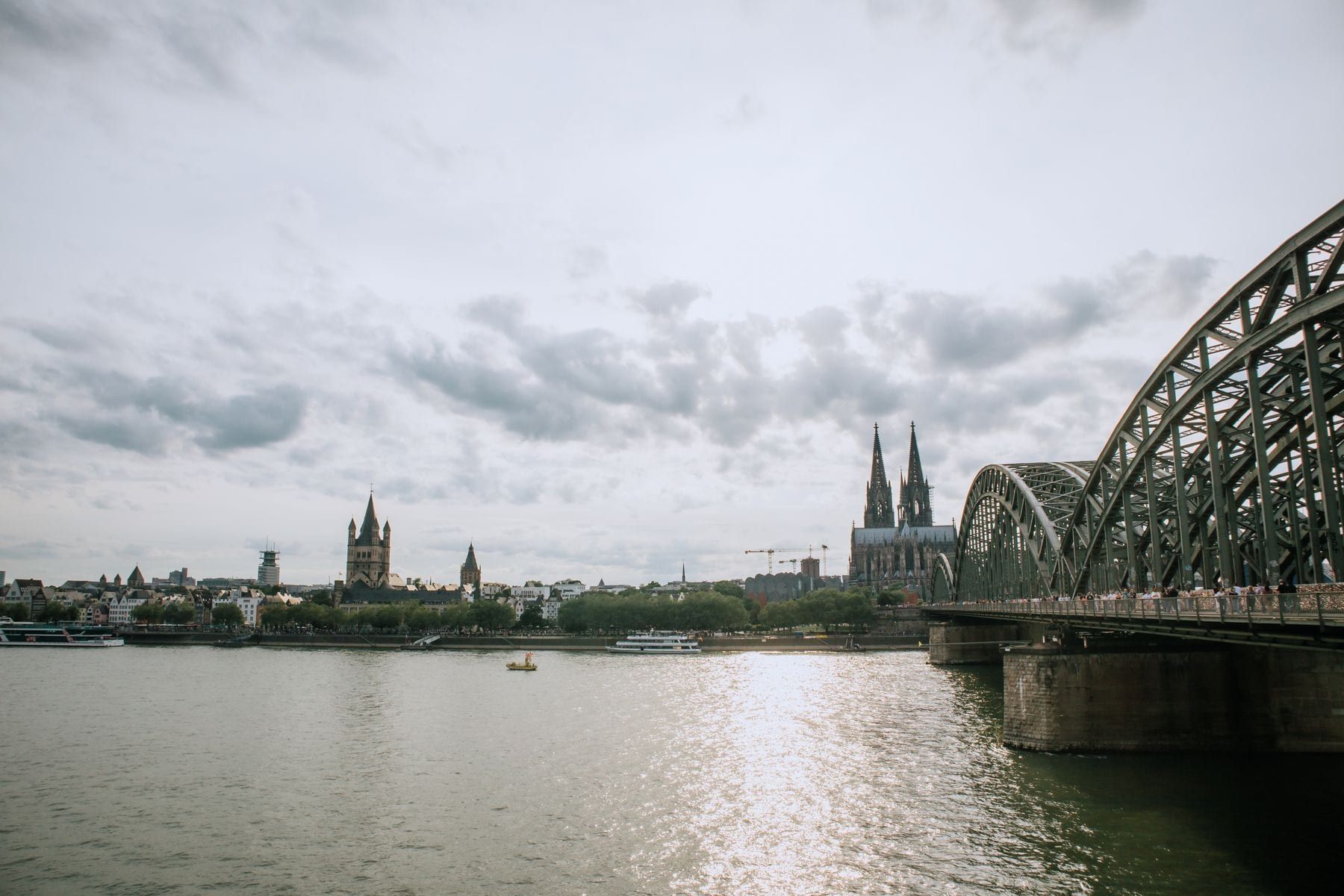
The cathedral is free and open from 6 in the morning until 8 pm, and that is exactly what you should use: at 6.30 am you have the nave practically to yourself and can look at the Shrine of the Three Kings and the Gerhard Richter window in peace. From 10 am the tour groups are lined up outside, and from 11 am access is restricted during Mass. The tower climb costs CHF 7 (about EUR 7), 533 steps with no lift, and at the top you have the view over the Rhine and the city. Allow an hour including the wait, longer at weekends in good weather. The treasury with the cathedral treasure costs another CHF 7, the combined ticket CHF 10. Right next to the cathedral is the Roman-Germanic Museum, which is housed temporarily in the Belgisches Haus on Neumarkt until probably 2027 because of renovation. The south side of the cathedral with the famous view of the Hohenzollern Bridge is best seen from the riverbank by the Museum Ludwig, in the late afternoon with the sun on the facade. Give yourself five minutes for the Domplatte: here you can see how the city was built around the cathedral after the war, and not particularly considerately.

Brewhouse and Kölsch: the rules nobody explains

Kölsch is a top-fermented beer, pale and light, served in a 0.2 litre Stange glass, and the brewhouse works by its own rules. The Köbes, the waiter in the blue apron, brings you a fresh Kölsch unasked as soon as your glass is empty and makes a mark on your beer mat. If you want to stop, you put the mat on top of the glass. Order a water and you will get a quip; a Pils you should not even mention. A Kölsch costs CHF 2.20 to 2.80 (about EUR 2.35 to 3), ten marks in an evening is normal, and it is still worth checking the count afterwards. The food is Rhineland cooking: Himmel un Ääd, Hämmche, Halver Hahn (a rye roll with cheese, not chicken), all CHF 12 to 22. The big houses in the old town, Früh am Dom, Peters, Gaffel am Dom, are touristy but genuine and good. Quieter and with more locals are Päffgen on Friesenstrasse, Brauhaus Sion or Malzmühle on Heumarkt, where Bill Clinton once sat. Reservations are not possible in most brewhouses; you sit down at a table where there is room, and that is part of the experience. You pay the Köbes, cash or card, and tip by rounding up to a round CHF 5.

Where to stay: the old town is loud, the Neustadt is better

The old town between the cathedral and Heumarkt sounds like the obvious choice, but it is loud at night, especially at weekends and in the weeks before Carnival, when stag parties roam the lanes. You are better off in Neustadt-Süd around Severinstrasse, in the Belgian Quarter or in Ehrenfeld, all 10 minutes from the cathedral by train. The station district around Breslauer Platz is practical but charmless. A mid-range double room costs CHF 100 to 140 (about EUR 107 to 150) during the week and CHF 130 to 180 at weekends, and then there are the trade fairs: Cologne has Gamescom in August, Anuga in October in even years, Photokina and the imm furniture fair in January. In fair weeks prices double and rooms under CHF 250 are rare. Check the trade fair calendar before you book. For Carnival, that is from Weiberfastnacht to Ash Wednesday, hotels are booked out months in advance. Deutz on the right bank of the Rhine is a good alternative with the best view of the cathedral and old town, one stop by train.

Cost traps and money savers: museums on the first Thursday

Cologne is cheap for the Swiss, and the museums are the best thing about it. Museum Ludwig (Picasso, Pop Art, CHF 12, about EUR 13), Wallraf-Richartz (old masters and Impressionists, CHF 11), the Chocolate Museum (CHF 15, worth it with children, less so without) and the Museum of Applied Arts. The first Thursday of the month is KölnTag: free entry to the municipal museums until 10 pm for everyone, not just locals, and Museum Ludwig and the Wallraf are among them. The MuseumsCard for CHF 20 is valid for two days in all municipal museums and on the first day for public transport too. The KölnCard with 50 per cent discount, on the other hand, only pays off if you really manage three museums in one day. Cost trap number one is eating right by the cathedral and on Alter Markt: pizza for CHF 18 and coffee for CHF 5 at mediocre quality. Two streets further, on Eigelstein or in the Südstadt, the same thing costs half. Rhine cruises with the KD from CHF 18 for the panorama trip are nice, but one hour is enough; the trip to Bonn is unspectacular scenically. A bottle of Kölsch from a kiosk, called a Büdchen here, costs CHF 1.50.

Belgian Quarter, Ehrenfeld and Carnival, honestly

The Belgian Quarter between Aachener Strasse and Friesenplatz is Cologne's district for cafés, small shops and bars around Brüsseler Platz; on summer evenings half of Cologne sits on the steps of St. Michael's church there. Ehrenfeld, a former working-class district in the west, is rougher, with street art along Venloer Strasse, Turkish bakeries, clubs and the best döner in the city. These two are where you should eat in the evening, not the old town. Then there is the riverbank in the Rheinauhafen with the three Kranhäuser, a good evening walk. And then Carnival: from Weiberfastnacht on the Thursday to Veilchendienstag the city stands still, the Rose Monday parade has a million people along the route, costumes are compulsory in every pub, and the Kölsch flows from 11.11 am. Honestly: if you do not want to party, avoid Cologne completely that week, because hotels are expensive, museums empty and pubs full. If you want to experience it, do it on Weiberfastnacht in the Südstadt or in Ehrenfeld and not on Heumarkt, and take cash, because the pubs hand Kölsch out through the window. The season opening on 11 November is a smaller version of the same.

Frequently asked questions about Cologne

What is the best way to get from Switzerland to Cologne?

By ICE directly from Basel SBB in around 4 hours, from Zurich and Bern with one change in Basel in 5 hours. Saver fares from CHF 30 (about EUR 32) each way, book early, standard fare CHF 120. By car it is 5 hours from Basel on the A5, toll-free, but in Cologne a car park costs CHF 25 to 35 a day and you do not need the car. Flying does not save any time.

How many days do you need for Cologne?

Two full days are enough for the cathedral, two museums, the riverbank and two brewhouse evenings. With a third day you can manage Ehrenfeld, the Belgian Quarter and a side trip to Bonn or Brühl with Augustusburg Palace. Cologne is also a good stopover on the way to Hamburg or Amsterdam, in which case one night is enough for cathedral and brewhouse.

When is the best time to visit Cologne?

May, June and September: mild weather, beer gardens on the Rhine open, no big trade fairs. Summer is good, but Gamescom is in August and hotels are expensive. Advent with seven Christmas markets, the loveliest by the cathedral, is atmospheric and busy. Carnival in February or March only if you want to party. In November it rains a lot, but hotels are cheap.

What does a weekend in Cologne cost?

Reckon on CHF 120 to 150 (about EUR 128 to 161) per person per day excluding travel: mid-range double room CHF 120, food and Kölsch CHF 45, public transport CHF 8, museums and cathedral tower CHF 20 to 30. With the return trip from Basel for CHF 130 you come to around CHF 450 per person for two nights. That makes Cologne about 30 per cent cheaper than Zurich or Basel.

Is the KölnCard worth it?

Only to a limited extent. The KölnCard costs CHF 10 (about EUR 11) for 24 hours and includes public transport plus up to 50 per cent off museums and city tours. Since you can reach almost everything in the centre on foot and the museum discounts are often only 20 per cent, the MuseumsCard for CHF 20 with two days of entry to all municipal museums is usually the better deal. On the first Thursday of the month entry is free anyway.

Is Cologne safe, and what is the station district like?

Cologne is a safe big city. Around the main station, on Breslauer Platz and Ebertplatz there are pickpockets and sometimes drunks at night, which is unpleasant but not dangerous. At Carnival the rule is: keep valuables on your body and your phone out of your back pocket. The old town is lively until late at night, and the Neustadt districts are no problem for solo travellers either.

Itineraries with this destination

Activities in the region

Events

Feb 4

Cologne Carnival (Weiberfastnacht to Ash Wednesday)

Festival

4 February 2027 Weiberfastnacht to Ash Wednesday; 2027: 4 to 10 February, Rose Monday on 8 February

The "fifth season" officially starts on 11 November, but things really kick off on Weiberfastnacht: at 11.11 am the street carnival is opened on Alter Markt, after which hundreds of thousands in fancy dress celebrate in the pubs of the old town, the Südstadt and Ehrenfeld. The highlight is the Rose Monday parade, around eight kilometres long with more than 10,000 participants, elaborate floats and tonnes of sweets (Kamelle) thrown into the crowd, with over a million people lining the route. The mood is warm but fuelled by alcohol and loud, and you will inevitably learn a few Cologne songs. Hotels cost two to three times the normal rate this week and are gone months in advance, and without a costume you will stand out. Museums and many shops are closed on Rose Monday.

For travellers: For the Rose Monday parade, find a spot along the route by 9 am, ideally on Severinstrasse or at Neumarkt; if you want to avoid the crowds, stay away from Cologne altogether this week.

More destinations in Rhineland & Moselle