Upper Middle Rhine Valley

Germany · Rhineland & Moselle · Travel guide

Upper Middle Rhine Valley

What five days in the valley of castles between Rüdesheim and Koblenz really cost, which of the 40 castles you should visit, when the boat is worth it and how to survive Rüdesheim.

Photo: Juergen Striewski / Pexels

What does a trip to Upper Middle Rhine Valley cost?

Adjust the values to your trip: the calculator updates live (EUR, converted from CHF estimates).

1,525 EUR
≈ 762 EUR per person
  • Getting there 235 EUR
  • Accommodation 589 EUR
  • Food 482 EUR
  • Local transport 134 EUR
  • KD boat from Rüdesheim to St. Goar and the Marksburg 86 EUR

Estimates for orientation, not booking prices. Getting there means train or car from Switzerland, return, per person. Hotels vary strongly by season: current prices are behind the links below.

Money & payment: You pay in euros (EUR). Germany is fonder of cash than Switzerland: bakeries, kiosks and small restaurants often say "cash only", though cards work almost everywhere from about EUR 10. Tip 5 to 10 percent by rounding up and naming the total when you pay. Getting there: By train (DB), car or plane, 1 to 8 hours depending on the destination.

Recommended hotels

Nine options in three price ranges, each among the best-rated on Booking.com.

Budget

Altkölnischer Hof

Market square, Bacharach

Family-run half-timbered hotel right on the market square of Bacharach, three minutes from the station, with a restaurant and its own wines. Plain, well-kept rooms, breakfast included. If you want to sleep in a castle for once: the youth hostel in Burg Stahleck above can only be booked directly. For walkers and rail travellers.

from CHF 90 / night (about EUR 96) View →

Rhein-Hotel Bacharach

Town wall, Bacharach

Family business in the medieval town wall right on the Rhine, rooms with river or vineyard views, good restaurant Stüber with regional cooking and its own wine. The railway runs in front of the house; earplugs are provided. For anyone using Bacharach as a base.

from CHF 85 / night (about EUR 91) View →

Hotel Rheinlust

Rheinallee, Boppard

Large house on the Boppard Rhine promenade with simple, clean rooms, a terrace towards the river and a restaurant. Not modern, but central, with the chairlift, boat landing and station within walking distance. For the price-conscious who choose Boppard as their base.

from CHF 95 / night (about EUR 102) View →

Mid-range

Bellevue Rheinhotel

Rheinallee, Boppard

Art Nouveau hotel of 1887 on the Boppard promenade, family-owned, with pool, sauna, terrace and the restaurant Le Chopin. Rooms on the Rhine side with balcony; the railway runs behind the house. The classic Rhine hotel, for couples and anyone looking for the old Rhine Romanticism.

from CHF 140 / night (about EUR 150) View →

Romantik Hotel Schloss Rheinfels

Burg Rheinfels, St. Goar

Hotel within the walls of the Rheinfels castle ruin high above St. Goar, with views of the Loreley and Burg Katz, spa and restaurant. Rooms vary; those in the old building have more charm. Up here it is quiet, no railway, but a 15 minute climb or shuttle. For the Loreley days.

from CHF 150 / night (about EUR 161) View →

Breuer's Rüdesheimer Schloss

Drosselgasse, Rüdesheim am Rhein

Historic wine estate and hotel of the Breuer family right on the Drosselgasse, with inner courtyard, wine tavern and its own Rheingau wines. Bustle outside the door by day, quiet in the evening, rooms individual and good. For anyone who wants Rüdesheim as a base in spite of everything.

from CHF 130 / night (about EUR 139) View →

Luxury

Burghotel Auf Schönburg

Schönburg, Oberwesel

Hotel in the 1,000 year old Schönburg high above Oberwesel, 25 rooms with four-poster beds, towers and views into the valley, restaurant with a Rhine view terrace. Quiet, secluded, no railway to be heard. For one or two nights, the castle experience the valley promises.

from CHF 220 / night (about EUR 235) View →

Burg Reichenstein

Burg Reichenstein, Trechtingshausen

Hotel in a castle rebuilt in neo-Gothic style at the southern end of the valley, with museum, the restaurant Puricelli and rooms with Rhine views. Smaller and less well known than Schönburg, but with its own museum in house. For history lovers who want to explore Bingen and Bacharach.

from CHF 180 / night (about EUR 193) View →

Hotel Krone Assmannshausen

Assmannshausen, Rüdesheim am Rhein

Traditional house since 1541 on the Rhine bank in the red wine village of Assmannshausen, with pool, terrace, a large wine cellar and a restaurant where Goethe and Freiligrath once sat. Rooms classic, some with Rhine views, railway behind the house. For bon vivants and wine lovers.

from CHF 170 / night (about EUR 182) View →

If you book through these links we earn a small commission, at no extra cost to you.

Experiences worth your time

KD boat from Rüdesheim to St. Goar

Two hours downstream through the densest stretch of castles to the Loreley, CHF 28 (about EUR 30), back by train for CHF 6. Smaller operators are cheaper. Upper deck on the starboard side, on the right heading for Koblenz, where most of the castles are.

View & book →

Marksburg near Braubach

The only hilltop castle on the Middle Rhine never destroyed, tours only, CHF 10 (about EUR 11), 50 minutes through kitchen, knights' hall and armoury. A 20 minute climb from Braubach station. Open daily, with shorter hours in winter. The most authentic castle in the valley.

View & book →

Rüdesheim cable car and Niederwald monument

Two-seater cabins float over the vineyards to the Germania monument, CHF 9 (about EUR 10) return, with the Ring-Ticket for CHF 20 including a forest walk, the Assmannshausen chairlift and the boat back. Ride at 9.30 in the morning, before the coaches arrive in Rüdesheim.

View & book →

Loreley plateau and Burg Rheinfels

Cultural park on the rock with viewpoints, visitor centre CHF 3 (about EUR 3), bus from St. Goarshausen or 30 minutes on foot. Take the ferry to St. Goar and climb to the Rheinfels ruin with its mine tunnels, CHF 6, bring a torch. Together half a day.

View & book →

Pfalzgrafenstein near Kaub

The white toll castle on the island in the Rhine, ferry from Kaub plus entry CHF 10 (about EUR 11), 45 minutes for the tour; the way there is the experience. From Kaub you can also see Burg Gutenfels and the Blücher Museum, where the general crossed the Rhine in 1814.

View & book →

Rheinsteig stage from Kaub to St. Goarshausen

22 kilometres and 6 hours over vineyards, plateau and the Loreley, with 800 metres of ascent and descent, well marked, free. Train back to Kaub. Guided walks with wine tasting from CHF 30 (about EUR 32). The finest day stage in the valley.

View & book →

Wine tasting in Bacharach or Oberwesel

Middle Rhine Riesling from steep sites, less known and cheaper than Rheingau and Moselle, five to six wines for CHF 12 to 20 (about EUR 13 to 21) at the winegrower's, for instance at the Weinstube Zum Grünen Baum in Bacharach with its wine carousel of 15 tastings. One hour, best in the late afternoon.

View & book →

Boppard chairlift to the Vierseenblick

Old chairlift up from the vineyards to the viewpoint where the Rhine bend looks like four separate lakes, CHF 10 (about EUR 11) return, April to October. With the Gedeonseck next door and a circular walk, 2 hours. Alternatively walk up in 45 minutes.

View & book →

Koblenz: Deutsches Eck and Ehrenbreitstein fortress

By cable car over the Rhine to the fortress, CHF 15 (about EUR 16) including entry, views of the Rhine-Moselle confluence and the Deutsches Eck, two to three hours. Plus the old town with the Schängel fountain and Schloss Stolzenfels south of the city, CHF 7. The right finale at the northern end of the valley.

View & book →

If you book through these links we earn a small commission, at no extra cost to you.

Food & drink

On the Middle Rhine you eat what winegrowers eat: Spiessbraten, sausage, potatoes, with Riesling from steep sites hardly anyone knows, and in Assmannshausen Spätburgunder. Gastronomically the valley is not the Moselle and certainly not Frankfurt, but in the wine taverns of Bacharach and Oberwesel you eat honestly and cheaply. The Drosselgasse in Rüdesheim is the place where you do not eat.

Middle Rhine Riesling

Weinstube Zum Grünen Baum in Bacharach, winegrowers in Oberwesel and on the Bopparder Hamm

Riesling from slate terraces between Bacharach and Boppard, the smallest well-known wine region in Germany, mineral, zesty, cheaper than Rheingau and Moselle. A quarter litre in a wine tavern CHF 3.50 to 5 (about EUR 3.75 to 5.35), a bottle at the winegrower's CHF 8 to 14.

Tip:The Bacharach wine carousel with 15 small tastings for CHF 25 is the best introduction to the valley.

Assmannshäuser Spätburgunder

Hotel Krone Assmannshausen or the wine estates in the village, Staatsweingut Assmannshausen

The red wine of the Rheingau from the Höllenberg near Assmannshausen, grown since the Middle Ages, light and elegant, one of the best Pinot Noirs in Germany. A glass CHF 5 to 8 (about EUR 5.35 to 8.55), bottles from CHF 15, top wines over CHF 50.

Spiessbraten

Inns on the Rhine heights and wine festivals in Oberwesel and Bacharach

Pork neck with onions and bacon, grilled on a spit over beechwood, with fried potatoes and salad. The feast dish of the Hunsrück and the Rhine heights, CHF 14 to 19 (about EUR 15 to 20), at wine festivals CHF 8 from a stall in a roll.

Tip:The original is cooked in a Schwenker, a swinging grill over an open fire; ask for it.

Rheinischer Döppekooche

Inns in Boppard, Braubach and Koblenz

Potato bake with Mettwurst and onions from the pot, with apple sauce, heavy and good, the winter and fairground dish between Koblenz and Bonn. CHF 10 to 14 (about EUR 11 to 15), often as the dish of the day.

Handkäs and Spundekäs

Wine taverns in Rüdesheim away from the Drosselgasse, in Bingen and Lorch

Handkäs mit Musik as in Frankfurt in the Hessian Rheingau; Spundekäs, a creamy soft cheese with paprika and onions, with a pretzel in Rheinhessen. The wine tavern snacks, CHF 6 to 8 (about EUR 6 to 9).

Tip:Spundekäs is found almost only around Mainz and Bingen, at the southern edge of the valley.

Rheinischer Sauerbraten

Old town inns in Koblenz and wine taverns in Bacharach

Beef marinated for days in vinegar and spices, with raisin sauce, dumplings and apple sauce, the region's Sunday meal. CHF 17 to 23 (about EUR 18 to 25) in inns, best in Boppard and Koblenz.

Federweisser with Zwiebelkuchen

Any wine tavern in the valley in autumn, wine festivals in Bacharach and St. Goar

Fermenting young wine, sweet and fizzy, with warm onion tart with bacon, September to October only. Glass CHF 3 (about EUR 3), slice of tart CHF 4 to 5; the combination belongs to the grape harvest.

Tip:Federweisser keeps fermenting; never transport the bottle lying down and never put it in the boot.

Rüdesheimer Kaffee

Cafés in Rüdesheim, more honestly in the café at the Asbach visitor centre

Coffee with Asbach Uralt brandy, flambéed with sugar, with cream and chocolate shavings, invented in 1957 for the Drosselgasse. Touristy, but fine on a cold afternoon, CHF 8 to 10 (about EUR 9 to 11).

Tip:Once is enough, and better after the cable car than before.

Book a food tour: Upper Middle Rhine Valley

Through markets and eateries with a guide, tastings included.

View & book →

If you book through these links we earn a small commission, at no extra cost to you.

History & background

The Upper Middle Rhine Valley between Bingen and Rüdesheim in the south and Koblenz in the north is 67 kilometres long, and along this stretch the Rhine cuts through the Rhenish Slate Mountains in a narrow valley that has been a UNESCO World Heritage Site since 2002. The Romans built the Limes here and planted the first vines; Boppard was the fort of Bodobrica, whose walls still stand. In the Middle Ages the valley became the most important trade route in Europe and at the same time a toll trap: along 67 kilometres, archbishops, counts and knights levied tolls on every ship from around 40 castles, and the Pfalzgrafenstein on an island near Kaub blocked the river with chains. The wealth of the castle lords was the reason for the density of fortresses that people admire today, and the reason they were called robber barons' castles. Most were blown up by French troops in the War of the Palatine Succession in 1689; only the Marksburg near Braubach survived undestroyed. What stands today is mostly ruins or 19th century reconstructions from the time when Rhine Romanticism began: Lord Byron, Victor Hugo and William Turner travelled here, Heinrich Heine wrote the poem of the Loreley in 1824, the maiden on the rock who lures boatmen to their doom with her song, and the Prussian kings bought and built castles such as Stolzenfels as summer residences. The first steamboats ran from 1827, the railway arrived in 1859 on the left bank and in 1869 on the right, and it has thundered through every village ever since. The Rhine remained a waterway: around 150 cargo ships pass the Loreley every day, where the river narrows to 113 metres and is 25 metres deep, and with its vineyards, castles and half-timbered towns the valley is a cultural landscape that has lived off tourism for 200 years and still has villages where half the houses stand empty.

Insider tips

Getting there and around: trains on both banks, ferries instead of bridges

For travellers from Switzerland the valley practically lies on the way: the ICE from Basel reaches Frankfurt in 2 hours 50 minutes or Mainz in a good 3 hours, and from there the regional train takes you to Rüdesheim, Bacharach, St. Goar or Boppard in 30 to 60 minutes. 4 to 5 hours in all, saver fares from CHF 30 (about EUR 32) each way. By car it is 3.5 hours from Basel to Bingen on the A5 and A61, no tolls. In the valley, though, you hardly need the car: regional trains run hourly on both banks, on the left bank the RB 26 from Mainz via Bingen, Bacharach and Boppard to Koblenz, on the right bank the RB 10 from Wiesbaden via Rüdesheim, Kaub and St. Goarshausen. Between Mainz and Koblenz there is not a single bridge for 67 kilometres, so car ferries cross instead, at Bingen, Lorch, Kaub, St. Goar and Boppard, CHF 1.50 to 2 per person, CHF 5 to 7 per car. The Rheinland-Pfalz-Ticket for CHF 28 per person per day, each additional person CHF 6, is valid on all regional trains and buses on both banks including the Hessian section. The Rhine cycle path is flat and runs through the valley on both sides, rental bikes CHF 15 to 20 a day, and the train carries bikes free.

Loreley: the rock, the myth and the reality

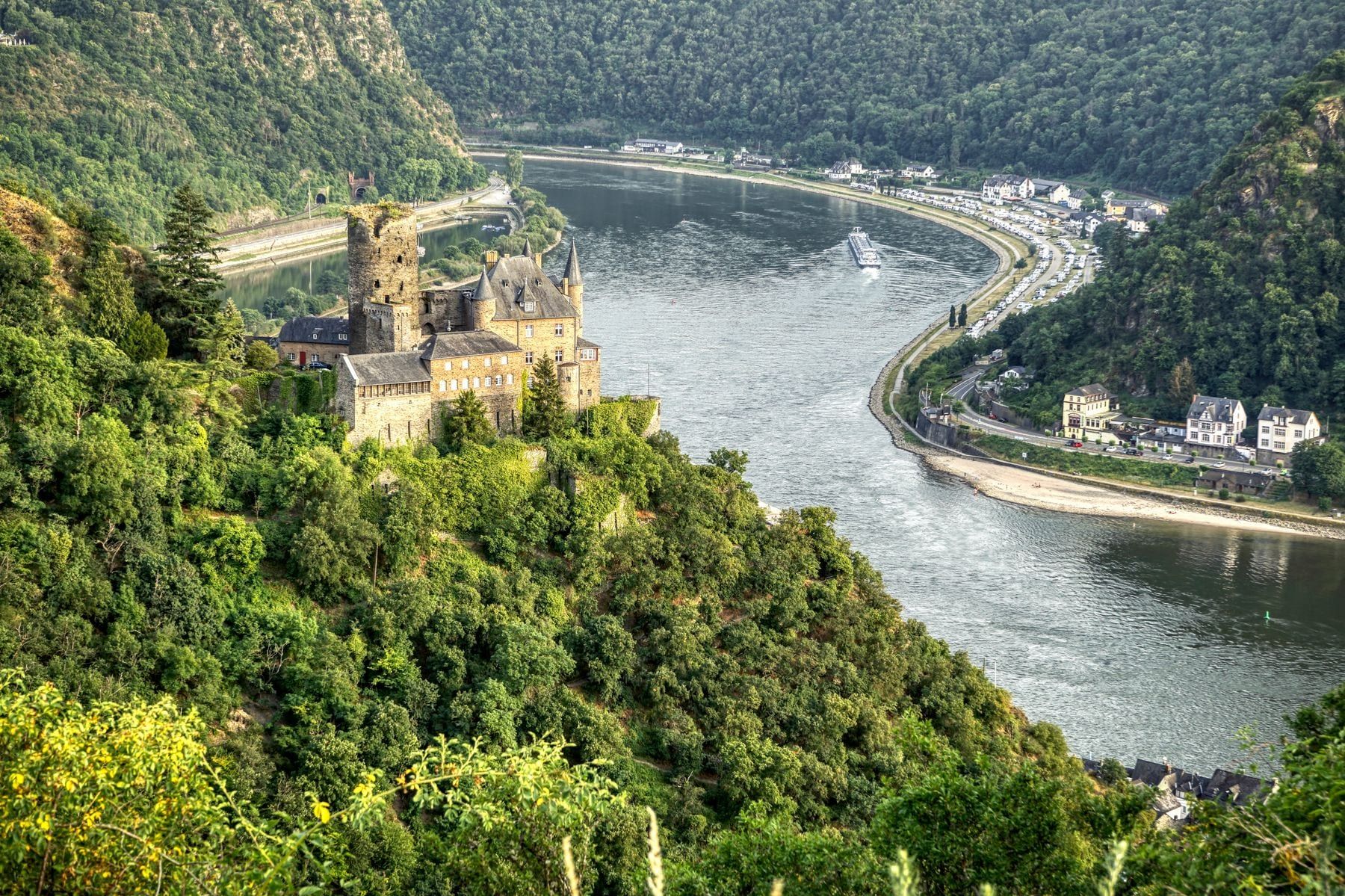
The Loreley is a 132 metre slate rock near St. Goarshausen where the Rhine is at its narrowest and deepest. That is all it is, and you should know that before you go with expectations. The myth comes from Clemens Brentano, who invented the figure in 1801; Heine made her famous in 1824 and Friedrich Silcher set her to music. Up on the plateau there has been a new cultural park since 2019 with viewpoints, a visitor centre (CHF 3, about EUR 3) and the open-air stage where concerts take place in summer. You get up there by bus from St. Goarshausen (CHF 3), on foot via the stepped path in 30 minutes or by car, parking CHF 5. The view into the river bend is lovely, best in the late afternoon when the sun lights the valley from the west. From the boat the rock is rather inconspicuous; the captain plays the song, and that is the moment. Honestly, the Loreley is worth a one-hour stop, not a destination. The Loreley statue on the harbour mole at St. Goarshausen is kitsch from 1983. More exciting is the opposite bank: St. Goar with Burg Rheinfels, the largest ruin on the Rhine, entry CHF 6, with underground mine tunnels you are allowed to explore with a torch.

Castles: which are worth it and which are not

Around 40 castles stand in the valley, and you cannot visit them all. Our ranking: the Marksburg near Braubach is the only hilltop castle on the Rhine never destroyed, guided tour CHF 10 (about EUR 11), one hour, with kitchen, torture chamber and knights' hall, more authentic than anything else. The Pfalzgrafenstein on the island near Kaub is the toll castle in the river, ferry and entry CHF 10, 45 minutes, more an experience than a visit. Burg Rheinfels above St. Goar is a ruin to explore, CHF 6, the best afternoon with children. Schloss Stolzenfels near Koblenz is Prussian Rhine Romanticism in its purest form, CHF 7, neo-Gothic, with a park. Burg Sooneck and Burg Reichenstein near Trechtingshausen are small and quiet, Reichenstein with a hotel and restaurant. Burg Katz above St. Goarshausen is private and closed; Burg Maus next to it offers falconry displays for CHF 10. Schönburg above Oberwesel is a hotel, Burg Stahleck above Bacharach a youth hostel; you can enter both as a guest, as a visitor only the courtyard. Burg Rheinstein, the first castle restored by Prussian princes, CHF 7, is worth the climb mainly for the view. Skip the castles that only work as restaurants, and plan at most two a day, because the climb costs 20 to 40 minutes every time.

Bacharach, Boppard, Oberwesel: where you should stay

Bacharach is the prettiest little town in the valley: half-timbering, a town wall you can walk all the way round, the Wernerkapelle as a Gothic ruin, wine taverns on Oberstrasse. 1,800 inhabitants, quiet in the evening, and Burg Stahleck above it is a youth hostel with the best view for CHF 35 (about EUR 37) a night. Oberwesel has the most complete town wall with 16 towers, the Liebfrauenkirche with its golden altar and fewer tourists than Bacharach. Boppard sits on the biggest bend in the Rhine and with 15,000 inhabitants is a small town with a promenade, Roman fort walls and the chairlift to the Vierseenblick, where the Rhine looks like four lakes, CHF 10 return. St. Goar is central for the Loreley and Rheinfels, but small. Rüdesheim is the most famous and the worst: the Drosselgasse is 144 metres long, with wine taverns, brass bands and tour groups from all over the world, a crush in the afternoon. Do not stay there; come in the morning for the cable car and leave. Kaub, Lorch, Braubach and Rhens are quiet villages with inns from CHF 70. A mid-range double room on the Rhine costs CHF 100 to 140, with a Rhine view CHF 20 more, and a Rhine view also means a railway view: the tracks run between hotel and river, and goods trains run at night. Take a room facing the courtyard or bring earplugs; that is not a joke.

Cost traps, money savers and timing

The valley is cheap if you do it right. The boats of the Köln-Düsseldorfer are the biggest item: Rüdesheim to St. Goar costs CHF 28 (about EUR 30) one way, 2 hours downstream, back by train for CHF 6, and that is the right combination, because upstream takes twice as long and you see the same thing. Small operators such as Bingen-Rüdesheimer or Loreley-Linie are 20 to 30 per cent cheaper than the KD. The cable car in Rüdesheim to the Niederwald monument costs CHF 9 return; the Ring-Ticket for CHF 20 combines cable car, a walk through the forest, the chairlift down to Assmannshausen and the boat back, which is the best day in the southern part of the valley. Wine taverns on the Rhine charge CHF 4 to 6 for a quarter litre of Riesling, the winegrower in Oberwesel or Lorch CHF 3. Rhine in Flames is the big fireworks display, five times each summer in different places: Bonn in early May, Rüdesheim in early July, Koblenz on the second Saturday in August, Oberwesel in mid-September, St. Goar on the third Saturday in September. From the bank it is free, from a boat it costs CHF 80 to 150, and hotels are booked out and pricier on those weekends. The best time is May to June and September to mid-October; July and August are hot and crowded, and from November to March the valley is shut, the boats barely run and the castles have winter hours.

Rheinsteig, Rheinburgenweg and the plateaus

The valley is lovelier from above than from below, and the walking trails are the reason to stay longer. The Rheinsteig runs 320 kilometres on the right bank from Wiesbaden to Bonn, the Rheinburgenweg 200 kilometres on the left bank, both well marked, with stages of 15 to 20 kilometres and ascents and descents of 500 metres each, because the trail jumps between riverbank and plateau. The finest day stages: Kaub to St. Goarshausen via the Loreley, 22 kilometres, 6 hours; Boppard to Braubach, 17 kilometres, with the view from the Gedeonseck; Bacharach to Oberwesel over the heights, 12 kilometres, 3 hours with castles and vineyards. Shorter are the Traumschleifen, circular walks of 6 to 15 kilometres, such as the Rheingold circuit near Trechtingshausen or the Mittelrhein via ferrata in Boppard, an easy fixed-rope route through the vineyards, free, 2 hours, no equipment needed. You can get everywhere from the train, and the ferries connect the banks. On the plateaus lie villages no tourist sees, with inns where the schnitzel costs CHF 12 (about EUR 13). And at the northern end lies Koblenz, where the Moselle and the Rhine meet at the Deutsches Eck: cable car over the Rhine to the Ehrenbreitstein fortress, CHF 15 including fortress entry, one of the largest fortresses in Europe with views over both rivers. Koblenz is exactly right as a day destination at the end of the valley.

Frequently asked questions about Upper Middle Rhine Valley

How do I get from Switzerland to the Middle Rhine Valley?

By ICE from Basel to Mainz in a good 3 hours, then regional train to Bacharach, St. Goar or Boppard in 30 to 60 minutes, 4 to 5 hours in all, saver fares from CHF 30 (about EUR 32) each way. From Zurich and Bern with a change in Basel, an hour more. By car 3.5 hours from Basel to Bingen on the A5 and A61, no tolls. In the valley you do not need the car; train, ferry and boat are enough.

How many days do you need for the Middle Rhine Valley?

Three days are enough for the boat, the Loreley, two castles and Bacharach. With four to five days you add Rüdesheim with the cable car, a Rheinsteig stage, Boppard and Koblenz. If you want to walk, stay a week and do the Rheinburgenweg or Rheinsteig stage by stage with the train back. As a day trip from Frankfurt or Mainz, Rüdesheim with the boat to St. Goar works, but that is only a taster.

Is a boat trip on the Rhine worth it?

Yes, once, downstream, from Rüdesheim or Bingen to St. Goar, two hours for CHF 28 (about EUR 30) with the KD or cheaper with the small operators. That is the classic stretch with the most castles and the Loreley. Back by train for CHF 6. Upstream takes twice as long, and longer trips become monotonous. The Rhine in Flames cruises for CHF 80 to 150 are only worth it if you want to see the fireworks from the water; the bank is free.

When is Rhine in Flames?

Five times a year in changing locations: Bonn in early May, Rüdesheim and Bingen in early July, Koblenz on the second Saturday in August with the biggest fireworks from the Ehrenbreitstein fortress, Oberwesel in mid-September, St. Goar and St. Goarshausen on the third Saturday in September with the Loreley as the backdrop. A convoy of up to 50 illuminated boats sails towards the fireworks. Book hotels months ahead for these dates.

What does a week in the Middle Rhine Valley cost?

Reckon on CHF 110 to 140 (about EUR 118 to 150) per person per day excluding travel: mid-range double room CHF 110, food and wine CHF 45, train, ferry and one boat trip CHF 20 to 25, castles and cable car CHF 15 to 20. Five days with the return trip from Basel for CHF 110 cost around CHF 700 per person. In inns and the Burg Stahleck youth hostel you get by on CHF 80 a day. The valley is cheaper than any Swiss lakeshore.

Is the railway noise on the Rhine really that bad?

Yes, that is no exaggeration. Main lines run along both banks with goods trains around the clock, up to 400 a day, and the tracks run between the villages and the river, often directly behind the hotels. Rooms with a Rhine view have the tracks under the window. Ask for rooms facing the courtyard or the hillside when you book, bring earplugs, or stay above the valley in a castle such as Schönburg or Stahleck, where it is quiet.

Itineraries with this destination

Activities in the region

Events

May 1

Rhine in Flames (Rhein in Flammen)

Festival

1 May 2027 Five dates May to September; 2027 expected: Bonn 1 May, Rüdesheim/Bingen 3 July, Koblenz 14 August, Oberwesel 11 September, St. Goar 18 September

On five evenings in the summer half-year, a convoy of around 50 illuminated boats sails down the Rhine while the castles and banks are lit up in Bengal red and several fireworks displays go up one after another over the river. Each date has its own stretch: Bonn with the big closing fireworks in the Rheinaue park, Rüdesheim and Bingen at the Binger Loch, Koblenz from Spay to the Deutsches Eck, Oberwesel with Schönburg castle and St. Goar with the Loreley and Rheinfels castle. It is most beautiful from a boat; places cost around CHF 60 to 150 (EUR 65 to 160) including dinner and are gone months in advance; from the bank you watch for free, but need to claim a spot early in the afternoon. The towns are packed on these evenings, there is no parking, and the last trains back are crammed. Everything goes ahead in the rain.

For travellers: Combine one of the dates with two or three days in the Upper Middle Rhine Valley; the Rheinsteig stages between St. Goar and Oberwesel are at their best on exactly these weekends, but hotels there are scarce then.

More destinations in Rhineland & Moselle