Saxon Switzerland

Germany · Saxony & Harz · Travel guide

Saxon Switzerland

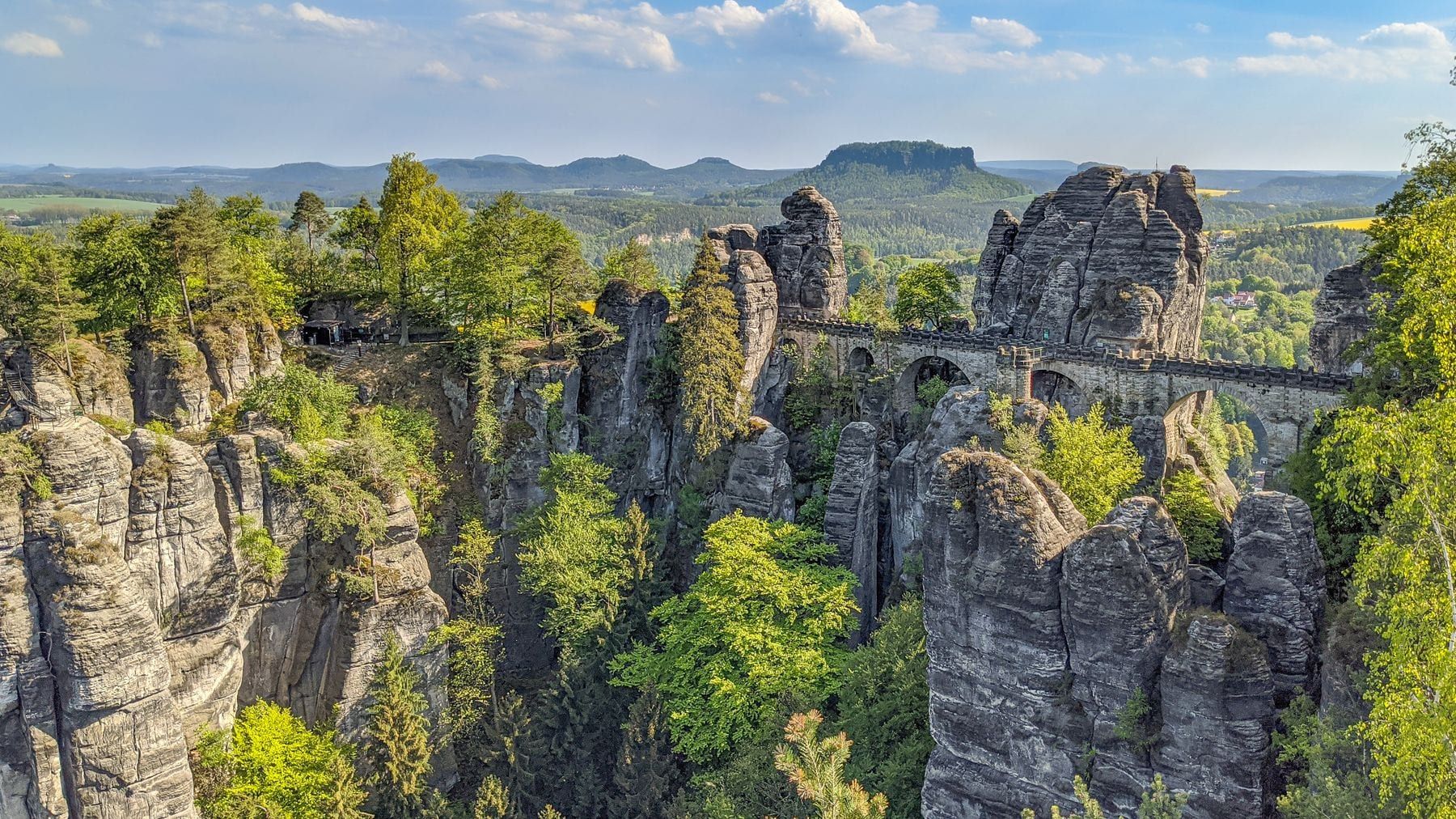
What a week of hiking in the Elbe Sandstone Mountains really costs, why you visit the Bastei at 7 am and not at 11 am, and how you get through the whole national park without a car.

Photo: Ronny Siegel / Pexels

What does a trip to Saxon Switzerland cost?

Adjust the values to your trip: the calculator updates live (EUR, converted from CHF estimates).

1,503 EUR
≈ 752 EUR per person
  • Getting there 375 EUR
  • Accommodation 508 EUR
  • Food 375 EUR
  • Local transport 64 EUR
  • Guided climbing tour (day course) 182 EUR

Estimates for orientation, not booking prices. Getting there means train or car from Switzerland, return, per person. Hotels vary strongly by season: current prices are behind the links below.

Money & payment: You pay in euros (EUR). Germany is fonder of cash than Switzerland: bakeries, kiosks and small restaurants often say "cash only", though cards work almost everywhere from about EUR 10. Tip 5 to 10 percent by rounding up and naming the total when you pay. Getting there: By train (DB), car or plane, 1 to 8 hours depending on the destination.

Recommended hotels

Nine options in three price ranges, each among the best-rated on Booking.com.

Budget

Kurparkstübl Bad Schandau

Spa gardens, Bad Schandau

Guesthouse with inn by the spa gardens of Bad Schandau, family rooms with kitchenette, small sauna, free parking, breakfast buffet included. Bus stop and Elbe ferry within walking distance. For families and hikers who want to stay cheaply and centrally.

from CHF 85 / night (about EUR 91) View →

Hotel Lindenhof Bad Schandau

Zentrum, Bad Schandau

Simple, family-run hotel on the edge of the centre of Bad Schandau, five minutes to the Kirnitzschtalbahn and the ferry. Plain rooms, Saxon cooking in-house, garden. For hikers who only need a bed and breakfast.

from CHF 90 / night (about EUR 96) View →

Berghotel Bastei

Bastei, Lohmen

The hotel right by the Bastei bridge, plain and functional in the main building, with the advantage that you have the view in the evening and morning without the day visitors. Restaurant and panoramic terrace. For the one sunrise that is worth it.

from CHF 110 / night (about EUR 118) View →

Mid-range

Hotel Elbresidenz an der Therme Bad Schandau

Elbufer, Bad Schandau

Large hotel on the Elbe bank, right by the Toskana Therme, which is included for guests. Modern rooms, many with Elbe views, in-house restaurants. For anyone who wants to bathe after hiking.

from CHF 120 / night (about EUR 128) View →

Parkhotel Bad Schandau

Zentrum, Bad Schandau

Long-established hotel from 1884 on the Elbe bank with an art nouveau villa and modern extension, sauna, restaurant and garden down to the Elbe. Central and quiet, the Kirnitzschtalbahn leaves from outside the door. For couples who combine hiking with comfort.

from CHF 110 / night (about EUR 118) View →

STEIGER Hotel Rathener Hof

Elbe bank, Kurort Rathen

Four-star house right on the Elbe bank in car-free Kurort Rathen, next to the ferry, with indoor pool, sauna and a view of the Bastei rocks. Quiet, well-kept rooms, half board available. For anyone who wants the Bastei to themselves in the early morning.

from CHF 130 / night (about EUR 139) View →

Luxury

STEIGER Hotel Elbschlösschen Rathen

Kurort Rathen

Wellness hotel right on the Elbe in Rathen with pool, sauna and spa, many rooms with balconies facing the river, ferry and Bastei ascent outside the door. For couples who want peace and a pool after the summit.

from CHF 160 / night (about EUR 171) View →

Bio-Hotel Helvetia

Schmilka, Bad Schandau

Flagship of the organic Refugium Schmilka, a whole village at the foot of the Schrammsteine with mill, brewery, bakery and bathhouse with sauna. Rooms with natural materials, organic cooking, car-free, reachable by S-Bahn and ferry. For gourmets in hiking boots.

from CHF 170 / night (about EUR 182) View →

Romantik Hotel Deutsches Haus Pirna

Altstadt, Pirna

Renaissance townhouse in the old town of Pirna, the gateway to Saxon Switzerland, with well-kept rooms and a restaurant. By S-Bahn you are in the national park in 20 minutes and in Dresden in 25. For anyone who wants to combine both.

from CHF 140 / night (about EUR 150) View →

If you book through these links we earn a small commission, at no extra cost to you.

Experiences worth your time

Bastei and Neurathen rock castle

The stone bridge between the rock needles 190 metres above the Elbe is free; the rock castle behind it with walkways over the gorges costs CHF 3 (about EUR 3). Come before 8 am or after 5 pm, 30 minutes' ascent from Rathen, two hours in all.

View & book →

Circular walk: Schwedenlöcher and Amselsee

From Rathen through the Amselgrund to the Amselsee, up through the Schwedenlöcher, a narrow rock gorge with 700 steps, to the Bastei and back. Three hours, free, rowing boat on the Amselsee CHF 6 (about EUR 6) per half hour.

View & book →

Königstein Fortress

The largest hilltop fortress in Europe on a table mountain, never conquered, with casemates, a 152-metre-deep well and a circuit along the wall. Admission CHF 14 (about EUR 15), lift CHF 2, three hours, 40 minutes on foot from Königstein or by the Festungsexpress.

View & book →

Schrammstein viewpoint

From Bad Schandau or Schmilka via Stiegen and ladders onto the rock ridge with the best panorama in the national park, returning through the Schrammsteingrund. Four to five hours, free, sure-footedness and boots with tread required.

View & book →

Kirnitzschtalbahn and Kuhstall

By historic tram from Bad Schandau 30 minutes through the Kirnitzsch valley to the Lichtenhain waterfall, CHF 8 (about EUR 9) return, free with the guest card, then an hour up to the Kuhstall, the rock arch with the Himmelsleiter. Half a day.

View & book →

Malerweg stage

One of the eight stages of the 116-kilometre circuit, for example stage 2 from Stadt Wehlen via the Bastei to Hohnstein or stage 3 from Hohnstein to the Kuhstall, 12 to 18 kilometres. Free, luggage transport bookable from CHF 15 (about EUR 16) per stage.

View & book →

Climbing course in the Elbe sandstone

Day course with a mountain guide and complete equipment on a real summit, by the Saxon rules, for beginners from ten years. CHF 70 to 100 (about EUR 75 to 107) per person, six to seven hours, only on dry rock, April to October.

View & book →

Lilienstein or Pfaffenstein

Two table mountains opposite the fortress: the Lilienstein climbed in an hour, 360-degree view, usually empty; the Pfaffenstein with the Barbarine rock needle and an inn, three-hour circuit. Both free, from Königstein on foot or by bus.

View & book →

Day trip to Bohemian Switzerland: Pravčická brána and Edmund Gorge

By S-Bahn and ferry to Hřensko, to the Pravčická brána (Prebischtor), the largest sandstone arch in Europe, admission around CHF 5 (about EUR 5), and a boat trip through the Edmund Gorge for CHF 5. Five to six hours, guided from Dresden or Bad Schandau CHF 50 to 80.

View & book →

If you book through these links we earn a small commission, at no extra cost to you.

Food & drink

The cooking of Saxon Switzerland is mountain inn cooking with a Bohemian touch: game from the national park, trout from the Kirnitzsch, dumplings and quark, with beer from small breweries. It is rarely refined and almost always honest, and after six hours on the Stiegen a Soljanka on the summit tastes better than any set menu in Dresden.

Wildgulasch mit Klössen

Mountain inns on the Bastei, Papststein and Pfaffenstein, restaurants in Hohnstein

Game goulash with dumplings: venison or wild boar from the forests of the national park, braised with juniper and lingonberries, with potato dumplings and red cabbage. CHF 16 to 22 (about EUR 17 to 24) in the mountain inns.

Tip:Fresh in autumn during the hunting season, in summer often from the freezer, so ask.

Trout from the Kirnitzsch

Inns in the Kirnitzsch valley between Bad Schandau and the Lichtenhain waterfall

Brown trout, fried or poached "blue", with boiled potatoes and butter, from the ponds and streams of the Kirnitzsch valley. CHF 15 to 20 (about EUR 16 to 21).

Tip:The fish farms in the valley also sell smoked trout to take away, CHF 5 to 7 per fish, for a snack on the summit.

Soljanka

Every summit inn, for example on the Brand near Hohnstein or at the Kuhstall

The sour and spicy soup with sausage, meat, gherkins and peppers is a GDR legacy and is on the menu in every mountain inn, with bread and sour cream. CHF 6 to 8 (about EUR 6 to 9), filling.

Tip:The best value for money on the mountain, especially in cold weather.

Quarkkäulchen mit Apfelmus

Restaurants in Bad Schandau and Rathen, the Bastei mountain inn

Fried quark and potato patties with cinnamon sugar and apple sauce, the Saxon sweet dish, here in the mountains often served as a main course. CHF 7 to 10 (about EUR 7 to 11).

Tip:The best reward after a Stiegen tour, too much as a dessert after goulash.

Bohemian dumplings with roast pork

Inns in Hřensko and at the Pravčická brána

Across the border in Bohemian Switzerland you eat the Czech classic vepřo knedlo zelo, roast pork with bread dumplings and sauerkraut, for CHF 7 to 10 (about EUR 7 to 11), with a Pilsner for CHF 2.

Tip:Czech crowns or card; euros are accepted but at a poor rate.

Beer from Schmilka and around

Braumanufaktur Schmilka, Schmilka

The Braumanufaktur Schmilka brews organic beer in the old mill at the foot of the Schrammsteine, and there are also beers from Pirna and Dresden. A half litre CHF 4 to 5 (about EUR 4 to 5), in Schmilka in the beer garden with a view of the Elbe.

Tip:The mill bakery next door bakes wood-fired bread, the picnic for the Schrammstein path.

Cake at the mountain inn

Papststein mountain inn, inns in Hinterhermsdorf and Hohnstein

Eierschecke, crumble and poppy seed cake from their own bakery, in the summit inns for CHF 3 to 4 (about EUR 3 to 4) a slice, with coffee CHF 6 to 7. Saxon coffee culture at 400 metres.

Tip:At 3 pm the terraces are full, at 1 pm they are not, and the cake is the same.

Book a food tour: Saxon Switzerland

Through markets and eateries with a guide, tastings included.

View & book →

If you book through these links we earn a small commission, at no extra cost to you.

History & background

The Elbe Sandstone Mountains were formed around 90 million years ago as the sea floor of the Cretaceous period: sand was deposited in thick layers, compressed into stone and later uplifted. The Elbe and its tributaries then cut valleys and gorges into the plateau, and frost and water widened the cracks into the table mountains, rock needles and ravines that shape the picture today: Lilienstein, Pfaffenstein, Schrammsteine, Bastei. Settlers came in the Middle Ages, mostly from Bohemia; the border between Saxony and Bohemia has run right through the mountains since 1459, and the Czech part is called Bohemian Switzerland. On the Königstein the Saxon electors built the largest hilltop fortress in Europe from 1589, which was never conquered and later served as a state prison; Augustus the Strong had the alchemist Böttger locked up there until he invented porcelain. The name "Saxon Switzerland" was coined in the 18th century by two Swiss artists, the painter Adrian Zingg and the engraver Anton Graff, who taught at the Dresden Academy and felt reminded of their homeland. The Romantics followed: Caspar David Friedrich painted the Wanderer above the Sea of Fog from motifs in the Elbe sandstone, Ludwig Richter drew, and Carl Maria von Weber set Der Freischütz in the Wolfsschlucht. Steamers ran from Dresden from 1826, the Bastei bridge was built in stone in 1851, and with the railway in 1851 the mountains became Germany's first hiking destination. In the Elbe sandstone, Dresden gymnasts invented free climbing with fixed rules around 1864, without chalk and metal wedges, rules that still apply today. Since 1990 the Saxon part has been a national park, the first rock national park in Germany.

Insider tips

Getting there: ICE to Dresden, then S-Bahn into the Elbe valley

From Zurich or Basel you take the ICE via Frankfurt or Berlin to Dresden, 7 to 8 hours, saver fare from around CHF 60 (about EUR 64) each way if booked early. From Dresden main station the S1 S-Bahn takes you every half hour through the Elbe valley to Rathen, Königstein, Bad Schandau and on to Schöna on the Czech border, 45 minutes to Bad Schandau, around CHF 8 for a single. On the right bank of the Elbe the S-Bahn often stops only opposite the village; in Rathen and Königstein a ferry takes you across, CHF 2 to 3. By car it is around 780 kilometres from Zurich, 8 hours, no tolls, but once there the car is a problem: the car parks at the Bastei and in Bad Schandau are full from 9 am on summer weekends, cost CHF 8 to 12 a day, and on the narrow roads up you sit in a jam. The better plan: stay in Bad Schandau or Rathen, get free public transport with the guest card, take the Kirnitzschtalbahn, the hiking buses and the ferries, and you are freer than with a car. If you want to add Bohemian Switzerland, take the S-Bahn to Schöna and the ferry across to Hřensko. From Vienna it is 6 to 7 hours via Prague, and the last stretch by Eurocity through the Elbe valley is already the start of the trip.

Where to stay: Bad Schandau as a base, Rathen for the Bastei

Bad Schandau is the main town of the national park, with the Kirnitzschtalbahn, ferry, thermal baths and most of the restaurants, and the best base without a car. A mid-range double room costs CHF 85 to 120 (about EUR 91 to 128), guesthouses from CHF 60, and the visitor tax of around CHF 3 per night is at the same time the guest card with which buses, the S-Bahn between Pirna and Schöna and the Kirnitzschtalbahn are free. Kurort Rathen, car-free and reachable only by ferry, lies directly below the Bastei: if you sleep there, you are on the bridge at 7 am before the buses from Dresden arrive, and alone in the evening. Königstein is quieter and cheaper, Stadt Wehlen and Pirna are alternatives downstream, and Hinterhermsdorf lies deep in the national park for anyone who wants silence. Price traps: the weekends from May to October and the Saxon summer holidays, when the Elbe valley is booked out; book two to three months ahead. On weekdays in June or September you will find something at short notice too. Many guesthouses charge supplements for short stays of one or two nights; three nights is the standard. Dresden as a base is possible, 45 minutes by S-Bahn, but you lose the morning hours on the mountain.

Cost traps and savings: guest card, Bastei, Königstein

The hiking itself is free, the national park charges no admission, and that makes Saxon Switzerland one of the cheapest mountain destinations for the Swiss. What does cost: the view from the Bastei is free, the Neurathen rock castle behind it with the walkways over the gorges CHF 3 (about EUR 3), and that is worth it. Königstein Fortress costs CHF 14, less in winter, CHF 2 extra for the lift instead of the stairs, three hours for walls, casemates and the deepest well in Saxony. The Kirnitzschtalbahn, a historic tram from Bad Schandau to the Lichtenhain waterfall, costs CHF 8 return, free with the guest card. The ferries across the Elbe CHF 2 to 3 per crossing, over time an item in the budget, partly included with the guest card. The Elbe steamers from Dresden are lovely and, at CHF 30 to 40 each way to Bad Schandau, expensive; the S-Bahn costs a quarter and passes the same scenery. Food in the mountain inns on the Bastei, Papststein or Brand is fair at CHF 14 to 20 for main courses, drinks dearer. Lunch in Bad Schandau CHF 11 to 16, a beer CHF 4, coffee and cake CHF 6 to 8. The Toskana Therme in Bad Schandau costs CHF 20 to 25 for two hours, money well spent after a rainy day.

Timing: low season, weekdays and the early morning

On a sunny Saturday in August the Bastei has more visitors than many a viewpoint in Zermatt, and that is the decisive point: come before 8 am or after 5 pm and you have the bridge almost to yourself; in between it is a catwalk. The best time for the mountains is May to June and September to October, with foliage and the light that Caspar David Friedrich painted, and temperatures for walking. July and August are hot, busy and often stormy, but pleasantly cool in the gorges. Autumn with fog in the Elbe valley and sun on the table mountains is the most beautiful; from late October to early November only hikers come. In winter the Stiegen with their iron rungs and ladders are partly iced over and closed, the Malerweg can then only be walked in parts, but the Bastei in snow is a picture in itself and the hotels are half the price. Important: in 2022 a large piece of national park on the border burned, and some paths between Schmilka and Hinterhermsdorf are still closed or rerouted; check at the national park centre in Bad Schandau, admission CHF 5 (about EUR 5). In hot weather there is a risk of forest fire, and then parts of the park are off limits; fires, smoking and barbecues are banned in any case.

Underrated: Schrammsteine, Pfaffenstein, Malerweg and Bohemian Switzerland

The Bastei is the postcard motif, but the better walks lie further up the Elbe valley. You reach the Schrammstein viewpoint above Bad Schandau in two hours via ladders and Stiegen, with a view of the rock ridges that beats the Bastei; the Häntzschelstiege there is a via ferrata variant without protection, for the sure-footed only. The Pfaffenstein near Königstein has the Barbarine, a 43-metre rock needle, and a summit plateau with an inn, a three-hour circuit. The Lilienstein, the table mountain opposite the fortress, is climbed in an hour, with a 360-degree view over the whole Elbe valley and usually empty. The Malerweg, at 116 kilometres in eight stages, is the great circuit through the mountains, from Pirna via the Bastei, Schrammsteine and Hinterhermsdorf back along the left bank of the Elbe with Königstein and Pfaffenstein; you can walk it in parts, and stages 2 to 4 are the most beautiful. The Kuhstall, a rock arch near Lichtenhain, is 30 minutes away by Kirnitzschtalbahn. Across the border lies Bohemian Switzerland with the Pravčická brána (Prebischtor), the largest sandstone arch in Europe, and the boat trip through the Edmund Gorge, from Hřensko by bus or on foot, admission around CHF 5 (about EUR 5), boat trip CHF 5. A day there belongs in every week here, and the prices are lower still.

Climbing, Stiegen and what you need to be able to do

The Elbe Sandstone Mountains are the cradle of free climbing, with 1,100 summits and 20,000 routes, and with their own rules: protection only with slings and the rings in the rock, chalk is banned, climbing only on free-standing summits, and not at all when the rock is wet, because the sandstone then crumbles. For beginners there are guided climbing courses from Bad Schandau, Rathen and Königstein, a day with equipment CHF 70 to 100 (about EUR 75 to 107), and that is the experience you take home from here, even without any experience. If you do not want to climb, there are the Stiegen: hiking paths with iron ladders, steps and rungs through the rocks, Häntzschelstiege, Rübezahlstiege, Heilige Stiege, Wilde Hölle, all without protection and only in dry weather, for the sure-footed without a fear of heights. The Schwedenlöcher and the Amselgrund near Rathen are the gorge walk for everyone, steps through cool rock crevices, one hour. Good hiking boots with tread are compulsory; wet sandstone is as slippery as soap. There is no mobile reception on the rocks, you carry water with you, and there are inns on many summits but not on all. The mountain rescue goes out every weekend, usually to people in trainers on the Stiegen. With children from eight, the Bastei, Schwedenlöcher and Kuhstall are easily doable, the Stiegen are not.

Frequently asked questions about Saxon Switzerland

How do I get to Saxon Switzerland from Switzerland, and do I need a car?

ICE via Frankfurt or Berlin to Dresden in 7 to 8 hours, saver fare from around CHF 60 (about EUR 64) each way, then the S1 S-Bahn in 45 minutes to Bad Schandau for CHF 8, so a long day of travel in all. By car around 780 kilometres, 8 hours, no tolls. Once there the car is more burden than help: car parks at the Bastei fill up early at weekends and cost CHF 8 to 12, while with the guest card the S-Bahn, buses and Kirnitzschtalbahn are free.

How many days make sense?

Three to four days for the classics: Bastei with the Schwedenlöcher, Schrammsteine, Königstein Fortress with the Lilienstein or Pfaffenstein, Kirnitzschtal with the Kuhstall. A week if you walk the Malerweg in stages or want a day in Bohemian Switzerland. A day trip from Dresden is enough for the Bastei and Rathen, but shows you only the busiest corner.

When is the best time for the Bastei?

In the morning before 8 am or in the evening after 5 pm, on a weekday, in May, June, September or October. Then you stand on the bridge with twenty people instead of a thousand. The buses from Dresden arrive from 10 am. If you stay overnight in Rathen, you walk up in 30 minutes. With fog in the Elbe valley and sun above, typical in autumn, the view is at its most beautiful. The bridge is free and always open; the Neurathen rock castle costs CHF 3 (about EUR 3).

What does a week of hiking cost compared with Switzerland?

About half. Mid-range double room CHF 85 to 120 (about EUR 91 to 128) instead of CHF 180, main course CHF 12 to 18, beer CHF 4, public transport free with the guest card, hiking without cable car costs because there are no cable cars. Admissions are manageable: Königstein CHF 14, Neurathen CHF 3, Kirnitzschtalbahn CHF 8. With CHF 80 to 100 per person per day excluding travel you are doing well, in guesthouses with CHF 60.

How demanding is the hiking?

Everything from a stroll to a via ferrata. The Bastei, Amselgrund, Kuhstall and Lilienstein are doable with normal fitness and hiking boots, often with many steps. The Stiegen through the Schrammsteine and Affensteine have ladders and iron rungs without protection; for those you need to be sure-footed and free of vertigo, and in the wet they are not possible. Malerweg stages have 15 to 20 kilometres and 500 to 800 metres of total ascent. Hiking boots with tread are compulsory; wet sandstone is extremely slippery.

Can I climb without experience?

Yes, with a guide. Climbing schools in Bad Schandau, Rathen and Königstein offer day courses for beginners with complete equipment for CHF 70 to 100 (about EUR 75 to 107), from two people, children from about ten. By the afternoon you are standing on a real summit. Elbe sandstone climbing has strict rules, no chalk, no wedges, only on dry rock, and the guides know them. Going alone without experience is not an option; the rings in the rock are far apart.

Itineraries with this destination

Activities in the region

More destinations in Saxony & Harz