a&o Dresden Hauptbahnhof
Large hostel-hotel of the a&o chain right at the main station, with double rooms, family rooms and dorms. Sober, clean, ten minutes to the Altstadt by tram. For groups and anyone who would rather spend the money on museums.
Germany · Saxony & Harz · Travel guide
What a long weekend in "Florence on the Elbe" really costs, why you should stay in the Neustadt rather than the Altstadt, and when you have the Frauenkirche almost to yourself.
Photo: Andrés García / Pexels
Adjust the values to your trip: the calculator updates live (EUR, converted from CHF estimates).
Estimates for orientation, not booking prices. Getting there means train or car from Switzerland, return, per person. Hotels vary strongly by season: current prices are behind the links below.
Money & payment: You pay in euros (EUR). Germany is fonder of cash than Switzerland: bakeries, kiosks and small restaurants often say "cash only", though cards work almost everywhere from about EUR 10. Tip 5 to 10 percent by rounding up and naming the total when you pay. Getting there: By train (DB), car or plane, 1 to 8 hours depending on the destination.
Nine options in three price ranges, each among the best-rated on Booking.com.
Budget
Large hostel-hotel of the a&o chain right at the main station, with double rooms, family rooms and dorms. Sober, clean, ten minutes to the Altstadt by tram. For groups and anyone who would rather spend the money on museums.
Design budget hotel right on Postplatz, you see the Zwinger as you walk out. Small, well-made rooms, bar in the lobby, no restaurant. The best price-to-location ratio in the Altstadt, book early.
Simple chain hotel on Wilsdruffer Strasse, between the Altmarkt and Postplatz. Small rooms, breakfast at extra cost, tram outside the door. For one or two nights when all you want to do is sleep.
Mid-range
Baroque town palace from 1730 in Rähnitzgasse, quiet and five minutes from the Goldener Reiter and the Augustusbrücke. Classically furnished rooms, inner courtyard, good breakfast. For couples who like the Neustadt elegant.
Modern four-star hotel on Schlossstrasse, between the Residenzschloss and the Altmarkt. Generous rooms, sauna, good breakfast and a location that turns every walk in the Altstadt into a stroll.
Solid four-star house on Rosenstrasse, ten minutes on foot from the Zwinger and right by the World Trade Center. Quiet rooms, spa with pool, in-house garage, which is rare in Dresden. A good choice if you arrive by car.
Luxury
The palace Augustus the Strong had built for his mistress, between the Zwinger and the Residenzschloss. Large rooms, pool, and in winter an ice rink in the inner courtyard. The first house in the city, with a price to match.
Small boutique luxury hotel right on the Neumarkt; from some suites you look out at the Frauenkirche. Personal service, roof terrace, in-house restaurant. For anyone who wants the Altstadt to themselves at night.
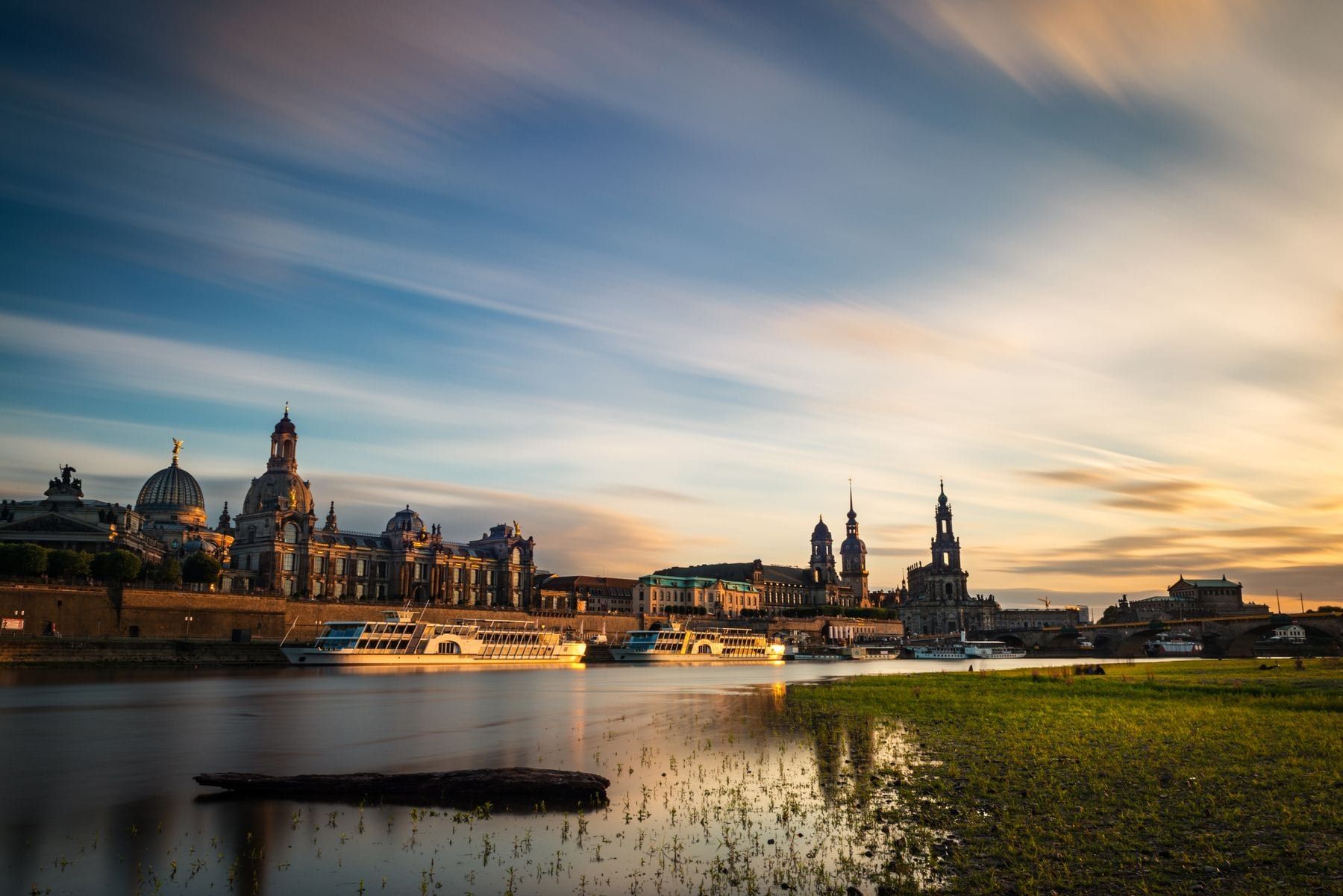
Large hotel on the Neustadt bank of the Elbe with the Canaletto view of the Altstadt from the river-side rooms, pool, garden and beer garden. A little dated, but the location by the Augustusbrücke cannot be beaten.
If you book through these links we earn a small commission, at no extra cost to you.
The rebuilt baroque church is free; the climb to the dome costs CHF 10 (about EUR 11) and gives you the best view of the Altstadt and the Elbe. Allow an hour, the queue is short in the morning, organ devotion daily at 12 noon.
Augustus the Strong's festival ground; the courtyard is free, the gallery with Raphael's Sistine Madonna, Vermeer and Canaletto costs around CHF 14 (about EUR 15) including the porcelain collection and the Mathematisch-Physikalischer Salon. Two to three hours.
The Historic Green Vault with a timed ticket for around CHF 14 (about EUR 15), plus the New Green Vault, the Armoury and the Türckische Cammer in the day ticket for around CHF 23. At least three hours; book the Historic Vault early online.
Guided tour of Semper's opera house for CHF 14 (about EUR 15), 45 minutes. Better: a performance by the Staatskapelle or the opera from CHF 25 in the back rows, three hours, book directly on semperoper.de.
Two hours from the Brühlsche Terrasse via the Fürstenzug, Hofkirche and Theaterplatz to the Zwinger, with the story of destruction and reconstruction. Guided CHF 15 to 25 (about EUR 16 to 27); there are also night watchman tours and walks in the Neustadt.
By tram or bike to Loschwitz, up by funicular or suspension railway (CHF 5 to 7, about EUR 5 to 7, return), back on foot past the Elbe palaces with the beer garden at the Lingnerschloss. Half a day, freely accessible.
On one of the historic paddle steamers of the Weisse Flotte upstream past the Elbe palaces to Schloss Pillnitz, around 90 minutes each way, CHF 20 to 30 (about EUR 21 to 32). Back by tram, Pillnitz park admission CHF 5.
40 minutes by S-Bahn, the old town, the cathedral and the Albrechtsburg on the castle hill, demonstration workshop of the porcelain manufactory for CHF 14 (about EUR 15). Guided from Dresden CHF 60 to 90, on your own around CHF 30 including train and admissions.
Courtyards with the house of the singing drainpipes, shops, cafés and street art between Görlitzer Strasse and Alaunstrasse. Free, one to two hours, best in the afternoon followed by dinner in the quarter. Guided scene walks from CHF 15 (about EUR 16).
If you book through these links we earn a small commission, at no extra cost to you.
Saxony eats heartily and drinks coffee like hardly any other German region: the "coffee Saxons" invented the coffee filter paper, and cake belongs with coffee. Dresden stands for Eierschecke and Christstollen, for Sauerbraten and dumplings, and in the Neustadt for a young cuisine that has nothing to do with any of that and still belongs.
Tray cake in three layers: yeast dough at the bottom, quark mixture in the middle, and a layer of eggs, butter and sugar on top that sets golden yellow in the oven. A slice CHF 3 to 4 (about EUR 3 to 4), best while still slightly warm.
Tip:Without raisins is the Dresden version, with raisins the Freiberg one: ask and you will get an explanation and usually a sample.
Heavy butter Stollen with raisins, candied lemon and orange peel, no marzipan, only genuine with the golden seal of the protection association. From CHF 12 (about EUR 13) per kilo, as a gift in a tin CHF 20 to 30.
Tip:The Stollen festival on the second Saturday of Advent with the giant Stollen is packed; the Stollen tastes best four weeks after baking.
Saxon pot roast: beef marinated for days in vinegar and spices, with red cabbage, dumplings and a sauce that in Saxony is often thickened with gingerbread. CHF 16 to 22 (about EUR 17 to 24).
Tip:At lunchtime it is often the dish of the day for CHF 12 to 14, in the evening it gets more expensive.
Small patties of quark, potato and flour fried in butter, with cinnamon sugar and apple sauce. Dessert or sweet main course, CHF 7 to 10 (about EUR 7 to 11).
Tip:Order them as a main course; as a dessert after the Sauerbraten you will not manage them.
Gingerbread from the small town of Pulsnitz east of Dresden, baked since 1558, spicy and soft. A pack CHF 4 to 8 (about EUR 4 to 9), also as pointed pieces with chocolate.
Tip:Pfefferkuchen is available all year round; the Pulsnitz gingerbread market weekend is in early November.
Radeberger from the neighbouring town was the court beer of the Saxon king, CHF 4 to 5 (about EUR 4 to 5) per half litre. Saxon wine from Radebeul and Meissen, mostly Müller-Thurgau, Riesling and Goldriesling, costs CHF 5 to 8 a glass.
Tip:Goldriesling exists only here, a light white wine for a summer evening on the Elbe meadows.
The Vietnamese community came as contract workers in GDR times and stayed: in the Neustadt you find pho, bánh mì and summer rolls for CHF 8 to 14 (about EUR 9 to 15), often better than any tourist restaurant in the Altstadt.
Tip:Lunch menus for CHF 9 to 11 are the cheapest good food in the city.
Through markets and eateries with a guide, tastings included.
If you book through these links we earn a small commission, at no extra cost to you.
For centuries Dresden was the residence of the Saxon electors and kings, and the city you see today is above all the work of one man: Augustus the Strong, Elector of Saxony and King of Poland, ruled from 1694 to 1733 and wanted a Versailles on the Elbe. He had the Zwinger built, bought up paintings across half of Europe, founded the Meissen porcelain manufactory after his alchemist Böttger invented European porcelain instead of gold, and filled the Green Vault with jewels. His son built the Hofkirche, and the master carpenter George Bähr created the largest stone dome north of the Alps with the Frauenkirche. In the 19th century Gottfried Semper's opera house and the picture gallery were added, the city was considered one of the most beautiful in Europe, and the painter Canaletto had already captured it as "Florence on the Elbe". On the night of 13 to 14 February 1945, British and American bombers completely destroyed the city centre, and around 25,000 people died. The GDR rebuilt the Zwinger and the Semperoper but left the ruin of the Frauenkirche standing as a memorial. Reconstruction only began after 1990, financed largely by donations, including from Britain: the cross on the dome was forged by the son of a British bomber pilot. The Frauenkirche was consecrated in 2005, and since then the Neumarkt around it has been rebuilt stone by stone to the old plans. Dresden is therefore a city where "baroque" is often less than 20 years old, which makes it no less worth seeing, just more honestly viewed.
From Zurich or Basel you take the ICE via Frankfurt or via Berlin to Dresden, 7 to 8 hours with one or two changes. With a Deutsche Bahn saver fare booked early you pay CHF 60 to 90 (about EUR 64 to 96) each way; the flexible fare is over CHF 150. Book the ticket on bahn.de or in the SBB app, both work, and DB often has the cheaper saver fares. From Vienna the Railjet to Prague and the Eurocity on to Dresden is the most scenic option, 7 hours, with the last stretch through the Elbe valley. By car it is around 750 kilometres from Zurich via Nuremberg and Chemnitz, 7 to 8 hours of pure driving, no tolls in Germany, fuel and wear around CHF 180 per trip. Once there you do not need the car: the DVB trams and buses run frequently, a day ticket costs around CHF 8, a single CHF 3. Car parks in the Altstadt charge CHF 15 to 25 a day, and many hotels in the Neustadt have no spaces of their own. If you want to add Saxon Switzerland, take the S-Bahn for that, not the car.
The Altstadt between the Frauenkirche and the Zwinger is surprisingly empty after 9 pm, the restaurants on the Neumarkt cook for coach parties, and the hotels there cost 30 to 50 per cent more than on the other side of the Elbe. The Innere Neustadt around Königstrasse is elegant and quiet, while the Äussere Neustadt between Albertplatz and the Alaunpark is the pub, café and culture quarter with the Kunsthofpassage, the courtyard with the singing drainpipes. From there you walk across the Augustusbrücke to the Frauenkirche in 20 minutes. Expect CHF 90 to 130 (about EUR 96 to 139) for a mid-range double room, budget chains from CHF 60. Price traps: the Striezelmarkt in Advent, the Dixieland Festival in May, the Semperopernball week at the end of January and trade fair weekends, when the same room quickly costs double and the city is full. Booking early pays off above all for Advent: if you reserve in September you still pay normal prices. The visitor tax of around CHF 2 per night comes on top.
The Staatliche Kunstsammlungen (State Art Collections) are the most expensive and the best thing about Dresden. Single tickets cost CHF 13 to 15 (about EUR 14 to 16) per museum (Old Masters Picture Gallery with the Sistine Madonna, New Green Vault, Armoury), and the Historic Green Vault needs a timed ticket for around CHF 14, often sold out days in advance. The trick is the Residenzschloss day ticket for around CHF 23 or the two-day ticket for all museums including the Zwinger for around CHF 30. The Frauenkirche is free, the climb to the dome costs CHF 10 and is worth more than any viewing platform. The Semperoper: a guided tour costs CHF 14, but a performance in the back rows is available from CHF 25, and that is the better experience. Book directly on semperoper.de, not through platforms with a mark-up. The steamers of the Weisse Flotte charge CHF 20 to 35 for an Elbe round trip; you see the same palaces from the Elbe cycle path for nothing. Lunch menus in the Neustadt cost CHF 10 to 14, a beer CHF 4.50, coffee and cake CHF 7 to 9. Dresden is cheap by Swiss standards, it is only the museums that add up.
The Striezelmarkt on the Altmarkt is one of the oldest Christmas markets in Germany, held since 1434, and from late November to 24 December it is the big event: Pflaumentoffel figures, Stollen, the pyramid, plus three more markets in the Altstadt and the medieval market in the Stallhof. Lovely, but overcrowded at weekends, so go on a weekday and early in the afternoon. Summer from June to August is the second-best time: from late June the Filmnächte on the Elbe bank show films and concerts with the Altstadt as a backdrop, the beer gardens on the Elbe are open, and the Elbe meadows belong to everyone. Spring and autumn are quieter and often cheaper; October, with the foliage around the Elbe palaces, is underrated. January and February are cold, grey and as empty as Dresden ever gets, but you stand alone in front of the Sistine Madonna. Flooding: the Elbe rises after snowmelt and heavy rain; in 2002 and 2013 the Altstadt was under water, in normal years you notice nothing.
Above the Elbe stand three palaces in the English style, Albrechtsberg, Lingnerschloss and Eckberg, with vineyards in front and a beer garden at the Lingnerschloss that has one of the best views in the city. You reach them on foot from the Blaues Wunder, the steel bridge of 1893 in Loschwitz, where the funicular and the suspension railway also start; both have been running for over 120 years and cost CHF 5 to 7 (about EUR 5 to 7) return. Down in the village of Loschwitz there are wine taverns and the Künstlerhaus. Further upstream lies Schloss Pillnitz, Augustus the Strong's summer residence in the Chinese style, with a park that costs CHF 5 and a camellia over 250 years old that flowers in March; steamer or tram plus ferry takes you there. For a day trip: Meissen with the Albrechtsburg, the cathedral and the porcelain manufactory, 40 minutes by S-Bahn, with the manufactory charging CHF 14 for the demonstration workshop. The Dresdner Heide in the north is a forest for cycling, and Radebeul with the Schloss Wackerbarth and Hoflössnitz wine estates is the city's wine-growing area.
Saxon cooking is hearty and sweet at the same time. At lunchtime you find Sauerbraten with red cabbage and dumplings in the Altstadt for CHF 16 to 20 (about EUR 17 to 21), and Quarkkeulchen for dessert for CHF 7. The Eierschecke, a three-layered tray cake of yeast dough, quark and an egg layer on top, is the compulsory pastry, CHF 3 to 4 a slice in every good bakery and café. Dresdner Christstollen only comes with the golden seal of the protection association, from CHF 12 per kilo; in Advent it is everywhere, the rest of the year at the big bakeries. For the evening you go to the Äussere Neustadt: Alaunstrasse, Louisenstrasse, Görlitzer Strasse, where bars, Vietnamese places, pizzerias and craft beer pubs stand door to door, a main course CHF 12 to 18. The beer gardens on the Neustadt bank of the Elbe, for example at the Narrenhäusel and by the Japanisches Palais, come with the famous Canaletto view included. Coffee house culture is found at Café Schinkelwache on Theaterplatz, expensive but with the location, and at the bakeries in the Neustadt for half the price.
By ICE via Frankfurt or Berlin in 7 to 8 hours from Zurich or Basel, saver fare from around CHF 60 (about EUR 64) each way if you book two to three months ahead, otherwise CHF 100 to 150. By car via Nuremberg around 750 kilometres and 7 to 8 hours, no tolls. Once there you do not need a car: trams, a bike and your feet are enough, and parking in the Altstadt costs CHF 15 to 25 a day.
Three full days is a good rule of thumb: one day for the Altstadt with the Frauenkirche, Zwinger and Residenzschloss, one day for the Neustadt with the Elbe palaces, Loschwitz and the Blaues Wunder, one day for Pillnitz or Meissen. If you want to add Saxon Switzerland, stay four to five days. A weekend is enough for the Altstadt and an evening in the Neustadt, but then you have only seen part of it.
May to September for the Elbe, the beer gardens and the Filmnächte on the river bank, Advent for the Striezelmarkt. October is the most beautiful and the quietest. July and August can get hot, as the city lies in the Elbe valley, and then the Elbe meadows and Pillnitz are the rescue. January to March is grey, but empty and cheap, and the museums are a pleasure then.
Considerably less. A mid-range double room CHF 90 to 130 (about EUR 96 to 139), a main course CHF 12 to 18, a beer CHF 4.50, a day ticket for public transport CHF 8. Only the museums at CHF 13 to 15 per museum and opera tickets in the front rows are expensive. With CHF 90 to 110 per person per day excluding travel you are doing well, with a museum ticket and an evening at the opera CHF 150.
For the Historic Green Vault yes, the time slots are often booked up days ahead, in Advent weeks ahead; book on skd.museum. For the Semperoper yes, good seats for operas are gone months in advance, remaining tickets are sold at the box office in the evening. The Frauenkirche, the Zwinger courtyard and the Brühlsche Terrasse are freely accessible; you buy tickets for the picture gallery and the dome on the spot. For the dome climb in the afternoon a queue of 20 to 30 minutes can form.
Dresden is as safe as any large German city, and the Äussere Neustadt is busy and unproblematic at night. The city has a difficult political reputation that hardly plays a role in everyday life as a guest; you can avoid Monday evenings on the Altmarkt. What you will notice: a lot is still cash, the tone is direct, and the Saxon dialect takes a day to get used to. In return, Dresdeners are proud of their city and happy to explain it.
Berlin · Leipzig · Dresden · Bad Schandau
Nightjet from Zurich to Berlin, then ICE and Deutschlandticket through the east: three cities that are cheaper and more exciting than their reputation, and the Bastei at 7 in the morning to finish.
Wernigerode · Bad Schandau · Dresden
Two low mountain ranges that the Swiss underestimate: the Harz with the Brocken, steam railway and Hexenstieg, then the sandstone rocks of Saxon Switzerland on the Malerweg, with a day in Dresden to finish. All by train and bus.
The two most famous Christmas markets in Germany: the Dresden Striezelmarkt on the Altmarkt has been held since 1434 and claims to be the oldest, with a 14-metre tiered pyramid from the Ore Mountains, prune figures (Pflaumentoffel), stollen and the Stollen Festival on the second Saturday of Advent, when a giant stollen weighing tonnes is paraded through the city. Nuremberg's Christkindlesmarkt on the Hauptmarkt is opened by the Christkind from the balcony of the Frauenkirche, with 180 red-and-white stalls, gingerbread, grilled sausages and a strict rule against plastic decorations. Mulled wine costs around CHF 4 to 5 (EUR 4 to 5) plus deposit, food CHF 5 to 10 (EUR 5 to 10), noticeably cheaper than in Switzerland. On Advent weekends both markets are so full from 3 pm that visitor flows are managed and coaches bring tens of thousands; on weekday mornings it is quiet. Hotels in Dresden and Nuremberg cost a good one and a half times the usual rate in Advent and are gone early for weekends; Dresden is around seven hours from Zurich by train, Nuremberg four.
For travellers: In Dresden combine the visit with the smaller markets in the Neustadt and the medieval market in the Stallhof, in Nuremberg with the sister cities market on Rathausplatz; both cities are reachable car-free by night train or ICE, which is the best choice in Advent.
What a few days in Germany's cheapest big city really cost, why Plagwitz is more exciting than the centre, and how you hear Bach without buying a concert ticket.
What a week of hiking in the Elbe Sandstone Mountains really costs, why you visit the Bastei at 7 am and not at 11 am, and how you get through the whole national park without a car.
What a week in Germany's northernmost mountain range really costs, whether the Brockenbahn is worth its CHF 50, and why Quedlinburg is the most beautiful town you have never heard of.