Schaffhausen and the Rhine Falls

Switzerland · Zurich, Basel & Lucerne · Travel guide

Schaffhausen and the Rhine Falls

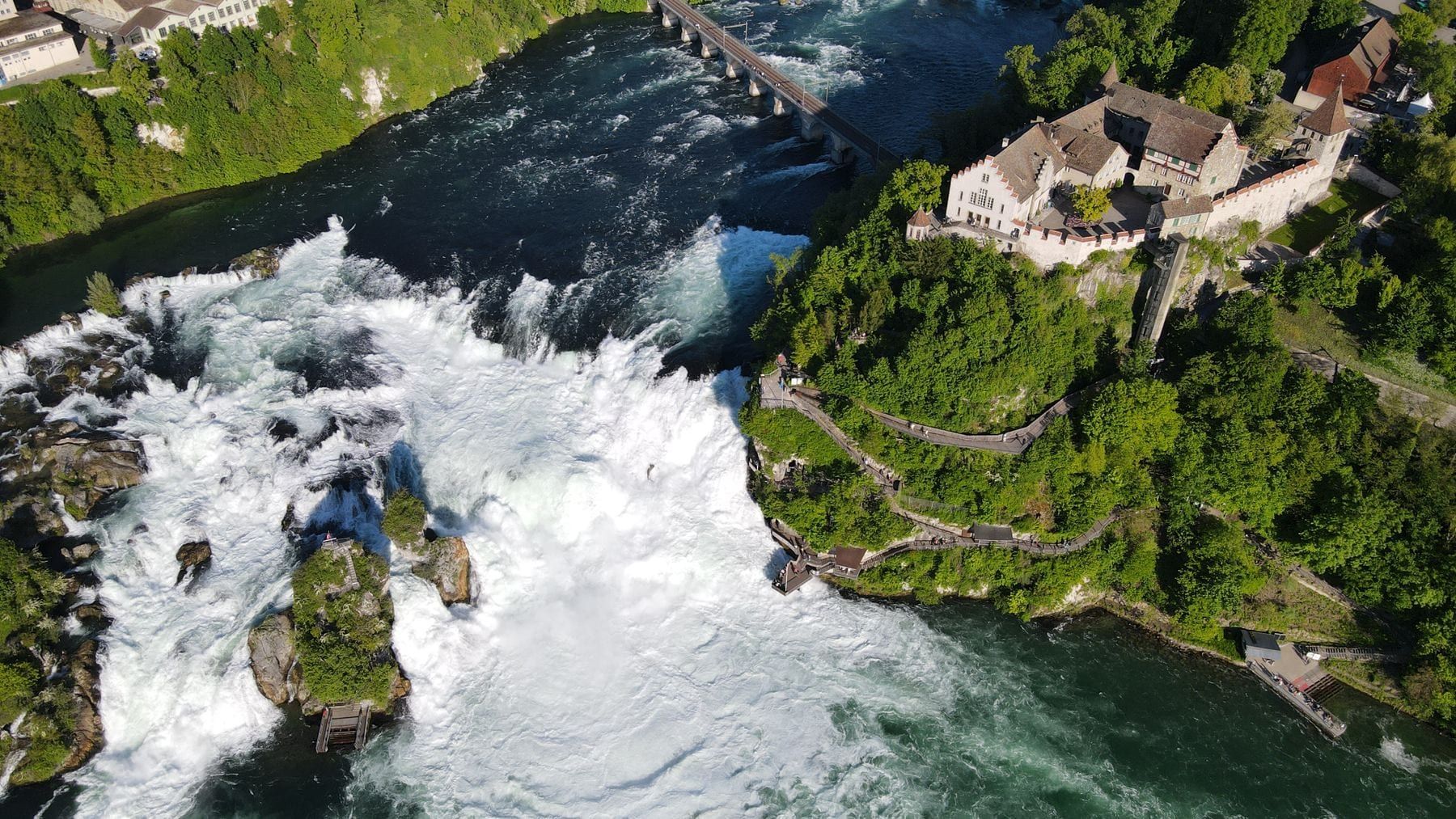
What a day or a weekend at the largest waterfall in Europe really costs, why the north bank beats Schloss Laufen, and why you should not see Schaffhausen only as a station to change trains.

Photo: Drone Blondie / Pexels

What does a trip to Schaffhausen and the Rhine Falls cost?

Adjust the values to your trip: the calculator updates live (EUR, converted from CHF estimates).

1,594 EUR
≈ 797 EUR per person
  • Getting there 86 EUR
  • Accommodation 856 EUR
  • Food 535 EUR
  • Local transport 64 EUR
  • Rhine Falls complete (Schloss Laufen platform and boat trip to the rock) 54 EUR

Estimates for orientation, not booking prices. Getting there means train or car from Switzerland, return, per person. Hotels vary strongly by season: current prices are behind the links below.

Money & payment: You pay in Swiss francs (CHF). Cards and the Twint app work practically everywhere, even on alpine pastures. Many shops accept euros but give change in francs at a poor rate. Service is included in prices; rounding up is customary. Getting there: By train (SBB) or car, 1 to 4 hours from Zurich.

Recommended hotels

Nine options in three price ranges, each among the best-rated on Booking.com.

Budget

Schaffhausen Youth Hostel

Belair, Schaffhausen

Youth hostel in a villa with a park on the edge of town, double and family rooms, breakfast included, bus to the old town in ten minutes. Quiet and cheap. For families and anyone who wants to see the Rhine Falls on a small budget.

from CHF 110 / night (about EUR 118) View →

Best Western Plus Hotel Bahnhof

Station, Schaffhausen

Four-star chain hotel opposite the station, three minutes to the old town, ten minutes by S-Bahn to the Rhine Falls. Little charm, but air-conditioned, clean and practical, and often the cheapest decent room in town. For a night in transit or an early start to the waterfall.

from CHF 140 / night (about EUR 150) View →

Hotel Rheinfels

Old town, Stein am Rhein

Inn right by the Rhine bridge in Stein am Rhein, with rooms facing the river and a fish restaurant on the terrace. Simple and family-run; in the evening you have the little town to yourself. For anyone who wants to experience Stein am Rhein without the day visitors.

from CHF 130 / night (about EUR 139) View →

Mid-range

Hotel Kronenhof Schaffhausen

Old town, Schaffhausen

Old-town hotel in a 15th-century building, five minutes from the station and at the foot of the Munot, with an inner courtyard and a restaurant. Rooms renovated, quiet despite the central position. For a weekend with the old town on the doorstep.

from CHF 160 / night (about EUR 171) View →

Sorell Hotel Rüden

Old town, Schaffhausen

Guild house from 1300 in the heart of the old town on the Oberstadt, run by the Sorell group, with the historic guild room as its restaurant. Comfortable rooms in the new building behind the old facade. For anyone who wants history with chain standards.

from CHF 170 / night (about EUR 182) View →

Hotel Adler Stein am Rhein

Rathausplatz, Stein am Rhein

Right on the painted Rathausplatz, itself with facade paintings by Alois Carigiet, and a restaurant serving fish from the Untersee. Rooms modern and bright. For anyone who wants to sleep inside the postcard and have the empty square in the morning.

from CHF 180 / night (about EUR 193) View →

Luxury

Hotel Chlosterhof Stein am Rhein

Riverbank, Stein am Rhein

The largest house in the region, right on the Rhine below the old town, with rooms facing the river, a wellness area and a restaurant with a terrace. Four stars, more practical than romantic. For comfort with Rhine views and for families who need space.

from CHF 240 / night (about EUR 257) View →

Hotel Park Villa

Parkstrasse, Schaffhausen

Historic villa with its own park on Parkstrasse, five minutes on foot from the old town, with individually furnished rooms full of antiques, restaurant, bar and free parking. For a night in a house that breathes Schaffhausen's industrial history instead of a chain.

from CHF 200 / night (about EUR 214) View →

Hotel Rheingerbe

Schiffländi, Stein am Rhein

Small hotel right on the Rhine at the Schiffländi landing in Stein am Rhein, with restaurant, terrace on the water and rooms with river views, 150 metres from the Rathausplatz. Not luxury in the sense of a spa, but of location and dinner by the river.

from CHF 190 / night (about EUR 203) View →

If you book through these links we earn a small commission, at no extra cost to you.

Experiences worth your time

Rhine Falls with boat trip to the rock

From the Schlössli Wörth on the north bank by boat to the rock in the middle of the waterfall, staircase up to the flagpole, CHF 20 (about EUR 21), 20 minutes and wet. Round trip in the basin CHF 12, crossing to the south bank CHF 5. April to October.

View & book →

Känzeli platform at Schloss Laufen

From the castle by lift or stairs down to the platform right next to the wall of water, admission CHF 5 (about EUR 5) including the visitor centre. Early in the morning or after 5 pm without coaches, 45 minutes. By S-Bahn directly to the Schloss Laufen station.

View & book →

Munot and Schaffhausen old town

The round fortress above the town is free, with casemates, a spiral ramp and battlements looking over the Rhine and the vines. Then through the Vordergasse to the Haus zum Ritter and the 171 oriel windows. Guided city tour from CHF 15 (about EUR 16), two hours.

View & book →

Boat trip to Stein am Rhein

Two hours upstream on the URh boat through the most beautiful river landscape in Switzerland, around CHF 15 (about EUR 16) one way with the Half Fare Card, bikes carried. On across the Untersee to Konstanz. April to October, back by train in 25 minutes.

View & book →

Stein am Rhein with the monastery of St. Georgen

Painted facades on the Rathausplatz, the monastery with its banqueting hall from 1515 (CHF 5, about EUR 5) and the climb to Hohenklingen Castle with its view and restaurant, free. Half a day, before 11 am or after 4 pm, otherwise the square is full of groups.

View & book →

Wine tasting in the Blauburgunderland

Hallau, Wilchingen and Osterfingen in the Klettgau, tastings at winegrowers from CHF 10 (about EUR 11), a bottle of Pinot Noir from CHF 15 at the farm, Hallau wine museum CHF 8. By car or bike, in autumn with Besenbeizen and the Herbstsonntag. Half a day.

View & book →

Museum zu Allerheiligen

In the former monastery with cloister, herb garden and the Romanesque Münster next door: archaeology, town history and art up to Otto Dix. Admission CHF 12 (about EUR 13), cloister and Münster free. An hour and a half, the best rainy-day plan in town.

View & book →

Bike tour along the Rhine to Stein am Rhein

25 flat kilometres along the river, through Diessenhofen with its wooden bridge, three hours with breaks. Rental bike at the station CHF 30 to 40 (about EUR 32 to 43) a day, e-bike CHF 50 to 60. Back by boat or train, both carry bikes.

View & book →

If you book through these links we earn a small commission, at no extra cost to you.

Food & drink

Schaffhausen eats between the Rhine and the vines: fish from the river, asparagus from the Klettgau in spring, game in autumn and Pinot Noir with everything. There is no single national dish, but there are winegrowers' taverns where the menu comes from the garden. Prices are below Zurich, and the wine country is cheaper again.

Felchen from the Rhine and the Untersee

Fish restaurants on the Rhine bank in Stein am Rhein or the Schlössli Wörth at the Rhine Falls

Delicate whitefish fillets, in butter or meunière style, with boiled potatoes, on the Untersee also deep-fried as Felchenknusperli. CHF 32 to 42 (about EUR 34 to 45) in a restaurant on the river.

Tip:Ask for the catch of the day; in early summer there is sometimes Rhine eel or pike.

Schaffhauser Zungen

Confiserie Reber on the Fronwagplatz or bakeries in the Vordergasse

Tongue-shaped pastries made from two meringue bases with a buttercream filling, the Schaffhausen sweet since 1901. CHF 3 to 4 (about EUR 3 to 4) a piece at the bakery.

Tip:Do not leave them in the sun, the buttercream forgives nothing.

Klettgau asparagus

Besenbeizen and inns in the Klettgau, for example in Hallau or Wilchingen

In April and May from Hallau and the surrounding area, white or green, with hollandaise sauce and cured ham or as asparagus risotto. Asparagus plate CHF 32 to 40 (about EUR 34 to 43).

Tip:Many farms sell directly at the roadside, a kilo for CHF 12 to 16.

Blauburgunder from Hallau

Tastings at winegrowers in Hallau or at the Hallau wine museum

The Pinot Noir of the Klettgau, light to full-bodied, the biggest red wine of German-speaking Switzerland. CHF 7 to 9 (about EUR 7 to 10) a glass in a restaurant, CHF 15 to 25 a bottle from the farm.

Tip:On the Hallauer Herbstsonntag in October the cellars are open, and the wine museum includes tastings with admission.

Rehpfeffer and game in autumn

Inns in the Randen and the Klettgau, for example Bad Osterfingen

On every menu from September to November: Rehpfeffer, venison stew, with Spätzli, red cabbage, chestnuts and cranberries. CHF 38 to 48 (about EUR 41 to 51), cheaper at lunchtime as a game plate.

Tip:Ask for local game; in the Randen they hunt themselves, and good menus say so.

Bölletünne

Besenbeizen in the wine country in autumn or the Saturday market in Schaffhausen

Thin onion tart with cream and bacon, the winegrowers' autumn dish to go with the new wine (Sauser). A slice CHF 6 to 9 (about EUR 6 to 10) in a pub or at the market.

Tip:Only in September and October, together with sweet Sauser for CHF 4 to 5 a glass.

Rhybadi Bratwurst

Rhybadi Schaffhausen and the Lindli promenade in summer

Bratwurst with a Bürli roll at the river bath or at the Munot kiosk, the summer lunch on the Rhine. CHF 7 to 9 (about EUR 7 to 10), beer with it CHF 5.

Tip:Barbecuing on the Lindli is allowed, and the Coop on the Vordergasse has the sausage and the bread.

Book a food tour: Schaffhausen and the Rhine Falls

Through markets and eateries with a guide, tastings included.

View & book →

If you book through these links we earn a small commission, at no extra cost to you.

History & background

The Rhine Falls are 15,000 years old, a child of the last ice age: when the Rhine looked for a new bed after the glaciers retreated, it hit a hard rib of Jurassic limestone, and ever since it has plunged 23 metres over a width of 150 metres at Neuhausen. In summer 600,000 litres a second thunder down, in June after the snowmelt almost double that, in winter a third. Because the waterfall stopped all shipping, everything had to be unloaded here, and out of that grew Schaffhausen: from the 11th century the town grew around the monastery of Allerheiligen, founded by the counts of Nellenburg, and the Münster of 1103 is one of the purest Romanesque buildings in Switzerland. Schaffhausen became a free imperial city, joined the Confederation in 1501, and from 1564 to 1589 built the Munot, a round fortress based on ideas from Dürer's treatise on fortification, with casemates and a ramp where pigeons live today. The merchants decorated their houses with 171 oriel windows, more than any other Swiss town, and painted the facades; the Haus zum Ritter of 1570 is the most famous. In the 19th century the water of the Rhine Falls powered industry: Neuhausen produced the first aluminium works in Europe and the knives of SIG, Schaffhausen the watches of IWC, made on the Rhine since 1868. On 1 April 1944 American aircraft bombed the town by mistake, 40 people died, the only heavy bombing of neutral Switzerland. Stein am Rhein, 20 kilometres upstream, survived completely intact and in 1972 received the first Wakker Prize for heritage protection. The Schaffhausen Blauburgunderland around Hallau, with 480 hectares, is the largest wine-growing area in German-speaking Switzerland.

Insider tips

Getting there and around: S-Bahn from Zurich, bike along the Rhine

Schaffhausen lies three quarters of an hour north of Zurich: the IC trains take 38 minutes, the S12 and S9 S-Bahn lines around an hour, return with the Half Fare Card CHF 20 to 25 (about EUR 21 to 27). From Basel you are here in 1 hour 50 via Zurich, from Winterthur in 20 minutes, from Konstanz in 50 minutes by boat or 40 minutes by train via Singen. From Germany, DB runs direct from Stuttgart via Singen to Schaffhausen in 2 hours 30, from Munich via Lindau in 4 hours. For the Rhine Falls themselves the S-Bahn stops directly at the station Schloss Laufen am Rheinfall (south bank) or Neuhausen Rheinfall (north bank), both 10 minutes from Schaffhausen. By car: 45 minutes from Zurich on the A4, a CHF 40 vignette is required, the Schloss Laufen car park costs CHF 5 a day, and in Schaffhausen's old town the Herrenacker car park CHF 1.50 an hour. For a weekend the car really is practical here, because the wine country, the Klettgau and Stein am Rhein need several changes by public transport. The best way to get around, though, is the bike: the Rhine path from Schaffhausen to Stein am Rhein is 25 flat kilometres along the river, rental bikes are available at the station for CHF 30 to 40 a day, and on the way back you take the boat, which carries bikes.

Rhine Falls: north bank, south bank, boat

The Rhine Falls have two banks, and the choice decides your day. The south bank with Schloss Laufen is the official one: this is where the coaches park, and here access to the visitor centre, the lift and the Känzeli platform right at the wall of water costs CHF 5 (about EUR 5) per person. The Känzeli is impressive, you stand in the spray next to the falling masses of water, but you stand there with a lot of people. The north bank at Neuhausen is free: from the Schlössli Wörth and from the riverside path you see the whole fall head-on, that is the postcard view, and that is where the boats leave. The Rhine Falls ferry (Mändli) takes you for CHF 20 to the rock in the middle of the falls, where you climb a staircase up to the flagpole, 20 minutes, wet, worth it. The plain crossing between the banks costs CHF 5, a 30-minute round trip in the basin CHF 12. Our plan: S-Bahn to Neuhausen Rheinfall, down to the Schlössli Wörth, boat to the rock, ferry across to Schloss Laufen, the Känzeli there, then back on foot across the railway bridge. That is two to three hours and CHF 30. In June and July the volume of water is greatest, on 31 July there are fireworks above the falls, and in the evening they are lit until 11 pm. Early in the morning or after 5 pm the coaches are gone.

Where to stay: old town or riverbank, not at the falls

At the Rhine Falls themselves there are two addresses, the youth hostel in Schloss Laufen and a few rooms in Neuhausen, and whoever sleeps there has the waterfall almost to themselves in the evening and morning, which is a good argument. For everyone else Schaffhausen is the better base: the old town has a few small hotels in guild houses and inns, double rooms CHF 140 to 200 (about EUR 150 to 214), plus the Zunfthaus zum Rüden and the Hotel Kronenhof with history. The price level is clearly below Zurich, 20 to 30 per cent less for similar houses, and at weekends they are often empty, because Schaffhausen lives off industrial business travellers during the week. Stein am Rhein is the romantic alternative, with hotels in the painted houses on the Rathausplatz or right on the Rhine, but very full during the day in summer and empty in the evening, which you enjoy as a hotel guest. In the wine country, in Hallau, Osterfingen or Wilchingen, you sleep in winegrowers' inns for CHF 120 to 160 including breakfast and eat with the wine in the evening, but for that you need a car or the bike. You do not need to book far ahead anywhere, except for the Rhine Falls fireworks on 31 July and the Stars in Town festival in Schaffhausen in August.

Munot, oriel windows and the old town nobody sees

Schaffhausen has 171 oriel windows, painted Renaissance facades and a car-free old town, and yet 90 per cent of Rhine Falls visitors never go in. The Munot is the reason to take an hour: the round fortress above the town is free to enter, the spiral ramp takes you into the casemates and up to the battlements with a view over the Rhine, the roofs and the vineyards, in the evening the Munot keeper rings the little bell at 9 pm, and in summer there is dancing up there (Munot balls, admission around CHF 10, about EUR 11). From the battlements the path leads down through the vines to the Vordergasse and the Haus zum Ritter with its frescoes by Tobias Stimmer. The Museum zu Allerheiligen in the old monastery (CHF 12) is astonishingly good for a town this size, with the cloister, the herb garden and a collection from the Stone Age to Otto Dix. The locals drink their coffee on the Fronwagplatz, their beer in the Fass-Beizli, and on Saturday mornings there is a market in the Vorstadt. From the Lindli, the Rhine promenade below the Munot, you swim in the Rhine in summer, entirely officially and for free, with steps into the water and the current carrying you downstream to the Rhybadi, the wooden river bath of 1870 (CHF 4). IWC has a small museum (CHF 6) on Baumgartenstrasse for anyone who likes watches.

Stein am Rhein, the wine country and the Untersee

Stein am Rhein is the best-preserved medieval small town in Switzerland, with painted facades around the Rathausplatz, the monastery of St. Georgen (CHF 5, about EUR 5, with a banqueting hall from 1515) and Hohenklingen Castle above the town, where you hike up for CHF 0 and eat for CHF 25 to 35. The problem: between 11 am and 4 pm on a summer day there are more tour groups than cobblestones on the square. Come in the morning or late afternoon, or sleep there. From Schaffhausen you are there in 25 minutes by train, or in 2 hours upstream on the URh boat, which is the most beautiful stretch of the Rhine, around CHF 15 one way with the Half Fare Card. The boat carries on across the Untersee to Konstanz, past the island of Reichenau with its churches. The Schaffhausen wine country, the Klettgau with Hallau, Wilchingen and Osterfingen, is the largest Pinot Noir area in German-speaking Switzerland: a wine museum in Hallau, tastings at the winegrowers from CHF 10, a bottle of Pinot Noir from CHF 15 direct from the farm. In October it is the Hallauer Herbstsonntag with a parade and open cellars. For the evening we recommend the Bad Osterfingen, a 16th-century inn in the middle of the vines, or the Besenbeizen, the pop-up taverns that winegrowers only open in autumn.

Timing and costs: day trip or weekend

Honestly, half a day is enough for the Rhine Falls alone, and many people do them as a trip from Zurich. For that, count on CHF 25 (about EUR 27) for the train, CHF 25 for the platform and boat and CHF 20 to 30 for food, so around CHF 75 per person. The weekend only pays off with Schaffhausen, Stein am Rhein and the wine country: two nights for two people CHF 300 to 380, food CHF 50 per person per day, boat and train CHF 25 a day, CHF 550 to 700 in total, a quarter less than the same weekend in Lucerne. The best time is May to July for the volume of water, September and October for wine and light, and winter for the Rhine Falls with ice at the edges and Schaffhausen without a single tourist. The Rhine Falls are open 365 days a year, the visitor centre and the boats run from April to October, in winter only the ferry at weekends. What is not worth it: the Adventure Park at the Rhine Falls is an ordinary rope park, the Historama in Schloss Laufen an add-on, and the souvenir stalls at the castle car park sell the same things as everywhere else. What is worth it: a glass of Schaffhausen Pinot Noir on the terrace of the Schlössli Wörth with a view of the falls, CHF 7, the best value for money of the day.

Frequently asked questions about Schaffhausen and the Rhine Falls

How do I get to the Rhine Falls, and do I need a car?

By train from Zurich to Schaffhausen in 38 minutes (return with the Half Fare Card CHF 20 to 25, about EUR 21 to 27) or by S-Bahn in around an hour directly to the station Schloss Laufen am Rheinfall or Neuhausen Rheinfall. From Stuttgart DB runs via Singen in 2 hours 30. For the Rhine Falls alone you do not need a car; for the wine country and Stein am Rhein one is practical, or you take bike and boat.

What do the Rhine Falls cost?

The north bank at Neuhausen with the Schlössli Wörth and the riverside path is free and has the head-on view. The south bank with Schloss Laufen costs CHF 5 (about EUR 5) for the visitor centre, the lift and the Känzeli platform right at the water. The boat trip to the rock in the middle of the falls costs CHF 20, the plain crossing CHF 5, a round trip CHF 12. With everything you are at CHF 30 per person.

Which side of the Rhine Falls is better?

For the view, the north bank at Neuhausen, from where you see the whole fall head-on, and where the boats start. For the experience, the south bank with the Känzeli, where you stand in the spray next to the falling water. Our advice: both, with the ferry for CHF 5 (about EUR 5) in between, or on foot across the railway bridge. With the boat to the rock that is two to three hours.

When is the best time to visit the Rhine Falls?

May to July, when the snowmelt fills the Rhine and up to a million litres a second come down. On 31 July there are the big fireworks. September and October are ideal for Schaffhausen, Stein am Rhein and the wine country, with autumn Sundays and open cellars. In winter the Rhine carries a third of the water, but everything is empty and the boats only run at weekends.

Is an overnight stay worth it, or is a day trip enough?

For the Rhine Falls alone, half a day from Zurich is enough. A weekend pays off with the Schaffhausen old town, the Munot, Stein am Rhein by boat and an evening in the wine country. Count on CHF 550 to 700 (about EUR 589 to 749) for two people and two nights including food and travel, which is considerably cheaper than Lucerne or Zurich. Whoever sleeps in the youth hostel in Schloss Laufen has the falls to themselves in the morning.

How do I get to Stein am Rhein, and how do I avoid the crowds?

From Schaffhausen by train in 25 minutes, by bike in two hours on the flat along the Rhine, or on the URh boat in two hours upstream, around CHF 15 (about EUR 16) with the Half Fare Card, the most beautiful option. The tour groups come between 11 am and 4 pm, so go early in the morning or after 4 pm, when the Rathausplatz is empty and Hohenklingen Castle is open for dinner.

Itineraries with this destination

Activities in the region

Events

Aug 1

Swiss National Day, 1 August

Public holiday

1 August 2027 1 August, public holiday; in 2027 a Sunday

Swiss National Day commemorates the Federal Charter of 1291 and is the only public holiday that applies across the whole country: shops, banks and offices are closed, trains run to a Sunday timetable, mountain railways and restaurants in tourist resorts stay open. It is celebrated village-style: lantern parades, bonfires on the hills, farm brunches in the morning and speeches with brass bands in the evening, plus private fireworks late into the night, which are banned in many places in dry years. The biggest fireworks go up on 31 July at the Rhine Falls, where the falls are lit in colour; there are further big displays in Zurich (not every year), Basel and Lucerne, and the official ceremony on the Rütli meadow. Hotels are fully booked around 1 August, which falls in the middle of the summer holidays, and prices are correspondingly high. With a dog, the evening is no fun at all.

For travellers: For the Rhine Falls fireworks on 31 July, arrive early and leave the car behind, as Schaffhausen and Neuhausen are closed to traffic; on the morning of 1 August hundreds of farms serve a farmhouse brunch (Buurezmorge), booking is essential.

More destinations in Zurich, Basel & Lucerne