Basel

Switzerland · Zurich, Basel & Lucerne · Travel guide

Basel

What a museum weekend in Basel costs, why in summer you float through the city on the Rhine instead of walking, and how the BaselCard saves you half of the admission fees.

Photo: Sevi Schiegg / Pexels

What does a trip to Basel cost?

Adjust the values to your trip: the calculator updates live (EUR, converted from CHF estimates).

1,723 EUR
≈ 861 EUR per person
  • Getting there 107 EUR
  • Accommodation 963 EUR
  • Food 589 EUR
  • Local transport 0 EUR
  • Museum day (Kunstmuseum and Fondation Beyeler, with BaselCard) 64 EUR

Estimates for orientation, not booking prices. Getting there means train or car from Switzerland, return, per person. Hotels vary strongly by season: current prices are behind the links below.

Money & payment: You pay in Swiss francs (CHF). Cards and the Twint app work practically everywhere, even on alpine pastures. Many shops accept euros but give change in francs at a poor rate. Service is included in prices; rounding up is customary. Getting there: By train (SBB) or car, 1 to 4 hours from Zurich.

Recommended hotels

Nine options in three price ranges, each among the best-rated on Booking.com.

Budget

Basel Youth Hostel

St. Alban, Basel

Youth hostel in an old silk ribbon factory right on the Rhine, five minutes on foot from the Kunstmuseum. Double rooms with bathroom, breakfast included, an inner courtyard with a stream. One of the best locations in the city at the lowest price.

from CHF 120 / night (about EUR 128) View →

ibis budget Basel City

Gundeldingen, Basel

Budget chain behind the SBB station, small functional rooms, nothing more and nothing less. With the hotel ticket you are at the Marktplatz in ten minutes. For anyone who would rather put the money into museums.

from CHF 90 / night (about EUR 96) View →

Central City Hotel Rochat

Petersplatz, Basel

Simple, quiet hotel on Petersplatz next to the university, within walking distance of the old town and the Spalenberg. Alcohol-free and without frills, but well run and fair. For travellers who want central and cheap.

from CHF 120 / night (about EUR 128) View →

Mid-range

Motel One Basel

Barfüsserplatz, Basel

The chain in its best Basel location: right on the Barfüsserplatz, old town and Rhine five minutes on foot. The familiar standard with good beds and a pleasant lounge. For city travellers who put location above room size.

from CHF 160 / night (about EUR 171) View →

Hotel Krafft Basel

Kleinbasel, Basel

Art nouveau house right on the Kleinbasel bank of the Rhine with views of the Münster and the Mittlere Brücke, and a restaurant with a terrace on the water. Rooms vary in size; the ones facing the Rhine are the more expensive and the right ones. For anyone who wants Basel from the river.

from CHF 200 / night (about EUR 214) View →

Hyperion Hotel Basel

Messe, Basel

Large, modern house on the Messeplatz in Kleinbasel, with spacious rooms, a gym and city views from the upper floors. Tram outside the door, Rhine bank in five minutes. Very fair on price outside the trade fairs.

from CHF 170 / night (about EUR 182) View →

Luxury

Grand Hotel Les Trois Rois

Old town, Basel

One of the oldest city hotels in Europe, right on the Rhine at the Mittlere Brücke, with the three-star restaurant Cheval Blanc. Rooms with river views, a terrace above the water, history since 1681. For the occasion when Basel is meant to shine.

from CHF 600 / night (about EUR 642) View →

Der Teufelhof Basel

Old town, Basel

Art and culture hotel in two old-town houses on the Leonhardsgraben, with rooms designed by artists, a theatre and two restaurants. Not classic luxury, but unique in Basel. For art travellers who see the hotel as part of the programme.

from CHF 260 / night (about EUR 278) View →

Nomad Design & Lifestyle Hotel

Aeschen, Basel

Exposed-concrete design hotel from the Krafft group near Aeschenplatz, with the restaurant Eatery and a bar that locals visit too. Five minutes on foot to the Kunstmuseum and the station. For design travellers who find the grand hotel too classic.

from CHF 240 / night (about EUR 257) View →

If you book through these links we earn a small commission, at no extra cost to you.

Experiences worth your time

Fondation Beyeler in Riehen

The best art museum in Switzerland in the Renzo Piano building with its park, Monet, Rothko, Giacometti and major temporary exhibitions. Admission CHF 25 to 30 (about EUR 27 to 32), half with the BaselCard, free up to age 25. Tram 6 in 20 minutes, allow two to three hours.

View & book →

Kunstmuseum Basel

The oldest public art collection in the world with the largest Holbein collection, and in the new building modern art from Picasso to Warhol. Admission CHF 26 (about EUR 28) for all buildings, free in the last hour and on the first Sunday of the month. Two to three hours.

View & book →

Old town walk with Münster and town hall

The Münster with the Pfalz terrace above the Rhine (tower CHF 6, about EUR 6), the red town hall on the Marktplatz, Spalenberg and Spalentor. Guided tour from CHF 20 with the BaselCard discount, two hours. Free on your own.

View & book →

Swimming the Rhine with a Wickelfisch

From June to September, drift 20 to 40 minutes through the city with the current, your clothes in a waterproof bag. Wickelfisch from CHF 30 (about EUR 32), then a beer at a buvette for CHF 5 to 6. Only when the green flag is flying and only as a confident swimmer.

View & book →

Museum Tinguely

Jean Tinguely's clattering machine sculptures in the Mario Botta building right on the Rhine, with buttons to press. Admission CHF 18 (about EUR 19), free up to age 16. The museum that delights children and adults alike, an hour and a half.

View & book →

Vitra Campus in Weil am Rhein

Tram 8 across the border to the architecture park with buildings by Gehry, Hadid, Herzog & de Meuron and the Vitra Design Museum. Campus free, museum around CHF 15 (about EUR 16), architecture tour CHF 16. Half a day, and the VitraHaus with its exhibition is free too.

View & book →

Rhine cruise and harbour tour

The Basel passenger boats run from the Schifflände upstream to Rheinfelden or to the three-country corner in the harbour, CHF 20 to 35 (about EUR 21 to 37), one and a half to four hours. Alternatively the four cable ferries take you across for CHF 2.

View & book →

Augusta Raurica

Roman city in Augst, 15 minutes by S-Bahn: a theatre for 10,000 people, a reconstructed Roman house, and the museum with the silver treasure of Kaiseraugst. Site free, museum CHF 8 (about EUR 9). Half a day, with a Roman festival in August.

View & book →

Zoo Basel

The "Zolli" in the middle of the city, since 1874, with vivarium, elephant house and ape house. Admission CHF 21 (about EUR 22), half with the BaselCard. Half a day for families, ten minutes on foot from the SBB station.

View & book →

If you book through these links we earn a small commission, at no extra cost to you.

Food & drink

Basel eats between three countries: Alsatian Flammkuchen, Baden wine and Swiss pub cooking land on the same table. The city has its own biscuit, its own soup and a Rhine-bank summer in which everything is eaten on wooden benches. Prices are slightly below Zurich but remain Swiss.

Basler Läckerli

Läckerli Huus on the Gerbergasse or Jakob's Basler Leckerly on the St. Johanns-Vorstadt

Hard, spiced honey gingerbread biscuits with kirsch, almonds and candied peel under a sugar glaze, made since the Middle Ages. A 300-gram tin costs CHF 12 to 16 (about EUR 13 to 17) and they keep for months.

Tip:Jakob's is the smaller, older manufactory from 1753 and a little stronger in flavour.

Basler Mehlsuppe

Pubs in the old town during Fasnacht, for example around the Marktplatz

Dark-roasted flour soup with onions and cheese, the breakfast at the Morgestraich at 4 am. During Fasnacht CHF 8 to 12 (about EUR 9 to 13) in every pub, otherwise only in traditional places.

Tip:It comes with Zwiebelwähe or Käsewähe, onion or cheese tart, both Fasnacht classics as well.

Flammkuchen

Restaurant Rheinfelderhof or the buvettes on the Kleinbasel bank of the Rhine

The wafer-thin Alsatian tart with cream, bacon and onions, at home everywhere in Basel. CHF 18 to 24 (about EUR 19 to 26) in a restaurant, CHF 12 to 15 at a stall at the Herbstmesse.

Tip:In Alsace, five tram stops further on, the same Flammkuchen costs half.

Cervelat from the grill

Buvettes on the Kleinbasel bank of the Rhine between the Mittlere Brücke and the Wettsteinbrücke

The Swiss national sausage, grilled on a disposable barbecue by the Rhine or at a buvette, scored and crisp. CHF 6 to 8 (about EUR 6 to 9) with bread and mustard.

Tip:Barbecuing on the bank is allowed, the locals bring their own sausage, and Coop and Migros are on the Greifengasse.

Market breakfast on the Marktplatz

Stadtmarkt Basel on the Marktplatz

Cheese, bread, fruit and sausage from the city market, which stands in front of the town hall every day except Sunday. For CHF 12 to 15 (about EUR 13 to 16) you are full, with coffee from one of the market cafés.

Tip:Friday and Saturday are the big market days, when the farmers from Alsace are there too.

Osterfladen and Fastenwähe

Bakeries in the old town, for example Bäckerei Gilgen or Sutter Begg

Fastenwähe is a caraway pastry in pretzel form that is only baked from Epiphany to Fasnacht, CHF 2 to 3 (about EUR 2 to 3). The Osterfladen, a semolina tart with raisins, is the spring classic, CHF 5 to 8 a piece.

Tip:Both are seasonal only, but then available in every bakery in the city.

Suuri Lääberli

Traditional Basel pubs in Grossbasel, for example the Restaurant Löwenzorn

Sour calf's liver with Rösti, Basel home cooking in a white wine sauce with vinegar and shallots. CHF 32 to 40 (about EUR 34 to 43) in a restaurant.

Tip:Order a Riesling-Silvaner from the Markgräflerland with it, it goes well and is cheap.

Book a food tour: Basel

Through markets and eateries with a guide, tastings included.

View & book →

If you book through these links we earn a small commission, at no extra cost to you.

History & background

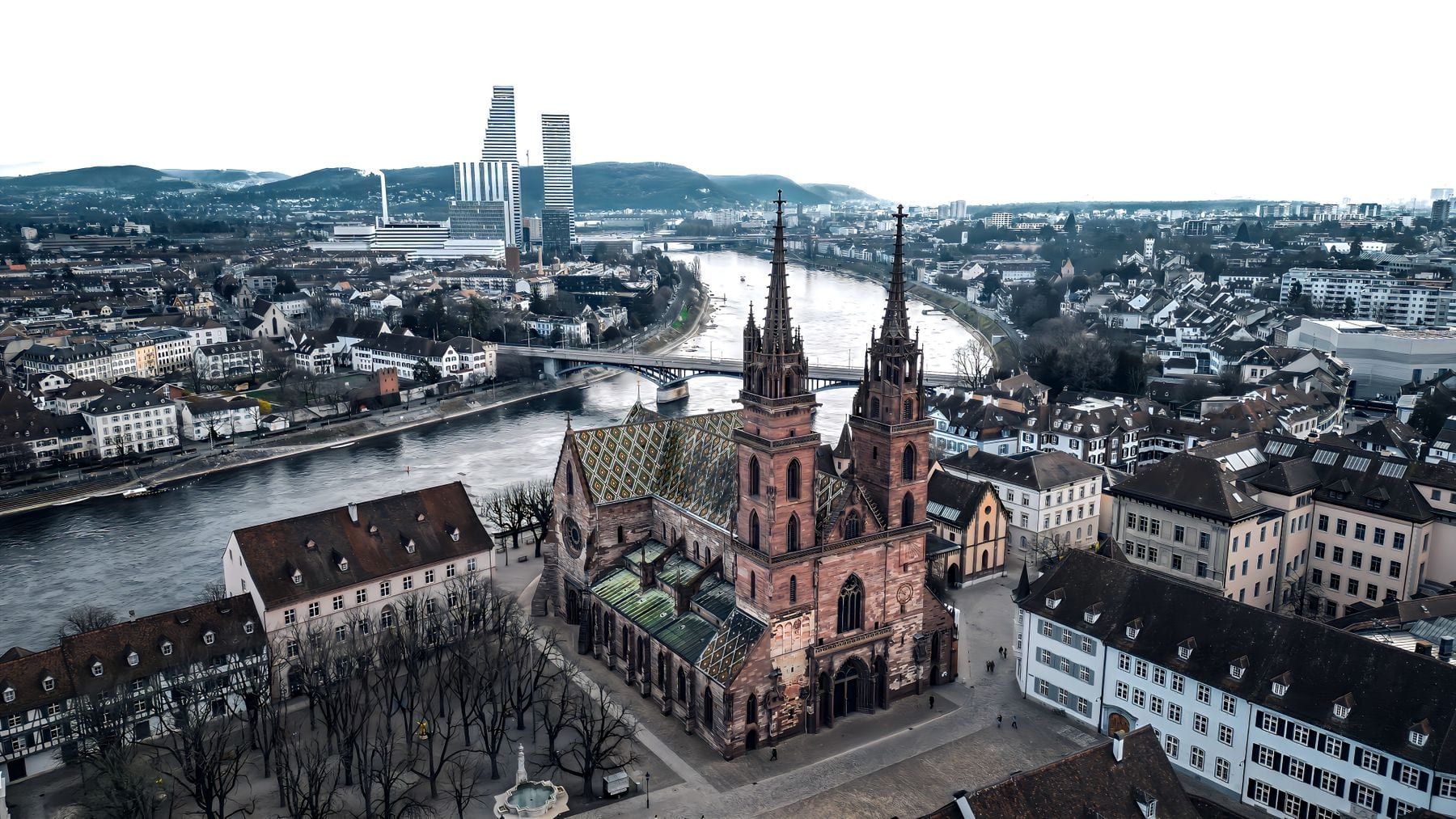
Basel lies on the Rhine knee, where the river bends north, and that position has made the city what it is: trading post, border town, hub for ideas. The Romans founded the colony of Augusta Raurica on the opposite bank, whose theatre still stands in Augst. The bishopric of Basel emerged in the 7th century; the red sandstone Münster was rebuilt after the earthquake of 1356, the strongest ever to hit central Europe. From 1431 to 1449 a church council met in Basel, and in 1460 Pope Pius II founded the university, the oldest in Switzerland. With it came the printers, and with the printers Erasmus of Rotterdam, who died here in 1536 and is buried in the Münster. Hans Holbein the Younger painted in Basel before he went to London. In 1501 Basel joined the Confederation, in 1529 it adopted the Reformation, and in 1833 city and countryside fell out so thoroughly that there have been two half-cantons ever since. The silk ribbon industry of the 18th century gave rise to dye chemistry; Ciba, Geigy and Sandoz became Novartis and Roche, whose towers by Herzog & de Meuron are today the tallest buildings in Switzerland. The city's art collection goes back to the Amerbach Cabinet of 1661, the first public art collection in the world. Out of that grew a Basel with around 40 museums for 175,000 inhabitants, Art Basel as the most important art fair in the world, and the Fasnacht carnival, UNESCO cultural heritage since 2017, which keeps the city awake for three days.

Insider tips

Getting there and around: three stations, free trams

Basel has three railway stations: Basel SBB for Switzerland and France, the Badischer Bahnhof for Deutsche Bahn, plus the French section at the SBB station. From Zurich you are here in 53 minutes (return with the Half Fare Card around CHF 35, about EUR 37), from Bern in 55 minutes, from Lucerne in an hour. From Germany, ICE trains run direct to Basel SBB from Frankfurt in three hours and from Freiburg im Breisgau in 40 minutes. The EuroAirport is on French soil and 20 minutes from the centre on bus 50, but hardly relevant for travellers from Switzerland. The most important thing: every hotel in Basel gives you the Mobility Ticket, which makes trams and buses free across the whole city for your entire stay. That is why we list zero francs for local transport. The tram network is dense and green, and lines 8 and 11 even run into Germany and France. A car is superfluous, the city centre is largely car-free, and car parks cost CHF 2.50 to 4 an hour. On foot you cross the old town in 20 minutes, and four ferries take you across the Rhine for CHF 2 a crossing, hanging on nothing but a cable and driven by the current.

Where to stay: Kleinbasel, Grossbasel and the trade fair trap

Grossbasel is the old town with the Münster, the Marktplatz and the more expensive hotels; Kleinbasel is the other bank of the Rhine with the trade fair, the Rheingasse, bars and cheaper beds. A mid-range double room normally costs CHF 150 to 220 (about EUR 161 to 235), and then comes the trap: during Art Basel in June, the successor fairs to Baselworld and the Swissbau, prices quadruple, budget rooms suddenly cost CHF 400, and whole weeks are sold out. Check the trade fair calendar before you book. The youth hostel in the St. Alban-Tal sits in an old silk ribbon factory right on the Rhine, five minutes from the Kunstmuseum, and at CHF 120 for a double room it is one of the best locations in the city. The chains (Motel One, Ibis, Hyperion) sit around the SBB station and the fair, both ten minutes from everywhere by tram. For charm: the small hotels in the Rheingasse and on the Spalenberg. For a Rhine view you pay from CHF 600 at Les Trois Rois, or from CHF 220 at the Krafft in Kleinbasel for the same view from the other direction. At weekends Basel hotels are often cheaper than during the week, because the pharma business travellers are missing.

Museums: which ones are worth the CHF 25

Basel has 40 museums and you will not manage them all, so here is the honest selection. The Fondation Beyeler in Riehen (tram 6, 20 minutes) is the best art museum in Switzerland: a Renzo Piano building in a park, Monet, Rothko, Giacometti, Picasso, plus world-class temporary exhibitions. Admission CHF 25 to 30 (about EUR 27 to 32), often cheaper on Mondays, free for anyone up to 25. The Kunstmuseum Basel (CHF 26 for all three buildings) has the largest Holbein collection in the world and modern art in the new building; the collection is free on the first Sunday of the month and daily in the last hour. The Museum Tinguely on the Rhine (CHF 18) with its rattling machines is the one children like best. The Vitra Design Museum is in Weil am Rhein on German soil, reachable by tram 8, admission around CHF 15, and the campus with buildings by Gehry, Hadid and Herzog & de Meuron is free. You get the BaselCard automatically from your hotel, and it halves most admission fees. The Museums-Pass-Musées (CHF 149 for a year) pays off from the third visit in the three-country region. Our advice for two days: Beyeler, Kunstmuseum and Tinguely, the rest is a bonus.

Swimming the Rhine: how to do it properly

From June to September half of Basel floats down the Rhine after work, and you join in. You need a Wickelfisch, the waterproof swimming bag that holds clothes, shoes and phone, from CHF 30 (about EUR 32) in any Basel sports shop or at a kiosk. You get in at the Museum Tinguely or at the steps on Schaffhauserrheinweg and get out at the Johanniterbrücke at the latest, or earlier at the steps along the Kleinbasel bank. The stretch takes 20 to 40 minutes; you do not swim, you let yourself drift and steer towards the bank. Rules: only when the green flag is flying, never at high water, not under the bridge piers, no alcohol beforehand, and the boats have right of way. The water is 20 to 24 degrees in summer. Afterwards you sit with the locals at a buvette on the Kleinbasel bank, the summer bars between the Mittlere Brücke and the Wettsteinbrücke, with beer for CHF 5 to 6 and a view of the Münster. If you do not want to drift: the Rheinbadhüsli Breite and St. Johann are wooden baths in the river with admission around CHF 5. And for CHF 2 the ferries will put you across to the other bank dry at any time.

Fasnacht and timing: the three finest days

The Basel Fasnacht begins on the Monday after Ash Wednesday at 4 am with the Morgestraich: all the lights go out, thousands of piccolos and drums start up at the same moment, and the painted lanterns move through the dark city. It is Protestant, disciplined and the opposite of the Rhineland carnival. For three days the cliques march, Tuesday is the day for children and Guggenmusik bands, and at 4 am on Thursday it is all over. For spectators: no costumes, only active participants wear them; you buy a Blaggedde (the Fasnacht badge, CHF 10 to 50, about EUR 11 to 54), which finances the Fasnacht, and you do not get in the way. Hotels are booked out months ahead, so plan early or come in from Zurich for the Morgestraich; the first train at 5 am is too late, but the Basel hotels offer night packages for it. Otherwise: June to September for the Rhine, but avoid Art Basel in the third week of June unless you are coming for the art. The Herbstmesse at the end of October with the big wheel on the Münsterplatz and the Christmas market on the Barfüsserplatz are the other highlights. January and February are grey, but ideal for museums at normal prices.

Three-country corner, Augusta Raurica and Alsace

Basel is the only place in central Europe where you can be in three countries within an hour. The three-country corner itself is a pylon in the Rhine port of Kleinhüningen, reached by tram 8, not spectacular, but the harbour bars and the silo with its viewing platform make the evening worthwhile. Tram 8 takes you on to Weil am Rhein and the Vitra Campus, tram 3 to Saint-Louis in Alsace. The Germans and French come to Basel to work, the Basel locals go across to shop: groceries are 30 to 40 per cent cheaper in Weil and Lörrach, and for travellers that means a dinner in an Alsatian winstub in Huningue or Saint-Louis costs CHF 20 to 30 (about EUR 21 to 32) instead of CHF 40. For history: Augusta Raurica in Augst, 15 minutes by S-Bahn, is the largest Roman ruined city north of the Alps, with a theatre for 10,000 spectators; the site is free and the museum with the silver treasure costs CHF 8. For wine and villages, the Markgräflerland between Basel and Freiburg is the outing: Badenweiler with its thermal baths, Staufen, the wine taverns around Schliengen, 30 to 45 minutes by S-Bahn or car, at half the Swiss price.

Frequently asked questions about Basel

How do I get to Basel, and do I need a car?

By train: 53 minutes from Zurich, 55 minutes from Bern, an hour from Lucerne, return with the Half Fare Card CHF 35 to 45 (about EUR 37 to 48). From Germany by ICE from Frankfurt in three hours, from Freiburg in 40 minutes, from Vienna on the Railjet via Zurich. You do not need a car: every hotel gives you a Mobility Ticket that makes trams and buses free, and the old town is largely car-free.

What does a weekend in Basel cost?

For two people and two nights, around CHF 360 to 440 (about EUR 385 to 471) for a mid-range hotel, CHF 55 per person per day for food, and CHF 50 to 60 per person for two to three museums with the BaselCard. Local transport is free with the hotel ticket. In total CHF 650 to 800 without travel. During Art Basel in June, two to three times that.

When is the best time to visit Basel?

June to September for swimming the Rhine and the buvettes on the bank, with the exception of the Art Basel week in mid-June, when hotel prices explode. The Fasnacht in February or March is unique but has to be booked months ahead. For museums, October to April is ideal, when the city is quiet and prices are normal.

Is the BaselCard worth it?

You do not have to buy it, you get it automatically with every hotel stay. It includes free trams and buses, 50 per cent off almost all museums, the zoo and city tours, and free wifi. Two museum visits save you around CHF 25 (about EUR 27) per person with it. If you come without a hotel stay, take a TNW day pass for CHF 11.

Can you really swim in the Rhine?

Yes, from June to September thousands do it every day. You need a waterproof Wickelfisch for your clothes (from CHF 30, about EUR 32), get in at the Museum Tinguely and drift for 20 to 40 minutes to the steps in Kleinbasel. Only when the green flag is flying, only as a confident swimmer, not at high water or after heavy rain. The boats always have right of way.

How many days do you need for Basel?

Two full days for the old town, the Münster, the Fondation Beyeler, the Kunstmuseum and an evening on the Rhine. With Tinguely, the Vitra Campus, Augusta Raurica and an outing to Alsace or the Markgräflerland it becomes three to four days. Basel also works as a base for the Black Forest and Alsace, both 30 to 60 minutes away.

Itineraries with this destination

Activities in the region

Events

Feb 15

Basel Carnival (Morgestraich)

Festival

15 February 2027 Monday after Ash Wednesday at 4 am until Thursday 4 am; 2027: 15 to 18 February

The "three most beautiful days": on the Monday after Ash Wednesday, at exactly 4 am, the street lights in the city centre go out and thousands of pipers and drummers set off with painted lanterns, the Morgestraich. For 72 hours the parades (Cortèges) follow on Monday and Wednesday afternoons, Gugge brass concerts on Tuesday evening, and Schnitzelbänke, rhymed satirical verses in Basel dialect, in the pubs. Basel's carnival is UNESCO heritage and the opposite of Cologne: spectators do not dress up, confetti (Räppli) is thrown only by the cliques, and the mood is melancholic and ceremonial rather than party-loud. There is no entrance fee; the carnival badge from CHF 10 (about EUR 10.50) funds the cliques and is considered a matter of decency. Hotels in Basel have been gone for months for the Monday and cost twice the usual rate; Zurich is an hour away, but the first trains arrive too late for the Morgestraich.

For travellers: For the Morgestraich, book a night in Basel or in Lörrach or Weil am Rhein just across the border, where it is cheaper; afterwards have flour soup and onion tart in a pub, they open at 4 am.

More destinations in Zurich, Basel & Lucerne