Bernina Express and Val Poschiavo

Switzerland · Graubünden & Ticino · Travel guide

Bernina Express and Val Poschiavo

What the most famous railway journey in the Alps really costs, why the regional train with an open window is often better than the panorama coach and why you should spend a night in Val Poschiavo instead of just passing through.

Photo: ILOVESwitzerland / Pexels

What does a trip to Bernina Express and Val Poschiavo cost?

Adjust the values to your trip: the calculator updates live (EUR, converted from CHF estimates).

2,012 EUR
≈ 1,006 EUR per person
  • Getting there 257 EUR
  • Accommodation 803 EUR
  • Food 535 EUR
  • Local transport 268 EUR
  • Bernina Express Chur to Tirano (2nd class, Half Fare Card, with reservation) 150 EUR

Estimates for orientation, not booking prices. Getting there means train or car from Switzerland, return, per person. Hotels vary strongly by season: current prices are behind the links below.

Money & payment: You pay in Swiss francs (CHF). Cards and the Twint app work practically everywhere, even on alpine pastures. Many shops accept euros but give change in francs at a poor rate. Service is included in prices; rounding up is customary. Getting there: By train (SBB) or car, 1 to 4 hours from Zurich.

Recommended hotels

Nine options in three price ranges, each among the best-rated on Booking.com.

Budget

Historic Hotel Albrici

Piazza, Poschiavo

Palazzo from 1682 right on the piazza of Poschiavo, with stucco ceilings, creaking floors and a restaurant with Val Poschiavo cooking. Simple rooms, lots of history, fair prices, five minutes from the station.

from CHF 120 / night (about EUR 128) View →

Hotel Bernina 1865

Village, Samedan

Traditional house in the centre of Samedan, the railway hub of the Engadin, with a large inn and good Graubünden cooking. Cheaper than Pontresina or St. Moritz, direct trains to the Bernina and the Albula.

from CHF 130 / night (about EUR 139) View →

Hotel Station Pontresina

Station, Pontresina

Right at Pontresina station, where the Bernina trains stop, simple rooms and a restaurant with a set lunch. If you want to be early into the viewing coaches, start here, before the trains fill up.

from CHF 120 / night (about EUR 128) View →

Mid-range

Hotel Le Prese

Le Prese, Val Poschiavo

Historic spa hotel right on Lago di Poschiavo, with a park, its own bathing spot, tennis and a restaurant by the water. The Bernina trains stop in front of the house, and in summer it is the loveliest location in the whole valley.

from CHF 180 / night (about EUR 193) View →

Albergo Croce Bianca

Centre, Poschiavo

Family-run three-star house in the middle of Poschiavo with one of the best kitchens in the valley, pizzoccheri and game from the region. Quiet rooms in the new wing, a good base for two nights in Val Poschiavo.

from CHF 160 / night (about EUR 171) View →

Hotel Bernina Tirano

Station, Tirano

Solid Italian hotel directly opposite Tirano station, with a restaurant and Valtellina wines. Practical if you arrive late or continue to Milan the next morning; prices in euros and considerably lower than in Switzerland.

from CHF 110 / night (about EUR 118) View →

Luxury

Grand Hotel Kronenhof

Village, Pontresina

Neo-baroque grand hotel from 1848 with painted halls, spa and glacier views, ten minutes from Pontresina station and therefore from the start of the Bernina line. Luxury without the St. Moritz bustle.

from CHF 500 / night (about EUR 535) View →

Hotel Walther Pontresina

Village, Pontresina

Art nouveau hotel from 1907 on the main street of Pontresina, with a spa, garden and a restaurant that counts among the best in the Engadin. More personal and smaller than the grand hotels, with prices to match.

from CHF 350 / night (about EUR 375) View →

Kulm Hotel St. Moritz

Village, St. Moritz

The birthplace of winter tourism above Lake St. Moritz, with a large spa, golf course and ice rink. The Bernina Express also starts from St. Moritz, ten minutes on foot from the hotel.

from CHF 600 / night (about EUR 642) View →

If you book through these links we earn a small commission, at no extra cost to you.

Experiences worth your time

Bernina Express from Chur to Tirano

The full UNESCO ride in panorama coaches over the Albula and Bernina, 4 hours 15 minutes, CHF 102 (about EUR 109) full fare one way including reservation, CHF 69 with the Half Fare Card. Left-hand side from Pontresina, book early, pack food.

View & book →

Regional train with open viewing coach

The same route from Pontresina or St. Moritz to Tirano on the regional train with open coaches (summer), no supplement or reservation, around CHF 17 from Pontresina with the Half Fare Card. Get off whenever you like, the next train is in an hour. Bring a jacket, it is cold up top.

View & book →

Walk from Ospizio Bernina to Alp Grüm

From the highest station on the line along Lago Bianco to Alp Grüm, 2 hours, flat, with the Palü glacier in view, free. Have lunch on the terrace of the Alp Grüm station restaurant looking into Val Poschiavo, CHF 25 to 35.

View & book →

Cavaglia glacier mills

The glacier garden by Cavaglia station with potholes from the Ice Age up to 30 metres deep, free admission, 45-minute circular trail. Walk down from Alp Grüm in 2 hours or arrive directly by train.

View & book →

Brusio circular viaduct

The famous spiral viaduct on which the train makes a full loop over itself. 15 minutes on foot from Brusio station; from the meadow you see the train better than from inside, free, an hour including the wait for the next train.

View & book →

Poschiavo old town and the Spanish quarter

Piazza with the confectioners' palazzi, the collegiate church of San Vittore, the colourful Spanish quarter and the village mill. 90 minutes on foot, guided walks from CHF 15 via the tourist office. Loveliest in the evening, once the trains have gone.

View & book →

Lago di Poschiavo: swimming and the lakeside path

Jump into the lake from Le Prese station (around 21 degrees in August), then follow the shore to Miralago, 90 minutes, flat, looking back at the Bernina group. Free; pedalos and canoes at the jetty from CHF 15 an hour.

View & book →

Tirano and the Madonna di Tirano

Two hours in Italy: the pilgrimage basilica from 1505, the old town and an espresso for CHF 1.50. Bernina trains terminate right next to the basilica, bring your passport. Lunch with pizzoccheri and bresaola CHF 20 to 30.

View & book →

Bernina Express Bus from Tirano to Lugano

The red bus runs in summer in the afternoon from Tirano along Lake Como to Lugano, 3 hours, reservation CHF 16 plus ticket, around CHF 35 with the Half Fare Card. Links the Bernina line with Ticino, February to October only.

View & book →

If you book through these links we earn a small commission, at no extra cost to you.

Food & drink

On the Bernina line you eat your way from Graubünden to Italy: up top Capuns, Pizokel and barley soup, down in Val Poschiavo pizzoccheri, polenta and Valtellina wine, in Tirano bresaola at half the price. Val Poschiavo is a pioneering organic valley with mountain cheese and Brasciadela bread, and the Nusstorte is at home here too, because the confectioners came from this valley.

Pizzoccheri

Inns around the piazza in Poschiavo, trattorias in Tirano

Buckwheat ribbon noodles with savoy cabbage, potatoes, cheese and brown sage butter, the dish of Valtellina and Val Poschiavo. CHF 20 to 26 (about EUR 21 to 28) in Poschiavo, CHF 12 to 15 in Tirano.

Tip:In Val Poschiavo garlic is often added, so ask if you are taking the train the next day.

Capuns

Restaurants in Pontresina and Samedan

Chard parcels with Spätzli dough and Bündnerfleisch, the standard dish on the Engadin part of the line. CHF 24 to 32 as a main course.

Tip:Eat in Pontresina before the ride, the choice at the top of the pass is small.

Pizokel

Alp Grüm station restaurant and inns on the Bernina Pass

Thick dumplings with bacon, cabbage and mountain cheese, tossed in the pan, hearty and warming. CHF 22 to 28, the right lunch up at the pass.

Tip:At Alp Grüm take the terrace, even if service is faster inside.

Bündnerfleisch and bresaola

Butchers in Poschiavo and Tirano

Air-dried beef twice over, once Graubünden style, once as Valtellina bresaola with lemon and olive oil. As a starter CHF 18 to 26, from CHF 10 in Tirano, to take away from the butcher CHF 8 to 12 or CHF 4 to 5 per 100 g respectively.

Tip:Buy bresaola in Tirano, and mind the customs allowance.

Polenta taragna

Grotti and trattorias in Poschiavo and Brusio

Buckwheat and maize polenta stirred with butter and mountain cheese, served with mushrooms, game or Luganighe sausage. CHF 22 to 30 in Val Poschiavo, CHF 12 to 16 in Tirano.

Tip:In autumn with venison or porcini from the valley, that is when it is at its best.

Gerstensuppe

Ospizio Bernina and Alp Grüm

Graubünden barley soup with smoked meat and vegetables, the cheap hot meal at the pass. CHF 12 to 16, even better with Brasciadela bread from Val Poschiavo.

Tip:In fog up top, have the soup and wait for the next train; the terrace is not worth it then.

Engadiner Nusstorte and Brasciadela

Bakeries in Poschiavo and Pontresina

The nut tart of the Engadin confectioners, many of whom came from Val Poschiavo, and Brasciadela, a dark ring-shaped bread with aniseed that goes with the cheese. Tart CHF 5 to 7 a slice, bread CHF 4 to 6.

Tip:Nut tart and bread survive the journey home, and so does vacuum-packed mountain cheese.

Valtellina wine

Grotti in Poschiavo, enoteche in Tirano

Nebbiolo from the terraces of Valtellina, called Chiavennasca here: Sassella, Grumello, Inferno and the powerful Sforzato. A glass CHF 6 to 9 in Val Poschiavo, CHF 3 to 5 in Tirano, a bottle from CHF 15 in the shop.

Tip:Five litres per person are duty-free, so a case of Sassella is just over the limit.

Book a food tour: Bernina Express and Val Poschiavo

Through markets and eateries with a guide, tastings included.

View & book →

If you book through these links we earn a small commission, at no extra cost to you.

History & background

The Bernina Railway was built between 1908 and 1910 as a private company that wanted to connect the resort of St. Moritz with the Italian Valtellina. It is an adhesion railway without a rack, even though it climbs from Tirano at 429 metres to Ospizio Bernina at 2,253 metres, with gradients of up to seven per cent, the steepest in the Alps for a railway without cogwheels. The engineers solved this with tight curves, spiral tunnels and the circular viaduct at Brusio, on which the train makes a full circle over itself to lose height. The Albula line from Thusis to St. Moritz was finished as early as 1903, with the 65-metre-high Landwasser Viaduct near Filisur and the spiral tunnels between Bergün and Preda, where the railway overcomes 400 metres of altitude over twelve kilometres as the crow flies. The two lines together have been UNESCO World Heritage since 2008, one of only three railways worldwide with that status. The Bernina Railway ran electrically and in winter from the start, which was considered impossible at the time; the rotary snowploughs of 1910 are still in use today. In 1943 the Rhaetian Railway took over the loss-making company, and since 1973 the Bernina Express has run as a tourist train with panorama coaches. Val Poschiavo itself, the valley between the Bernina Pass and Tirano, is Italian-speaking, has belonged to Graubünden since 1512 and lived from the mule trade, from emigrants who grew rich as confectioners all over Europe and brought palazzi home to Poschiavo, and since 1910 from the railway. Today, with barely 4,500 inhabitants, it is one of the quietest valleys in Switzerland, organically farmed and with a lake whose colour you will not forget.

Insider tips

Getting there, the route and how long it really takes

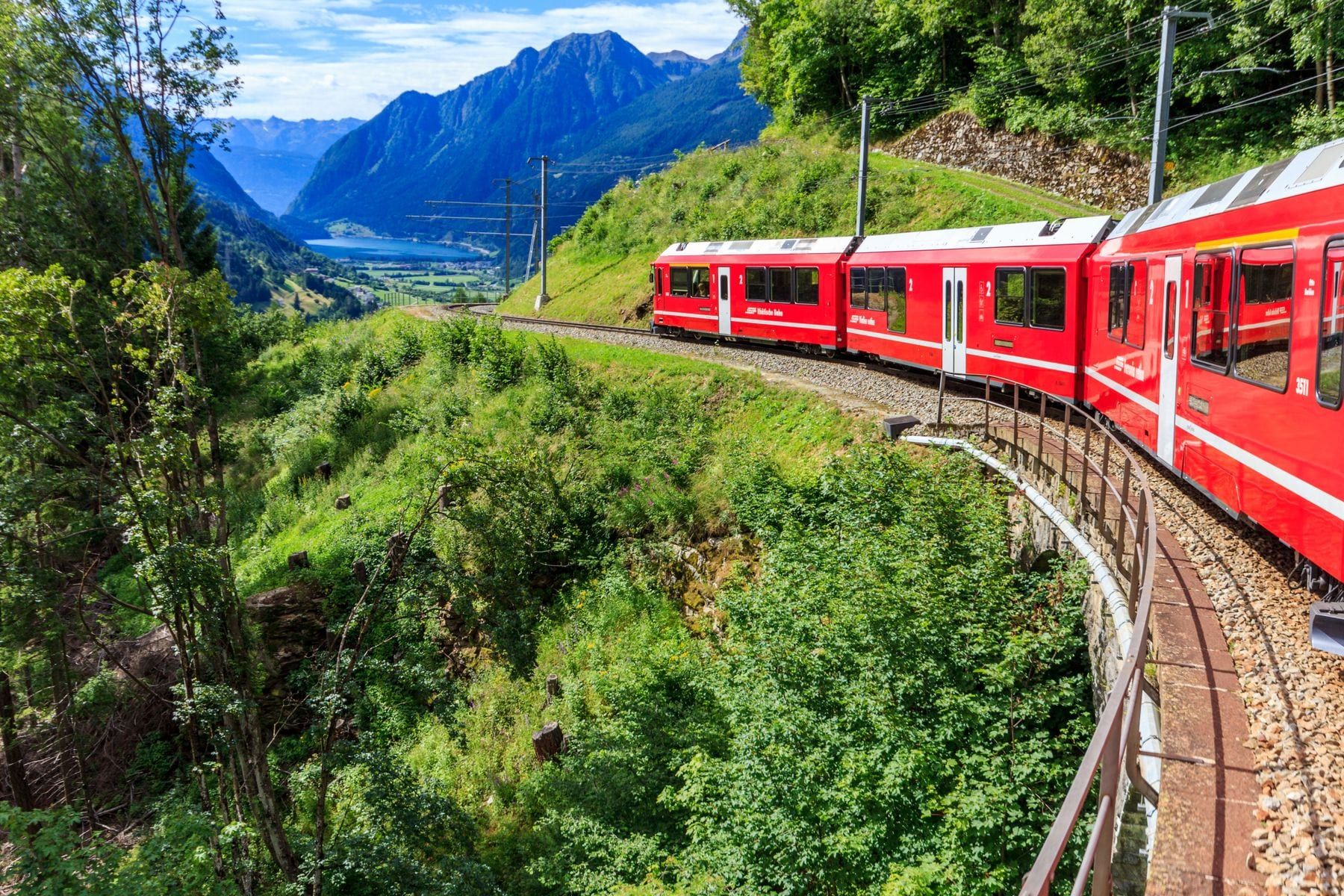
The Bernina Express runs from Chur via Thusis, the Albula line, Samedan, Pontresina, the Bernina Pass and Val Poschiavo to Tirano, around 4 hours 15 minutes for 144 kilometres, 55 tunnels and 196 bridges. From Zurich the IC gets you to Chur in 75 minutes, from Basel and Bern in around 2 hours 30 minutes, from Munich via Zurich or Lindau in 4 hours. In summer the Bernina Express runs two to three times a day from Chur, plus from St. Moritz and Davos, in winter once a day. Driving over the Julier or Bernina Pass only makes sense if you are on a round trip and fit in part of the railway as an excursion, say Pontresina to Alp Grüm. Back from Tirano you either take the train straight away, the Bernina Express Bus along Lake Como to Lugano (summer only, 3 hours, reservation required) or the Italian railway to Milan in 2 hours 30 minutes and from there the EC home through the Gotthard. That makes a round trip Zurich, Chur, Tirano, Milan, Zurich over two to three days for around CHF 200 (about EUR 214) with the Half Fare Card.

Ticket, reservation, price: how the Rhaetian Railway does its sums

You pay for two things: the normal ticket for the route and the reservation supplement for the panorama coach. Chur to Tirano costs around CHF 66 (about EUR 71) full fare in 2nd class, CHF 33 with the Half Fare Card, free with the GA travelcard, and Interrail is valid with the supplement. The seat on the Bernina Express is compulsory and costs CHF 36 per person and direction in summer (May to October), CHF 32 in winter; 1st class carries the same supplement but a dearer base fare (around CHF 115 full price). With the Half Fare Card you are therefore at around CHF 70 one way, without it CHF 100, for two return CHF 280 to 400. That is honestly a lot of money for four hours of train. You have to reserve on sbb.ch or rhb.ch, in summer three to four weeks ahead for weekends, otherwise the window seats on the left-hand side (facing Tirano) are gone. Panorama coaches have windows up to the ceiling that you cannot open: in sunshine they reflect, they are poor for photography, and the air conditioning is a matter of luck. In return you get commentary in four languages through headphones and a minibar at your seat. The view is the same as from the regional train.

The money saver: the regional train with an open window

The same route is served hourly by the RhB's normal regional train, no supplement, no reservation, with windows you can open, and in summer with open-air viewing coaches without a roof between Pontresina or St. Moritz and Tirano (no extra charge, subject to availability, usually at the back of the train). You can get off wherever you like, spend two hours at Alp Grüm, take the next train, and pay only the route ticket, CHF 33 (about EUR 35) from Chur with the Half Fare Card. With the SBB Saver Day Pass (from CHF 52 with the Half Fare Card, book early) you can even travel from Zurich to Tirano and back for that price, including every detour, just not on the panorama train. You take the Albula line from Chur to Samedan on the IR or RE as well, which run hourly. Rule of thumb: if you want to take photos and get off, take the regional train. If you want to sit comfortably for four hours and have what is outside explained to you, take the Express. Most travellers would be happier with the regional train and a stopover. On the regional train from Pontresina there is still room at the window before 10 am; from midday the viewing coaches are full.

Where to get off: Ospizio Bernina, Alp Grüm, Cavaglia

The three stops worth making are all up at the pass. Ospizio Bernina at 2,253 metres is the highest point of the line, between Lago Bianco, milky with glacier water and draining into the Po, and Lej Nair, which flows into the Inn; the watershed runs between the tracks. From the station you walk 2 hours along Lago Bianco to Alp Grüm, flat, no climbing, with the Palü glacier in front of your nose. Alp Grüm at 2,091 metres has a station restaurant with a terrace from which you look 1,000 metres down into Val Poschiavo, Lago di Poschiavo included; coffee and cake around CHF 10 (about EUR 11), lunch CHF 25 to 35, and there are simple double rooms for CHF 100 to 150 too. From Alp Grüm you walk down in 2 hours to Cavaglia and its glacier mills, 30-metre-deep potholes from the Ice Age, free admission, then continue by train. If you only make one stop, make it Alp Grüm. Between Cavaglia and Poschiavo the railway winds its way 700 metres down in loops, and here the seat on the left in the direction of travel is yours.

Poschiavo and Tirano: why a night in the valley

Poschiavo is an Italian town on Swiss soil: a piazza with palazzi built by the confectioners who came home, a baroque church, a Spanish quarter with colourful 19th-century villas, inns serving pizzoccheri and Valtellina wine. Mid-range double rooms cost CHF 130 to 180 (about EUR 139 to 193), less than in the Engadin, and in the evening, once the last Bernina Express has gone through, the village belongs to the locals. From here, the next morning, you ride 15 minutes to Lago di Poschiavo (swimming from Le Prese, 21 degrees in August), walk along the lake to Miralago (90 minutes) and take the train to the Brusio circular viaduct, which you look at calmly from the road instead of missing it from the window. Tirano in Italy is the terminus, with the basilica of the Madonna di Tirano and the station where the RhB tracks sit next to the Italian ones. Two hours are enough: old town, espresso for CHF 1.50 instead of CHF 4.50, lunch for CHF 20 to 30 with pizzoccheri and bresaola from Valtellina. Bring your passport or ID, you are crossing a border. Spending the night back in Val Poschiavo is more relaxed than another four hours to Chur in the evening.

Season, weather, seat: the details that make the day

The best time is mid-June to mid-October, when the open coaches run, the trails at the top are free of snow and Lago Bianco is turquoise rather than frozen. Autumn from the end of September, with yellow larches in Val Poschiavo, is the loveliest ride, July the fullest. In winter the Bernina Express runs only once a day, but the pass is a white desert with walls of snow beside the train, and the supplement is a little cheaper. In fog or rain at the top of the pass you see nothing, so check the weather forecast for the Bernina Pass in the morning; the regional train lets you change your plans, the Express does not. Seats: from Chur to Samedan the right-hand side is better (Landwasser Viaduct, Albula valley), from Pontresina to Tirano the left (Morteratsch, Lago Bianco, Val Poschiavo, Brusio). Food on the Express is minibar only, CHF 5 (about EUR 5) for a coffee and CHF 12 for a sandwich, so pack food or eat at Alp Grüm. In the open coaches it is cold and windy, even in August, so bring a jacket. And: leave your luggage at the hotel or in a locker in Chur or St. Moritz for the day trip, there is no room for it in the open coaches.

Frequently asked questions about Bernina Express and Val Poschiavo

How do I get to the Bernina Express, and where is the best place to board?

From Zurich in 75 minutes by IC to Chur, where the Bernina Express starts. From Basel or Bern around 2 hours 30 minutes to Chur. If you want the full UNESCO route, board in Chur; Albula and Bernina together take 4 hours 15 minutes. If you only want the most spectacular part, take the normal train to Pontresina or St. Moritz and from there the Bernina Express or regional train to Tirano, which is 2 hours 15 minutes. You do not need a car, it would be in the wrong place in Tirano.

What does the Bernina Express really cost?

Chur to Tirano 2nd class: around CHF 66 (about EUR 71) ticket plus CHF 36 reservation in summer, so CHF 102 one way, CHF 69 with the Half Fare Card, only the CHF 36 with the GA travelcard. For two return you are at CHF 280 to 400. The regional train on the same route costs only the ticket, CHF 33 with the Half Fare Card, or from CHF 52 from Zurich and back with the Saver Day Pass. The reservation is the surcharge for panorama windows and commentary, not for the view.

Do I have to reserve, and how far ahead?

On the Bernina Express yes, the seat reservation is compulsory and costs CHF 32 to 36 (about EUR 34 to 39) per direction, bookable on sbb.ch, rhb.ch or at the ticket desk. In summer three to four weeks ahead for weekends; on weekdays a few days are often enough, and in winter it usually works at short notice. On the regional train you reserve nothing, you get on and sit down, including in the open viewing coaches, which run subject to availability at no extra charge.

Bernina Express or regional train: which is better?

For photographers, walkers and anyone who wants to get off, the regional train: windows that open, open coaches in summer, hourly, no supplement, free stopovers. For anyone who wants to sit comfortably for four hours, hear the commentary and arrive at the destination, the Express with a guaranteed seat. The route and the view are identical. Our honest recommendation: the regional train with a stop at Alp Grüm, and put the money for the reservation into a night in Poschiavo.

Can I do the Bernina Express as a day trip from Zurich?

Yes, but it gets long: leave Zurich at 7 am, Chur 8.30, Tirano at 1 pm, two hours in Tirano, back on the regional train via St. Moritz to Zurich around 9 pm, which is 14 hours, 10 of them on the train. Better is a night in Poschiavo or Pontresina and the return journey the next day, or the round trip via Milan and the Gotthard. As a day trip, Pontresina to Alp Grüm and back is the more worthwhile option.

Do I need a passport, and how do I pay in Tirano?

Tirano is in Italy, so bring your passport or identity card; checks are rare, but they happen. You pay in euros, cards work almost everywhere, and you need cash for small bars. In Val Poschiavo the franc applies, and many places take euros too. On the way back into Switzerland you may bring in goods worth CHF 150 (about EUR 161) per person duty-free, 5 litres of wine, 1 kilogram of meat, so buy the Valtellina bresaola in moderation.

Itineraries with this destination

More destinations in Graubünden & Ticino