Furano & Biei

Japan · Hokkaido · Travel guide

Furano & Biei

What the lavender fields in July and the hills of Biei really cost, why you miss half of it without a rental car and how Furano becomes a quiet ski resort in winter.

Photo: Natsuko Aoyama / Pexels

What does a trip to Furano & Biei cost?

Adjust the values to your trip: the calculator updates live (EUR, converted from CHF estimates).

3,601 EUR
≈ 1,800 EUR per person
  • Flights 2,354 EUR
  • Accommodation 508 EUR
  • Food 428 EUR
  • Local transport 161 EUR
  • Rental car for 2 days in Furano and Biei (per person, 2 sharing) 150 EUR

Estimates for orientation, not booking prices. Flights and hotels vary strongly by season: current prices are behind the links below.

Money & payment: You pay in yen (JPY). 1,000 yen is roughly CHF 6 or EUR 6.50. Cards work in cities and hotels; small restaurants, temples and rural stations often want cash. An IC card (Suica or ICOCA) on your phone pays for trains, buses and convenience stores. Flight time: 12 to 14 hours, usually with one stop.

Recommended hotels

Nine options in three price ranges, each among the best-rated on Booking.com.

Budget

Furano Natulux Hotel

Station, Furano

Design hotel right opposite Furano station, with sleek dark rooms, a small spa with sauna and a good breakfast in the café. Cheaper than it looks, and the best base for anyone without a car. Book early for July.

from CHF 75 / night (about EUR 80) View →

Furano Hops Hotel

Kamifurano

Simple hotel in Kamifurano, about 20 minutes' drive north of Furano and halfway to Biei, between lavender fields and hills. Plain, clean rooms, an in-house restaurant, free parking and a ski shuttle in winter. With a rental car a cheap base for solo travellers and couples.

from CHF 60 / night (about EUR 64) View →

Hotel Lavenir Biei

Station, Biei

The hotel right at Biei station, with bike rental, a shared bath and a restaurant serving Biei vegetables. The rooms are simple, but the location is perfect without a car: Twinkle Bus, rental bikes and the local train are on the doorstep.

from CHF 80 / night (about EUR 86) View →

Mid-range

La Vista Furano Hills Natural Hot Spring

Asahimachi, Furano

Dormy Inn group hotel a few minutes' walk from Furano station, with an onsen bath, outdoor bath, sauna and the well-known breakfast buffet with Hokkaido produce. Quietly set on a hillside with a view over the town to Tokachi-dake; the ski area is a few minutes away by bus or car. Free ramen in the evening.

from CHF 120 / night (about EUR 128) View →

Biei Shirogane Onsen Hotel Park Hills

Shirogane Onsen, Biei

Large onsen hotel in the forest at Shirogane, 10 minutes from the Blue Pond, with an outdoor bath, a buffet and a shuttle from Biei station. Simple rooms in Japanese and Western style. The right location for an evening at the illuminated pond and early mornings without the coaches.

from CHF 130 / night (about EUR 139) View →

Furano Resort Orika

Nakafurano, Furano

Golf resort hotel between Furano and Farm Tomita, with an onsen bath, large rooms and a view across the valley to the Tokachi range. Only makes sense with a car, but quiet and fairly priced in summer for the size of the rooms.

from CHF 110 / night (about EUR 118) View →

Luxury

New Furano Prince Hotel

Furano ski area, Furano

The big tower at the foot of the Furano zone, ski-in ski-out, with onsen, Ningle Terrace and a forest café on the grounds. Rooms from the 1990s, but with panoramic views. Full and expensive in winter; in summer there is a lavender field right by the hotel and prices are half.

from CHF 180 / night (about EUR 193) View →

Fenix Furano

Kitanomine, Furano

Scandinavian-style apartments with kitchen, washing machine and sauna, 300 metres from the Kitanomine gondola. For families and groups staying several days, cheaper than two hotel rooms. No restaurant, but the village with its izakaya is right outside the door.

from CHF 250 / night (about EUR 268) View →

Hoshino Resorts Tomamu The Tower

Tomamu, Shimukappu

An hour south of Furano, the biggest resort on Hokkaido: the Unkai cloud terrace in summer, an ice village and a huge ski area in winter, a wave pool and dozens of restaurants. For a family that wants everything in one place, the price is fair for what you get.

from CHF 220 / night (about EUR 235) View →

If you book through these links we earn a small commission, at no extra cost to you.

Experiences worth your time

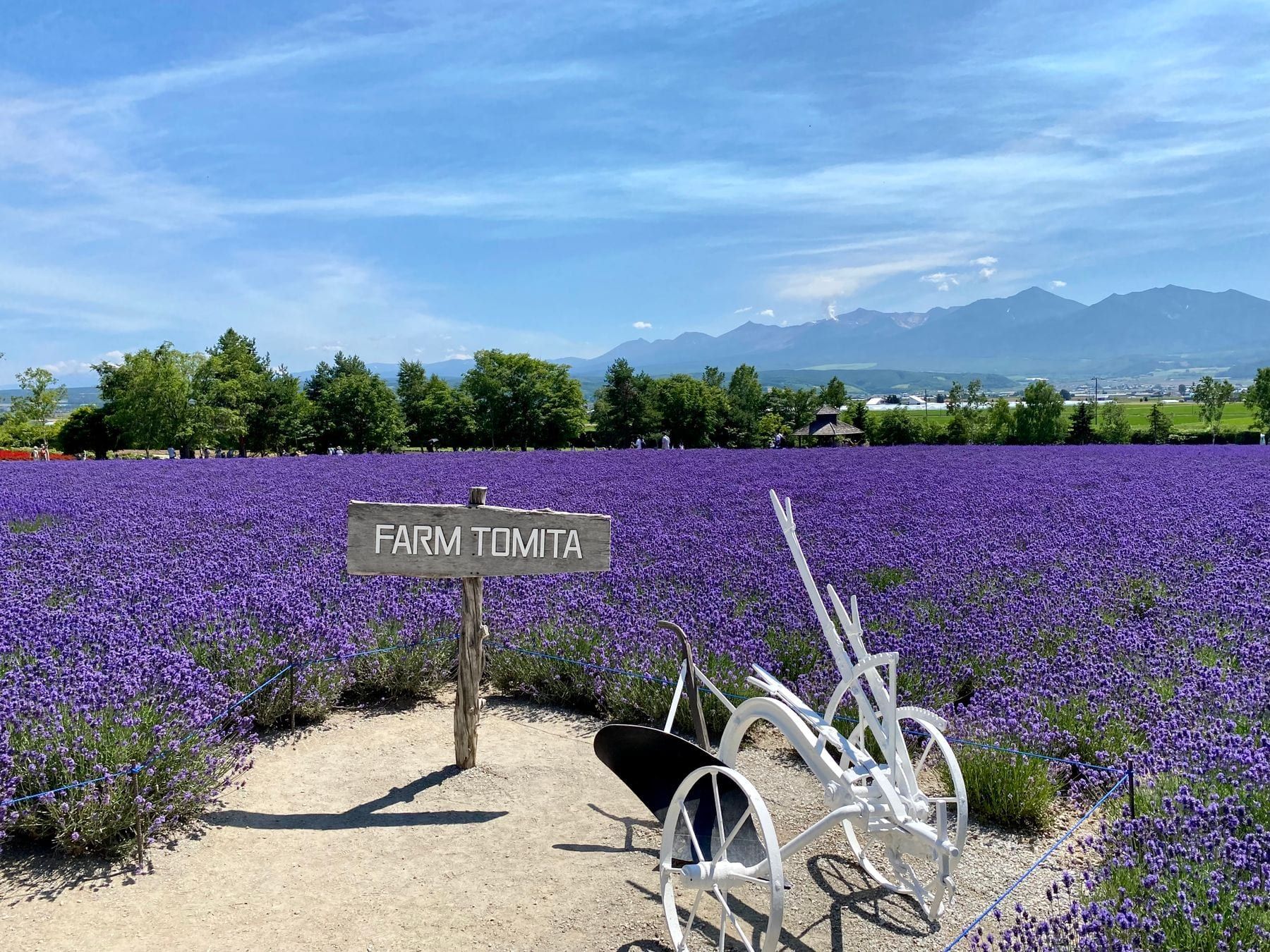
Farm Tomita and Lavender East

Free entry and parking, lavender soft-serve CHF 3 (about EUR 3), flowering season 10 to 25 July. Come before 8 am or after 5 pm; Lavender East (4 kilometres away) is bigger and emptier. The summer train stops at Lavender Farm.

View & book →

Blue Pond (Aoi-ike) and Shirahige waterfall

The pond is free, parking CHF 3 (about EUR 3), the bus from Biei CHF 3. Bluest before 9 am or under an overcast sky, and lit up in the evening in winter. The waterfall five minutes further up is free and usually empty.

View & book →

Patchwork Road and Panorama Road in Biei

Two loops through the hills with the famous lone trees (the Ken and Mary tree, the Seven Stars tree, the Parent and Child trees). By car 1.5 hours each, by e-bike (CHF 12, about EUR 13, for three hours) only one of them. Do not walk into the fields: farmers have already cut down trees because of tourists.

View & book →

Shikisai-no-Oka flower hill

Seven hectares of flower stripes in Biei, June to September, entry CHF 3 (about EUR 3), tractor bus CHF 3, buggy CHF 12 for 15 minutes. Snowmobiles and sledges in winter. Kitschier than Tomita, but with alpacas and a view of the Tokachi range.

View & book →

Furano Cheese Factory, winery and Ningle Terrace

Cheese factory with tastings (free, cheese workshop CHF 6, about EUR 6), the Furano winery with tastings (free) and Ningle Terrace, 15 craft shops in wooden huts in the forest by the Prince Hotel, lit up in the evening. All three in one afternoon by Furano bus or car.

View & book →

Hot air balloon over Furano

Tethered balloon rides in summer, morning and evening, CHF 15 (about EUR 16) for five minutes at 30 metres above the fields; free flights in winter from CHF 150. Operators in Nakafurano and Kamifurano, cancelled in wind.

View & book →

Tokachidake Onsen and volcano hike

Day bath at Ryounkaku CHF 5 (about EUR 5) at 1,280 metres, hike to the Ansei crater 2 hours, to the summit 4 to 5 hours (July to September). In winter a guided snowshoe tour from CHF 70. Bus from Kamifurano three times a day.

View & book →

Skiing in Furano or Asahidake

Furano day pass CHF 40 to 45 (about EUR 43 to 48), ski rental CHF 30, season from late November to early May. Asahidake (two hours by car) has just one ropeway (CHF 20 return) and ungroomed deep snow, only for confident skiers. Guided powder days from CHF 150.

View & book →

Rafting and canoeing on the Sorachi river

Between May and October, two hours from CHF 40 (about EUR 43), children from age six. In winter the same operators run snowmobile tours (CHF 60) and ice fishing on Lake Kanayama (CHF 50 with tempura of your catch). Meeting point usually in central Furano.

View & book →

If you book through these links we earn a small commission, at no extra cost to you.

Food & drink

Furano and Biei are farming country, and you can taste it: melons, corn, potatoes, asparagus, milk and cheese straight from the fields, plus an omelette curry of their own and wine from Hokkaido grapes. There are hardly any top restaurants, but there are farm shops and guesthouses whose breakfast beats any hotel buffet.

Furano omu curry

Restaurants of the Furano Omu Curry association in Furano town, for example Yuiga Doxon

The local dish since 2006, made to fixed rules: an omelette over rice, Furano curry alongside, a little flag with the Furano emblem, local vegetables and a glass of Furano milk or wine. Mild and filling, CHF 10 to 13 (about EUR 11 to 14).

Tip:Yuiga Doxon near the station has the long queue; Masaya a few streets away is just as good and lets you choose the heat of the curry.

Furano melon and Yubari melon

Stalls at Farm Tomita and the melon farmers on Route 237 in Nakafurano

Orange-fleshed melons with 15 per cent sugar, in season from July to August. A slice at a stall costs CHF 3 to 5 (about EUR 3 to 5), a whole one CHF 15 to 40, and as a combo with soft-serve (melon slice with ice cream) CHF 6.

Tip:Melon House Tomita next to the farm serves half a melon with soft-serve, which is lunch on a lavender day.

Furano cheese and milk soft-serve

Furano Cheese Factory, 10 minutes by car south of town

The Furano Cheese Factory makes camembert, a cheese with squid ink (black and mild) and wine cheese. Milk soft-serve made with that morning's fresh milk CHF 3 (about EUR 3), a piece of cheese CHF 8. Wood-fired pizza at the factory CHF 12.

Tip:The pizza oven only runs until 4 pm; sign up online in advance for the cheese workshop and the butter class.

Biei corn and potatoes with butter

Biei Senka (farm shop on Route 237) or Shikisai-no-Oka

Corn from Biei (the Pure White variety) is so sweet that people eat it raw. Boiled or grilled at a stall CHF 3 (about EUR 3), a baked potato with Hokkaido butter and salted squid CHF 4, from July to September.

Tip:Biei Senka also sells corn soft-serve and vegetables to take away; the croissants from its bakery are breakfast for the hills.

Biei wheat bread and Jun-Pei croquettes

Biei Senka bakery and Jun-Pei restaurant near Biei station

Biei grows wheat, and the bakery in the Kita-Kobo hall turns it into bread that is surprisingly crusty for Japan. The Jun-Pei restaurant makes potato croquettes and tonkatsu rice; a croquette costs CHF 2 (about EUR 2), a set CHF 11.

Tip:Jun-Pei has a queue at lunchtime and closes early in the afternoon; if you come after 2 pm, there is nothing left.

Hokkaido wine from Furano

Furano Winery on the hill above town, with tastings and a view of Tokachi-dake

The municipal Furano winery has made red wine from Seibel and Zweigelt grapes since 1972, plus a lavender white wine. A glass costs CHF 4 to 6 (about EUR 4 to 6), a bottle CHF 12 to 25. Light and high in acidity, not great, but honest.

Tip:The grape juice factory right next door sells the unfermented juice for CHF 4 (about EUR 4), a reason for children to come up the hill too.

Guesthouse breakfast from the garden

Any guesthouse in Biei and Nakafurano

In the guesthouses of Biei and Furano breakfast is the main event: asparagus, tomatoes, eggs from the neighbour, yoghurt made from the milk next door and home-baked bread, often on a terrace with a view of the hills. Included, or CHF 10 to 15 (about EUR 11 to 16) extra.

Tip:Book your guesthouse with dinner if you come without a car; otherwise there is nothing to eat in Biei after 7 pm.

Book a food tour: Furano & Biei

Through markets and eateries with a guide, tastings included.

View & book →

If you book through these links we earn a small commission, at no extra cost to you.

History & background

Furano lies at the geographical centre of Hokkaido; a triangle in the middle of town marks the island's "navel", celebrated every July with the Belly Button Festival (Heso Matsuri), when thousands parade through the streets with painted bellies. The Sorachi river valley was only settled from 1897 by pioneers from Honshu, who grew rice, onions and melons on the volcanic soil of the Tokachi range. Lavender arrived from France in 1948, when the company Soda Koryo had it grown in Furano for the perfume industry; in the 1960s it covered 230 hectares. When cheap synthetic lavender oil made prices collapse in 1970, almost all farmers ripped out their fields. Only Tadao Tomita in Nakafurano kept his plants, and when Japan National Railways printed a photo of his fields in its calendar in 1976, the first visitors came. That became Farm Tomita, today the most visited lavender field in Asia. Biei, 30 kilometres north, became known through the photographer Shinzo Maeda, who from 1971 photographed the rolling fields with their stripes of wheat, potatoes and beet and in 1987 opened the Takushinkan gallery in an old schoolhouse. The Blue Pond was created in 1988 as a by-product of an erosion control dam after the eruption of Tokachi-dake, and became world famous in 2012 when Apple used a picture of it as a Mac wallpaper. The TV series "Kita no Kuni kara" (1981 to 2002) also made Furano the Japanese byword for a simple life in the countryside.

Insider tips

Getting there, and why you really need a rental car here

From Sapporo the Limited Express Lilac or Kamui runs to Asahikawa (85 minutes, CHF 30, about EUR 32), then the local Furano line train goes via Biei to Furano (70 minutes, CHF 7). In summer there is also the direct Furano Lavender Express from Sapporo (2 hours, CHF 35), and the seasonal Lavender Farm Station stop is a seven-minute walk from Farm Tomita. So for Farm Tomita alone the train is enough. Not for Biei: the Patchwork Road, the Panorama Road, the famous lone trees and the Blue Pond are scattered over 100 square kilometres, the train runs every two hours and the bus to the Blue Pond five times a day. A rental car (from CHF 50 per day, at Asahikawa station or the airport, small branches in Furano and Biei, book weeks ahead for July) is the difference between two stops and a whole day in the hills. Alternatives are a rental bike in Biei (e-bike CHF 12 for three hours, the hills are steep) or the Biei Twinkle Bus loop in summer (CHF 15, with a Japanese-speaking guide, limited seats). The nearest airport is Asahikawa (AKJ), 40 minutes by bus from Biei.

Where to stay: a guesthouse in Biei, a hotel in Furano, a ski resort on the mountain

The region lives on small guesthouses (pensions), mostly run by couples, with breakfast from their own garden and rooms for CHF 70 to 120 (about EUR 75 to 128). In Biei they are scattered between the hills, perfect with a car, unreachable without one; ask about a pick-up from the station when you book, many offer it. Furano town has business hotels (Natulux, La Vista, CHF 70 to 130) and, with its station, restaurants and nearby lavender fields, is the more practical base without a car. The Furano ski area above town has the New Furano Prince Hotel and a few lodges; in winter they are ski-in ski-out, in summer empty and cheap. Between mid July and mid August everything is booked out and expensive, so book in March. If you do Furano and Biei in one day by car, you can also stay in Asahikawa, 40 minutes away, the city with the most and cheapest hotels (business hotel CHF 50). There are ryokan at Tokachidake Onsen up on the volcano (from CHF 130 per person with dinner), spectacular but remote.

Cost traps: lavender car parks, melons and souvenir stalls

Farm Tomita is free, parking too, and that is exactly why 2,000 cars a day arrive in July. The trap is the private car parks in neighbouring fields that charge CHF 5 to 10 (about EUR 5 to 11), while 300 metres further on you park for free. The second farm, Lavender East, is also free; the tractor bus across it costs CHF 2. The Yubari and Furano melons at the stalls are first-rate, but a whole melon costs CHF 15 to 40 and is hard to eat in a hotel room; a slice for CHF 3 is enough. Lavender souvenirs (oil, soap, soft-serve) are fairly priced at Tomita and no cheaper on the roadside in Biei. The Blue Pond used to be free; since 2022 parking costs CHF 3, the pond itself nothing. Shuttle buses from Biei cost CHF 3 one way, a taxi CHF 25. Shikisai-no-Oka, the flower hill in Biei, has charged CHF 3 entry plus CHF 3 parking since 2023, and the alpaca enclosure another CHF 3. Nothing on its own, but for a family it quickly adds up to CHF 40. Food in Biei is scarce: restaurants close between 2 and 5 pm, so eat at lunchtime or shop at the Coop supermarket in Biei.

Timing: lavender week, autumn fields and the quiet winter version

The lavender at Tomita blooms from late June to early August, peaking between 10 and 25 July, which is when the rest of Japan is there too. Come on a weekday before 8 am or after 5 pm (the farm itself has no closing time, only the shops do); between 10 am and 3 pm coaches from Taiwan and Korea stand there in rows. From early July the early lavender also blooms on Hinode Park hill in Kamifurano, with fewer people. June is green and quiet, without lavender but with lupins and poppies. August and September bring sunflowers, cosmos and the harvest; the patchwork fields turn golden and the hotels free up again after Obon (mid August). October colours Tokachi-dake, and the first snow arrives in early November. Winter in Biei (December to March) is a trip of its own: white hills, the famous trees black against the snow, the Blue Pond lit up in the evening (November to April), hardly any visitors, and Furano has a ski area with powder snow but without Niseko prices. Golden Week is slushy here, and May has nothing to offer.

Skiing in Furano: Niseko quality without Niseko prices

With 1,000 metres of vertical and 28 runs in two linked sections (the Furano zone and the Kitanomine zone), the Furano ski area above town is one of the best on Hokkaido; World Cup races have been held here. The snow is drier and colder than in Niseko because Furano lies inland (minus 20 degrees happens), and it falls less often, but the sun shines more. The day pass costs CHF 40 to 45 (about EUR 43 to 48), a hotel on the mountain CHF 100 to 200, a guesthouse in town CHF 80, ski rental CHF 30. There is no nightlife, but the Kitanomine zone is a small village with ten izakaya and a bar in a tree house. Backcountry is strictly regulated here, only through the official gates. From Furano, Tomamu (one hour, the Hoshino resort with an ice hotel) and Asahidake (two hours, Hokkaido's highest mountain, with a ropeway and wild deep snow) make good day trips. If you want a week of skiing without English-speaking resort life, Furano is the right place.

Day trip: Tokachidake Onsen and the climb up the volcano

From Biei or Kamifurano a road climbs in 40 minutes to 1,280 metres at Tokachidake Onsen, the highest onsen on Hokkaido, on the active volcano Tokachi-dake, which last erupted in 1988. Two places offer day baths: Ryounkaku with rust-brown iron water and an outdoor pool above the valley (CHF 5, about EUR 5), and Kamihoroso with clear water and a view of the volcano (CHF 6). From here the trail leads up Tokachi-dake (2,077 metres, 4 to 5 hours return, July to September, lava fields, the smell of sulphur, no shade), or the easier path to the Ansei crater (2 hours). On the way you pass the Shirahige waterfall, from whose rock face comes the blue water that colours the Blue Pond further down; the bridge above it is freely accessible and lit up in winter. Without a car a summer bus runs from Kamifurano station (CHF 5, three times a day). This day costs CHF 20 for petrol and the bath and shows the wild side of the postcard region.

Frequently asked questions about Furano & Biei

How many days do I need for Furano and Biei?

Two full days with a rental car: one for Biei (Patchwork Road, Panorama Road, Shikisai-no-Oka, Blue Pond, Shirahige waterfall) and one for Furano (Farm Tomita, Lavender East, Furano Cheese Factory, Ningle Terrace). With Tokachidake Onsen it becomes three. Without a car one day is enough for Tomita and the Blue Pond by train and bus, but you will not see the rest.

When exactly does the lavender bloom?

Early lavender from late June, the main fields at Tomita (the Okamurasaki and Yotei varieties) from 10 to 25 July, later varieties until early August. After the harvest at the end of July the most famous fields are cut, and the farm then shows its other flower stripes. If you are only coming for the lavender, book the third week of July and a weekday.

Can I do Furano and Biei without a rental car?

For Furano, yes: Farm Tomita has its own train stop in summer, Furano town is walkable and the Furano bus links the cheese factory, the winery and Ningle Terrace. For Biei only partly: the Blue Pond and Shirahige waterfall by bus, the hills by e-bike (hard work) or the Twinkle Bus (summer only, limited seats). For two or more people a rental car at CHF 50 (about EUR 54) per day is cheaper than bus plus taxi.

Is the Blue Pond really worth it?

Yes, if your expectations are right: it is a small pond with dead larches standing in milky blue water, 15 minutes to see it, and the colour depends on the light; it is strongest under an overcast sky and brown after rain. Early in the morning or in the evening without the coaches it is beautiful; at midday it is a queue for photos. In winter, lit up and with snow on the trees, it is a different place, often more beautiful than in summer.

How does Furano compare with Niseko as a ski resort?

Furano is smaller, colder, drier and much cheaper: a day pass costs CHF 40 to 45 (about EUR 43 to 48) instead of 55 to 70, hotels half as much, runs are longer and better groomed, there is less deep snow off-piste, hardly any nightlife and almost only Japanese guests. For piste skiers and families who want Japan rather than Australia, Furano is the better choice. For powder hunters Niseko remains number one.

What does a day in Furano and Biei cost in total?

With a guesthouse (CHF 90 for two, about EUR 96), a rental car (CHF 50 plus CHF 10 for petrol), entry fees (CHF 10), lunch and an izakaya in the evening (CHF 40 per person) you come to around CHF 120 to 140 per person per day. Without a car and with a business hotel in Furano, CHF 90 to 100. Farm Tomita and the hills cost nothing; the money goes on accommodation and getting around.

Itineraries with this destination

Activities in the region

More destinations in Hokkaido