Otaru

Japan · Hokkaido · Travel guide

Otaru

What a day or a night in the old port city costs, where to eat the best sushi on Hokkaido and why you should stay past 5 pm, when the coaches have gone.

Photo: Jeffry Surianto / Pexels

What does a trip to Otaru cost?

Adjust the values to your trip: the calculator updates live (EUR, converted from CHF estimates).

3,456 EUR
≈ 1,728 EUR per person
  • Flights 2,354 EUR
  • Accommodation 455 EUR
  • Food 482 EUR
  • Local transport 80 EUR
  • Sushi set on Sushi Street 86 EUR

Estimates for orientation, not booking prices. Flights and hotels vary strongly by season: current prices are behind the links below.

Money & payment: You pay in yen (JPY). 1,000 yen is roughly CHF 6 or EUR 6.50. Cards work in cities and hotels; small restaurants, temples and rural stations often want cash. An IC card (Suica or ICOCA) on your phone pays for trains, buses and convenience stores. Flight time: 12 to 14 hours, usually with one stop.

Recommended hotels

Nine options in three price ranges, each among the best-rated on Booking.com.

Budget

Dormy Inn Premium Otaru

Station, Otaru

Right next to the station, with an onsen bath and sauna on the top floor, free ramen in the evening and a breakfast where you top your own kaisendon. Rooms are compact, but hard to beat for price and location. Ten minutes on foot to the canal.

from CHF 70 / night (about EUR 75) View →

Hotel Vibrant Otaru

Ironai, Otaru

In the former Hokkaido Bank of 1923 on the bank street, with a vault door in the lobby, high ceilings and simple rooms. Between the station and the canal, five minutes from both. Cheap, full of character and a little dated.

from CHF 55 / night (about EUR 59) View →

Tabist THE GREEN OTARU

Inaho, Otaru

Simple business hotel on the main road between the station and the canal, with a main building and an annex; the rooms in the main building have been renovated. Breakfast included, and prices stay moderate even in February. For a night when all you need is a bed.

from CHF 50 / night (about EUR 54) View →

Mid-range

Hotel Sonia Otaru

Canal, Otaru

The hotel right on the canal: from the canal-side rooms you see the warehouses and the gas lamps. European-style furnishings with wooden furniture, an onsen bath in house and a breakfast with Hokkaido produce. Canal-view rooms cost extra and are worth it.

from CHF 100 / night (about EUR 107) View →

Unwind Hotel & Bar Otaru

Ironai, Otaru

In the former Hotel Echigoya of 1931, Otaru's first Western-style hotel, with a fireplace in the lobby, a bar and an evening wine hour for guests. Rooms in wood and warm colours, five minutes from the canal. One of the most atmospheric hotels on Hokkaido.

from CHF 120 / night (about EUR 128) View →

Authent Hotel Otaru

Station, Otaru

Large city hotel between the station and the canal, with spacious, quiet rooms, a breakfast buffet with local fish and parking for rental cars. Less charm than Sonia or Unwind, but reliable and often cheaper.

from CHF 90 / night (about EUR 96) View →

Luxury

Grand Park Otaru

Chikko, Otaru

High-rise hotel at the marina next to the Wing Bay shopping centre, every room with a view of the sea or the mountains, a gym and two restaurants. Two train stops from the centre (Otaru-Chikko), but the biggest rooms in town and prices below big-city level.

from CHF 150 / night (about EUR 161) View →

Otaru Asarigawa Onsen Hotel Musashitei

Asarigawa Onsen, Otaru

Large onsen ryokan in the valley behind Otaru, with outdoor baths, kaiseki and Japanese rooms looking out on the forest. 20 minutes by bus from the station, next to the Asari ski area in winter. For the classic ryokan night with crab and yukata.

from CHF 220 / night (about EUR 235) View →

Otaru Furukawa

Canal, Otaru

Small Japanese-style hotel right on the canal, with rooms that have a tatami area, an onsen bath looking over the canal and a restaurant serving Hokkaido kaiseki. More ryokan than hotel, quiet and personal. The most expensive address on the water, and the most beautiful.

from CHF 180 / night (about EUR 193) View →

If you book through these links we earn a small commission, at no extra cost to you.

Experiences worth your time

Otaru Canal and warehouses

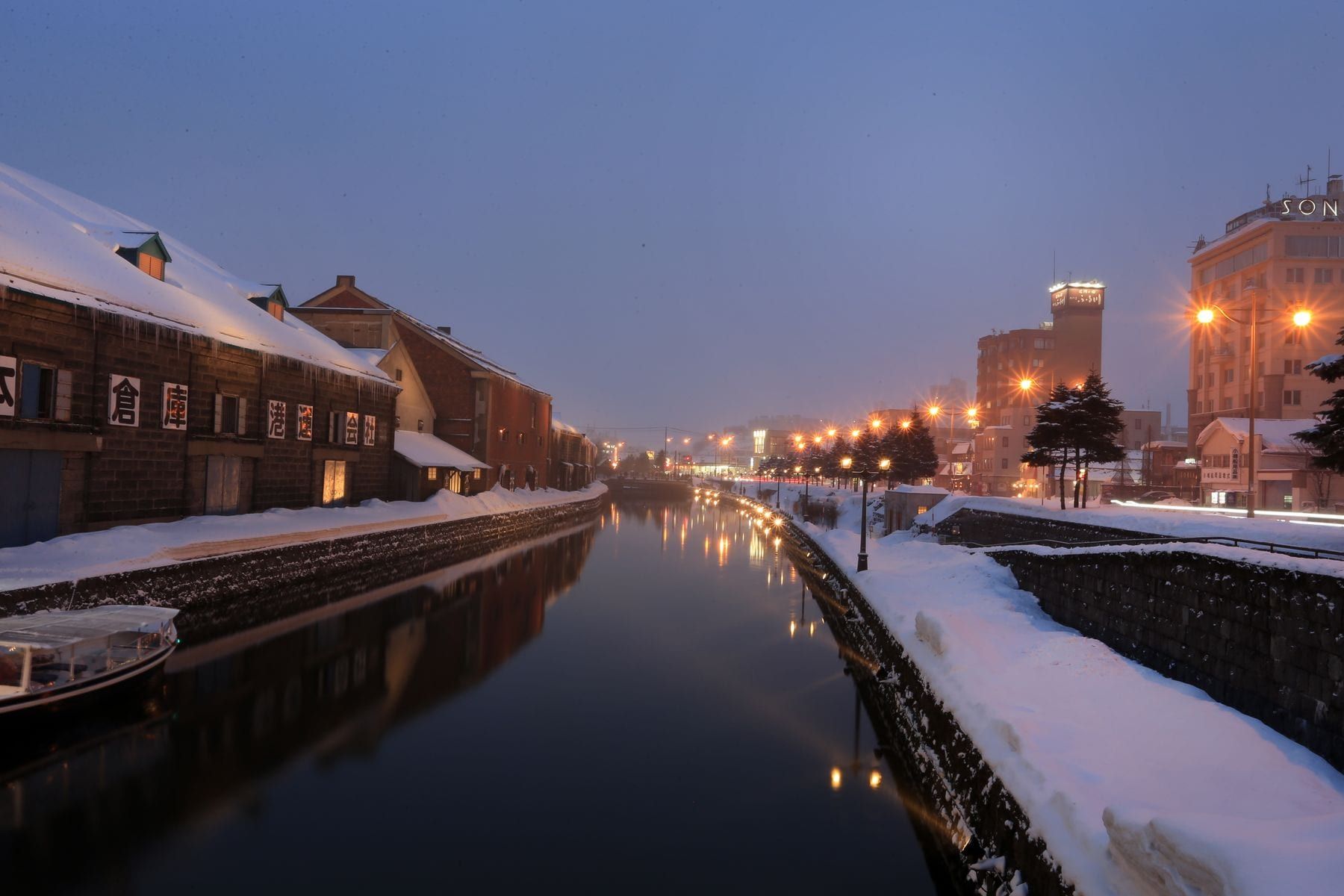
The 1.3-kilometre canal with gas lamps and stone warehouses, freely accessible and lit up in the evening. A boat trip costs CHF 12 to 14 (about EUR 13 to 15) for 40 minutes, nice but not essential. The narrower northern section beyond Chuo Bridge is empty and prettier.

View & book →

Sakaimachi street and Kitaichi Glass

The 900-metre shopping street with glassblowing studios, LeTAO, the Music Box Museum and Kitaichi Glass. Kitaichi Hall, lit by 167 oil lamps, is a café (coffee CHF 5, about EUR 5); the lamps are lit at 9 am, and that is the moment to be there.

View & book →

Glassblowing workshop

Blow your own cup or vase, CHF 20 to 35 (about EUR 21 to 37) including materials, 20 to 30 minutes, pick-up the next day or shipping. Children from 6 with help. Book in February and in summer.

View & book →

Tenguyama ropeway

CHF 9 (about EUR 10) return, bus from the station CHF 2, at the top a view over the bay and the city, a chipmunk park in summer and a ski area in winter (day pass CHF 25). Go up for sunset: the night view is considered one of the three best on Hokkaido.

View & book →

Nikka Whisky Yoichi Distillery

25 minutes by train (CHF 3, about EUR 3), free tour with three tastings (book online), museum and stone buildings from 1934 freely accessible. Yoichi whisky costs less at the distillery than at duty-free, and the limited bottles are only sold here.

View & book →

Shakotan Peninsula and Cape Kamui

Guided day tour from Sapporo with a stop in Otaru CHF 70 to 100 (about EUR 75 to 107), or 1.5 hours by rental car from Otaru. Cape Kamui is 40 minutes on foot along the ridge (June to October), glass-bottom boat CHF 10, sea urchin bowl CHF 25 to 40 in summer.

View & book →

Herring Mansion and Shukutsu

Bus from the station, 20 minutes (CHF 1.50, about EUR 1.60), Nishin Goten CHF 2: a herring baron's villa from 1897 overlooking the bay, with the aquarium next door (CHF 10) and the beach in summer. Hardly any foreign visitors.

View & book →

Snow Light Path (Yuki Akari no Michi)

Ten days in mid February, 5 to 9 pm, thousands of candles in snow lanterns along the canal and the old Temiya railway line, free entry. Come on a weekday, wear warm shoes, then go for sushi. Evening tours from Sapporo with train and guide from CHF 40 (about EUR 43).

View & book →

If you book through these links we earn a small commission, at no extra cost to you.

Food & drink

Otaru has the highest density of sushi restaurants on Hokkaido and the fish right on its doorstep: sea urchin from Shakotan, herring, squid, scallops and salmon roe from Ishikari Bay. Add the town's confectionery tradition, from LeTAO to Amato's rum balls, and the beer from the canal brewery.

Sushi at the counter

Sushi Street (Sushiya-dori), for example Masazushi Honten or Ise Sushi

Nigiri with fish from the bay: botan ebi (sweet shrimp), hotate (scallop), uni, ikura, and herring in spring. A set of ten to twelve pieces costs CHF 25 to 40 (about EUR 27 to 43) at lunchtime, omakase in the evening CHF 60 to 120. The rice in Otaru is slightly sweeter than in Tokyo.

Tip:Masazushi also has a branch on Sakaimachi street with a shorter queue; come at 11.30 am, because at 12.30 pm you queue for 45 minutes.

Kaisendon at Sankaku Market

Sankaku Market at Otaru station, places such as Takinami Shokudo

The seafood rice bowl in the narrow market hall next to the station: salmon roe, crab, scallop, sea urchin, CHF 12 to 35 (about EUR 13 to 37) depending on your budget. Less elegant than Sushi Street, same fish, half the price.

Tip:On request the traders will grill a crab leg or a scallop for you for CHF 5 to 10 (about EUR 5 to 11), and you eat it standing at the stall.

Nishin soba (herring on buckwheat noodles)

Soba restaurants in the centre and the restaurant on the Nishin Goten grounds in Shukutsu

The dish of the herring town: sweet and salty braised herring on hot soba in broth, a legacy of the days when herring was cheaper here than rice. CHF 9 to 12 (about EUR 10 to 13). In spring the izakaya serve freshly grilled herring (nishin-yaki).

Tip:Bowls of soba are big in Otaru, so share one if sushi is still to come.

LeTAO Double Fromage cheesecake

LeTAO main shop on Merchen Square at the end of Sakaimachi street

Two layers, baked and unbaked cheesecake made from Hokkaido mascarpone and cream cheese, sold frozen and creamy once thawed. A slice in the café costs CHF 5 (about EUR 5), a whole cake CHF 12. Otaru's best-known sweet since 1998.

Tip:In the café on the first floor there is a cake and tea set for CHF 9 (about EUR 10), and the tower on top has a free observation deck.

Kitakaro soft-serve and Amato rum balls

Kitakaro Otaru Honkan on Sakaimachi street, Amato Honten on Miyako-dori

Kitakaro, in a former bank, makes huge cream puffs (yume-fuwari, CHF 2, about EUR 2) and soft-serve (CHF 3); Amato has made rum balls with raisins and marzipan since 1929 (CHF 1.50 each) as well as pancakes with red bean paste. Both are Otaru brands you hardly find anywhere else.

Tip:The Amato café has stood still since the 1950s and serves cream zenzai (red bean soup with ice cream) for CHF 5 (about EUR 5), a lunch of Otaru grandmothers.

Otaru beer at the canal brewery

Otaru Soko No. 1 right on the canal

German beer brewed to the Reinheitsgebot (pils, dunkel, weiss) in the brewery in Warehouse No. 1 on the canal, made by a German brewmaster since 1995. A glass costs CHF 5 to 7 (about EUR 5 to 7.50), in a beer hall with long tables and sausages.

Tip:The brewery offers a free 20-minute tour; afterwards have a wheat beer on the canal-side terrace between 4 and 5 pm, when the groups leave.

Zangi and hokke at the izakaya

Izakaya in the Hanazono district south of the station

In the evening locals head to the izakaya in the Hanazono district behind the station: grilled hokke (Atka mackerel, a whole fish with grated radish, CHF 8 to 12, about EUR 9 to 13), zangi (CHF 5), potatoes with butter, and Sapporo Classic for CHF 4.

Tip:Hanazono looks dark and empty in the evening; the places are tucked away in side alleys and back courtyards, so just walk in wherever the red lanterns are glowing.

Book a food tour: Otaru

Through markets and eateries with a guide, tastings included.

View & book →

If you book through these links we earn a small commission, at no extra cost to you.

History & background

Otaru was once richer than Sapporo, and you can still see it. From 1865 the port on Ishikari Bay became a hub for herring, which arrived in spring in such quantities that the sea turned white; the herring barons built themselves mansions such as the Nishin Goten in Shukutsu, and the fish was shipped to Honshu as fertiliser. In 1880 Hokkaido's first railway opened between Otaru and Sapporo to bring coal from Horonai to the port. Around 1900 Otaru had branches of every major Japanese bank, a stock exchange and a branch of the Bank of Japan, whose 1912 building is now a museum; the street is still called the "Wall Street of the North". In 1923 the canal was finished, 1.3 kilometres long, on which barges carried cargo from the ships to the warehouses. From 1955 the herring stopped coming, the ports of Tomakomai and Muroran took over, and Otaru fell into decline. In the 1970s the city wanted to fill in the canal and build a road; a citizens' movement fought against it for ten years, and in 1986 half of it was preserved with gas lamps and a promenade, while the rest was narrowed. The glass industry came through fishing: from 1901 the company Kitaichi made oil lamps and glass floats for herring nets, and in the 1980s it turned into an art glass manufacturer. Today 110,000 people live in Otaru, half as many as in 1964.

Insider tips

Getting there: 30 minutes from Sapporo, along the sea

From Sapporo the JR Rapid Airport (the same train that comes from the airport) takes 32 minutes to Otaru, a single ticket costs CHF 4.50 (about EUR 4.80), every 15 to 30 minutes, and Suica works. Sit on the right-hand side in the direction of travel: from Zenibako the train runs right along the sea, with ice on the rocks in winter. From New Chitose airport the same train goes straight there in 75 minutes (CHF 11), so Otaru works as your first stop on Hokkaido too. Do not get off at Otaru but one station earlier at Minami-Otaru if you want to start with the glass street (Sakaimachi); from there you walk downhill through the shops to the canal and take the train back from Otaru station at the end, so you never walk uphill. In town you need no bus, everything lies within a kilometre of the canal; the Otaru loop bus (CHF 1.50) only helps for Shukutsu and the Herring Mansion (20 minutes). A taxi to Tenguyama costs CHF 10, the bus CHF 2. A rental car is unnecessary for Otaru, but useful for the Shakotan Peninsula beyond.

Where to stay: a night is worth it, by the canal or in Asarigawa

Almost everyone does Otaru as a day trip, and that is exactly why a night here is so good: after 5 pm the groups are on the train back to Sapporo, the canal is lit up, the sushi places have room, and at 8 am you walk along an empty promenade. Hotels by the canal: Hotel Sonia right on the water (CHF 90 to 130, about EUR 96 to 139) and the Unwind Hotel in a building from 1931 (CHF 110 to 160, free wine in the evening). Near the station are the business chains (Dormy Inn with onsen, Hotel Vibrant in a former bank, CHF 55 to 85). There are few hostels, but cheap business hotels instead. The third option is Asarigawa Onsen, 20 minutes by bus in the valley behind Otaru: two or three big onsen hotels (Hotel Musashitei, Otaru Asarigawa Onsen Hotel Kurage, from CHF 120 per person with dinner), and in winter the small Asari ski area with powder snow for Sapporo commuters. Prices in Otaru are stable; they only rise during the Snow Light Path in February and at summer weekends. If you are coming from Niseko, the bus gets you here in 1.5 hours.

Cost traps: Sushi Street, music box souvenirs and the canal cruise

Sushi Street (Sushiya-dori) has around 20 restaurants, some with English menus, photos and prices of CHF 60 to 100 (about EUR 64 to 107) for a set that costs CHF 30 elsewhere. Rule of thumb: no photos at the door, no tout, but a counter set for CHF 25 to 40 on a board. The long-established houses Masazushi, Ise Sushi and Nihonbashi are more expensive (omakase CHF 60 to 120) but worth the money; for CHF 15 to 20 you get a kaisendon bowl in the Sankaku Market hall that is every bit as good as the tourist restaurants. Souvenirs: the music boxes in the Music Box Museum (Otaru Orgel Doh) cost CHF 15 to 300, Kitaichi glass CHF 10 to 500, and the same pieces are on sale in five places along the street, so compare first. The canal cruise (CHF 12 by day, CHF 14 in the evening, 40 minutes) is pretty, but the canal is 1.3 kilometres long and you see nothing from the boat that you do not see from the path. LeTAO sells its Double Fromage cheesecake (CHF 12 for a whole cake) in every airport, so do not buy it here if you have to carry it around Japan.

Timing: the Snow Light Path in February, summer evenings and the dead middle of the day

The best time of day is non-negotiable: before 10 am or after 4.30 pm. In between, Sakaimachi street is packed with groups from Sapporo hotels and from the cruise ships that dock in the port in summer (the terminal was rebuilt in 2023). The Otaru Yuki Akari no Michi (Snow Light Path) runs for ten days in mid February, alongside the Sapporo Snow Festival: thousands of candles in snow lanterns along the canal and the old Temiya railway line, from 5 to 9 pm, free and the most beautiful winter scene on Hokkaido. Come on a weekday; at weekends the canal path is one long queue. In summer (July, August) Otaru has 24 degrees and a sea breeze, the beaches at Zenibako and Ranshima are Sapporo's seaside, and on the last weekend of July the Ushio Matsuri brings fireworks. June is the month for sea urchin from Shakotan, October for autumn colours on Tenguyama and few people. November and April are grey, but the sushi tastes just as good.

Underrated: the bank street, Tenguyama and the Herring Mansion

Behind the canal, on Ironai street, stand the bank palaces from around 1910, when Otaru was the financial centre of Hokkaido. The former Bank of Japan (free entry, with a vault and an exhibition) and the Nippon Yusen building show the wealth that the glass shops paper over. From there you walk ten minutes to the station, behind which the bus (or a taxi, CHF 10, about EUR 11) goes to Tenguyama: the ropeway costs CHF 9 return, and at the top a view stretches over the city, the harbour and the bay as far as Sapporo; at night it counts among the three great night views of Hokkaido and is far less visited than Moiwa in Sapporo or Mount Hakodate. In winter there is a small ski area with powder snow (day pass CHF 25). Third corner: Shukutsu, 20 minutes north by bus, with the Nishin Goten (Herring Mansion, CHF 2), a herring baron's villa from 1897 with dormitories for 120 fishermen, and the aquarium (CHF 10, with penguins that do not do as they are told). Next to it, in summer, is Shukutsu beach with clear water. This is the Otaru that people from Sapporo visit at the weekend.

Day trip: the Shakotan Peninsula and Yoichi whisky

West of Otaru begins the Shakotan Peninsula, Hokkaido's only marine national park: sheer cliffs, capes with hiking trails (Cape Kamui, 40 minutes on foot along the ridge, June to October) and a blue the Japanese call "Shakotan blue". By rental car from Otaru (CHF 50, about EUR 54, per day) you reach the cape in 1.5 hours; a glass-bottom boat in Bikuni costs CHF 10, and a sea urchin bowl in season from June to August CHF 25 to 40 (the sea urchin then comes fresh from the water in front of the restaurant). It also works by bus from Otaru (CHF 15 one way, 2 hours, few departures), and guided day tours from Sapporo with a stop in Otaru cost CHF 70 to 100. Halfway lies Yoichi, 25 minutes by train from Otaru (CHF 3): the Nikka whisky distillery of 1934, built on the Scottish model by Masataka Taketsuru, with a free tour including three tasting glasses (book online), stone buildings, coal-fired stills and a museum. Yoichi is also doable by train in winter, when Shakotan lies under snow. Together with sushi in the evening, that makes a full, inexpensive day.

Frequently asked questions about Otaru

Is a day trip from Sapporo enough for Otaru?

For the canal, the glass street, the Music Box Museum, the bank street and a sushi lunch, yes: leave at 8.30 am, get off at Minami-Otaru, walk downhill, eat at noon before the restaurants fill up, and head back around 4 pm or stay for the lit canal. If you add Tenguyama, Shukutsu or Yoichi, you need a night. The night is worth it just for the empty canal in the evening.

Where is the best sushi in Otaru?

For the experience at the counter: Masazushi (main branch on Sushi Street, omakase from CHF 60, about EUR 64), Ise Sushi or Nihonbashi, all with reservations. For value: Sankaku Market by the station, or the restaurants off the main street with a daily set for CHF 25 to 40. The fish comes from Otaru, Shakotan and Yoichi: sea urchin in summer, herring in spring, crab and salmon roe in winter.

What does a day in Otaru cost?

Return train from Sapporo CHF 9 (about EUR 10), entry fees (Bank of Japan free, Music Box Museum free, Kitaichi glass free, Tenguyama CHF 9) around CHF 10, sushi lunch CHF 30 to 40, coffee in a warehouse CHF 5, a glass souvenir CHF 15. That comes to CHF 70 to 90 per person without an overnight stay. With a business hotel (CHF 70) and an evening at an izakaya (CHF 30), around CHF 180.

Is Otaru worth visiting in winter?

Yes, especially in mid February during the Snow Light Path, when the canal and the old railway line are lit with snow lanterns in the evening. Even otherwise, the canal with snow on the warehouse roofs is a prettier picture than in summer. Expect minus 5 degrees, wind off the sea and slippery paths; spikes for your shoes are sold at the konbini. The sushi restaurants are emptier in winter and the fish is fattier.

Can I blow glass myself in Otaru?

Yes, several workshops on Sakaimachi street and by the canal run classes: blowing a cup or a vase costs CHF 20 to 35 (about EUR 21 to 37) including materials and takes 20 to 30 minutes; the piece cools overnight and is either posted to you for a fee or picked up the next day. Sandblast engraving and bead work are cheaper (CHF 10 to 15) and ready straight away. Book in summer and in February; otherwise just turn up.

How do I combine Otaru with Niseko or Hakodate?

Otaru is on the way: from New Chitose airport by train straight to Otaru (75 minutes), then by bus (CHF 15, about EUR 16, 1.5 hours) or local train via Kutchan (2 hours) to Niseko. For Hakodate you go back from Otaru to Sapporo and then take the Hokuto (4 hours), or drive via the Shakotan Peninsula and the west coast (5 to 6 hours, very beautiful, in summer).

Itineraries with this destination

More destinations in Hokkaido