Matsuyama & Dogo Onsen

Japan · Chugoku & Shikoku · Travel guide

Matsuyama & Dogo Onsen

What three days in Shikoku's largest city really cost, how to bathe at Dogo Onsen Honkan without queuing, and why Matsuyama is the best way into Shikoku.

Photo: Mak_ jp / Pexels

What does a trip to Matsuyama & Dogo Onsen cost?

Adjust the values to your trip: the calculator updates live (EUR, converted from CHF estimates).

3,488 EUR
≈ 1,744 EUR per person
  • Flights 2,354 EUR
  • Accommodation 482 EUR
  • Food 407 EUR
  • Local transport 54 EUR
  • Ferry from Hiroshima to Matsuyama (high-speed boat, return) 193 EUR

Estimates for orientation, not booking prices. Flights and hotels vary strongly by season: current prices are behind the links below.

Money & payment: You pay in yen (JPY). 1,000 yen is roughly CHF 6 or EUR 6.50. Cards work in cities and hotels; small restaurants, temples and rural stations often want cash. An IC card (Suica or ICOCA) on your phone pays for trains, buses and convenience stores. Flight time: 12 to 14 hours, usually with one stop.

Recommended hotels

Nine options in three price ranges, each among the best-rated on Booking.com.

Budget

Toyoko Inn Matsuyama Ichibancho

Ichibancho, Matsuyama

In the centre between the castle hill and the Okaido shopping arcade, with a tram stop outside the door. The chain's standard rooms with breakfast. From here everything is within walking distance or a tram ride.

from CHF 55 / night (about EUR 59) View →

Hotel Patio Dogo

Dogo Yunomachi, Matsuyama

Simple hotel right next to Dogo Onsen Honkan, Western-style rooms, cheap for the location. No onsen of its own, but you are in the Honkan or Tsubaki no Yu in a minute.

from CHF 70 / night (about EUR 75) View →

Cinnamon Guesthouse Dogo

Dogo Yunomachi, Matsuyama

Small adults-only guesthouse in the middle of Dogo, a few minutes' walk to the Honkan. Simple rooms with private bathrooms, friendly hosts, check-in from 4 pm. Good value for the location, ideal as a base for the onsen and the castle.

from CHF 55 / night (about EUR 59) View →

Mid-range

Dormy Inn Matsuyama

Ichibancho, Matsuyama

Central on the Okaido arcade, an onsen bath on the roof with a view of the castle, sauna, free ramen in the evening and a breakfast with tai-meshi. As reliable as everywhere in this chain.

from CHF 90 / night (about EUR 96) View →

Candeo Hotels Matsuyama Okaido

Okaido, Matsuyama

Modern rooms above the shopping arcade, a sky bath on the top floor, the tram and castle ropeway three minutes away. Quieter than the location suggests, good breakfast.

from CHF 95 / night (about EUR 102) View →

Dogo Yaya

Dogo Tako-cho, Matsuyama

Design hotel in Dogo without dinner, but with a breakfast buffet with freshly squeezed mikan juice, rooms in light wood, bikes to borrow and yukata for the walk to the Honkan. For anyone who wants ryokan atmosphere without having to do kaiseki.

from CHF 90 / night (about EUR 96) View →

Luxury

Funaya

Dogo Yunomachi, Matsuyama

The traditional house in Dogo since 1627, where emperors and Soseki stayed, now a large ryokan with a garden, large spring baths and kaiseki. Choose a room with a garden view; the street side is noisy.

from CHF 220 / night per person with half board (about EUR 235) View →

Dogo Kan

Dogo Tako-cho, Matsuyama

Postmodern building by the architect Kisho Kurokawa with a courtyard, several large baths and rooms in Western and Japanese style. Dinner as kaiseki or buffet, five minutes' walk to the Honkan.

from CHF 200 / night per person with half board (about EUR 214) View →

Yamatoya Honten

Dogo Yunomachi, Matsuyama

Ryokan with its own noh stage, where performances take place in the evening, large baths and a kaiseki built around tai-meshi and Inland Sea fish. Two minutes' walk to the Honkan, very Japanese, but English still works.

from CHF 210 / night per person with half board (about EUR 225) View →

If you book through these links we earn a small commission, at no extra cost to you.

Experiences worth your time

Dogo Onsen Honkan

The bathhouse from 1894, fully renovated since July 2024. Basic bath around CHF 4.20 (about EUR 4.50), with rest room and tea CHF 10 to 17, bookable online. Come before 7 am or after 8 pm.

View & book →

Matsuyama Castle by chairlift

One of the twelve original castle keeps, reached by open chairlift, combined ticket around CHF 6 (about EUR 6). Steep wooden stairs, armour, views to the Inland Sea. Two hours; packed during cherry blossom in early April.

View & book →

Botchan train

Replica of the 1888 steam locomotive on the tram tracks between the centre and Dogo, 20 minutes for around CHF 8 (about EUR 9). Runs only a few times a day; timetable at the stop. The manual turning is the highlight.

View & book →

Ishite-ji, temple 51

Pilgrimage temple with a National Treasure gate from 1318, a pagoda and a dark tunnel full of Buddha figures through the hill. No admission fee, 20 minutes' walk from Dogo, one hour. Pilgrims in white are part of the scene.

View & book →

Shimanami Kaido from Imabari

Cycle across the four-kilometre Kurushima-Kaikyo Bridge and onto the islands, bike hire from CHF 18 (about EUR 19), e-bike from CHF 36 at Imabari station. 40 minutes by train from Matsuyama; start early.

View & book →

Mikan picking on the peninsula

From October to December mikan farms around Matsuyama and on the islands open for picking your own, around CHF 6 to 10 (about EUR 6 to 11) with eating on site. Good with children and with a sea view; get there by car or on a tour.

View & book →

Uchiko: merchant town and kabuki theatre

25 minutes south by train: a street of wax merchants' houses, the Uchiko-za theatre from 1916 (admission around CHF 2.50, about EUR 2.70), hardly any tourists. Half a day, easy to combine with Ozu and its castle.

View & book →

Haiku walk and Shiki Museum

Matsuyama is Japan's haiku city, with post boxes for poems everywhere. The Shiki Museum in Dogo (around CHF 2.40, about EUR 2.60) explains the poet, and tours with haiku writing are available from CHF 30.

View & book →

If you book through these links we earn a small commission, at no extra cost to you.

Food & drink

Ehime is Japan's citrus garden and has the Inland Sea on its doorstep: mikan in every form, sea bream on rice, fried fish paste and sake from the mountains. Matsuyama eats simply and well, and prices are lower than in Kyoto or Tokyo.

Tai-meshi (sea bream on rice)

Restaurants in the Okaido arcade and in Dogo, Goshiki for the cooked style

Two styles: in Matsuyama the whole bream is cooked with the rice in the pot; in Uwajima raw fish with raw egg and soy sauce goes over the rice. Both CHF 10 to 20 (about EUR 11 to 21).

Tip:Uwajima style is the more exciting version if you like raw fish.

Mikan and mikan juice

Matsuyama airport, Dogo arcade, michi-no-eki markets

Ehime grows more than 40 citrus varieties, from mikan to iyokan to setoka. A glass freshly squeezed CHF 2 to 4 (about EUR 2 to 4), a net of mikan at the market CHF 3. At the airport the juice comes out of a tap.

Tip:In February and March there is setoka, the sweetest variety, only briefly.

Jakoten

Stalls in the Dogo arcade and at the ferry pier

Fried fish paste made from small fish with skin and bones, dark and salty, hot from the stall. CHF 1.50 to 2.50 (about EUR 1.60 to 2.70) each.

Tip:With a little ginger soy sauce and a beer.

Botchan dango

Sweet shops in the Dogo arcade

Three rice dumplings on a skewer, coated in green tea, yellow egg and red bean paste, named after the novel. CHF 1 to 2 (about EUR 1 to 2) per skewer.

Tip:Buy them fresh and soft; the packaged ones are drier.

Imabari yakibuta tamago meshi

Restaurants around Imabari station

Rice with slices of braised roast pork, a fried egg and sweet sauce, the workers' meal of Imabari. Around CHF 7 to 9 (about EUR 7 to 10).

Tip:The right meal after the Shimanami Kaido.

Sashimi from the Kurushima Strait

Izakayas in Nibancho and Sanbancho, Matsuyama

Sea bream, mackerel and squid from the currents of the Kurushima Strait, firm to the bite because of the current. A sashimi platter CHF 10 to 18 (about EUR 11 to 19) in an izakaya.

Tip:Ask for the fish of the day rather than going by the menu.

Tart (taruto)

Ichiroku Honpo in the city centre and in Dogo

A sponge roll with red bean paste and yuzu, not a tart in the Western sense, and the pastry of the lords of Matsuyama since the 17th century. A slice CHF 1.50 (about EUR 1.60).

Tip:Keeps for two weeks, a good souvenir.

Book a food tour: Matsuyama & Dogo Onsen

Through markets and eateries with a guide, tastings included.

View & book →

If you book through these links we earn a small commission, at no extra cost to you.

History & background

Dogo Onsen claims the title of Japan's oldest bathhouse, mentioned in the Nihon Shoki of 720, and according to legend an injured heron discovered the healing spring. Prince Shotoku is said to have bathed here in 596, followed later by emperors and poets, and the water still comes out of 18 springs at 42 to 51 degrees. The city around it only came into being in 1602, when the general Kato Yoshiaki fortified Katsuyama hill as a reward for the Battle of Sekigahara and built Matsuyama Castle. The Matsudaira ruled it until 1868; the present main keep dates from 1854 and is one of Japan's twelve original castle keeps. In 1894 the Dogo Onsen Honkan was built, a three-storey wooden building with a heron on the roof, followed in 1899 by the imperial bath Yushinden. A year after it opened, the young Natsume Soseki came to the city as an English teacher, bathed in the Honkan almost every day and wrote about it in 1906 in the novel 'Botchan', which made Matsuyama immortal in Japan. His friend Masaoka Shiki, born in Matsuyama, renewed the haiku, and the city has called itself the haiku capital ever since. With 500,000 inhabitants Matsuyama is the largest city on Shikoku, the centre of the mikan industry and home to stations 51 to 53 of the 88-temple pilgrimage. From 2019 to July 2024 the Honkan was restored while staying open, and it has been fully open again since.

Insider tips

Getting there: ferry from Hiroshima or flight from Tokyo

Matsuyama is on Shikoku, and that makes getting there part of the trip. The most beautiful option is the boat from Hiroshima: the Superjet high-speed boat takes 70 minutes from Ujina port to Matsuyama Kanko-ko, around CHF 47 (about EUR 50) each way, while the slow ferry takes 2 hours 40 minutes for around CHF 27, with views of dozens of islands. From the port a bus takes 25 minutes to the station and on to Dogo. From Okayama the Shiokaze limited express crosses the Seto Ohashi Bridge in 2 hours 40 minutes for around CHF 40, included in the Japan Rail Pass. From Tokyo you fly to Matsuyama in 90 minutes for CHF 60 to 150 with JAL, ANA or Jetstar; the airport is 15 minutes by bus from the station, and in arrivals stands the famous mikan juice tap. In town you ride the Iyotetsu tram for CHF 1.20 per ride; Dogo Onsen is the terminus of lines 3 and 5, 20 minutes from the centre. ICOCA works, and a day pass costs CHF 4.50.

Dogo Onsen Honkan: how to bathe in the original

Since July 2024, after five years of renovation, the Honkan has been fully open again, and demand is high accordingly. The principle: at the entrance you choose one of several plans. The basic bath, Kami no Yu, costs around CHF 4.20 (about EUR 4.50), and you bring your own towel or rent one. For around CHF 10 to 17 you get the smaller Tama no Yu followed by tea and rice crackers in a yukata in a tatami room upstairs, looking out over the rooftops; that is the version worth having. The plans with a rest room can be booked online, tickets for the basic bath only on site, and at weekends you queue from 10 am. Come at opening time, 6 am, when the drum sounds, or after 8 pm. Tattoos are allowed in the Honkan, unlike in many ryokan. The water is soft, alkaline and odourless, the pools are small; it is about the building, not about wellness. If you want to bathe without queuing: Tsubaki no Yu next door, the locals' bath, costs CHF 2.70, and Asuka no Yu, the new building from 2017, shows off Asuka-period craftsmanship with plans up to CHF 10.

Castle by chairlift and the Botchan train: the city day

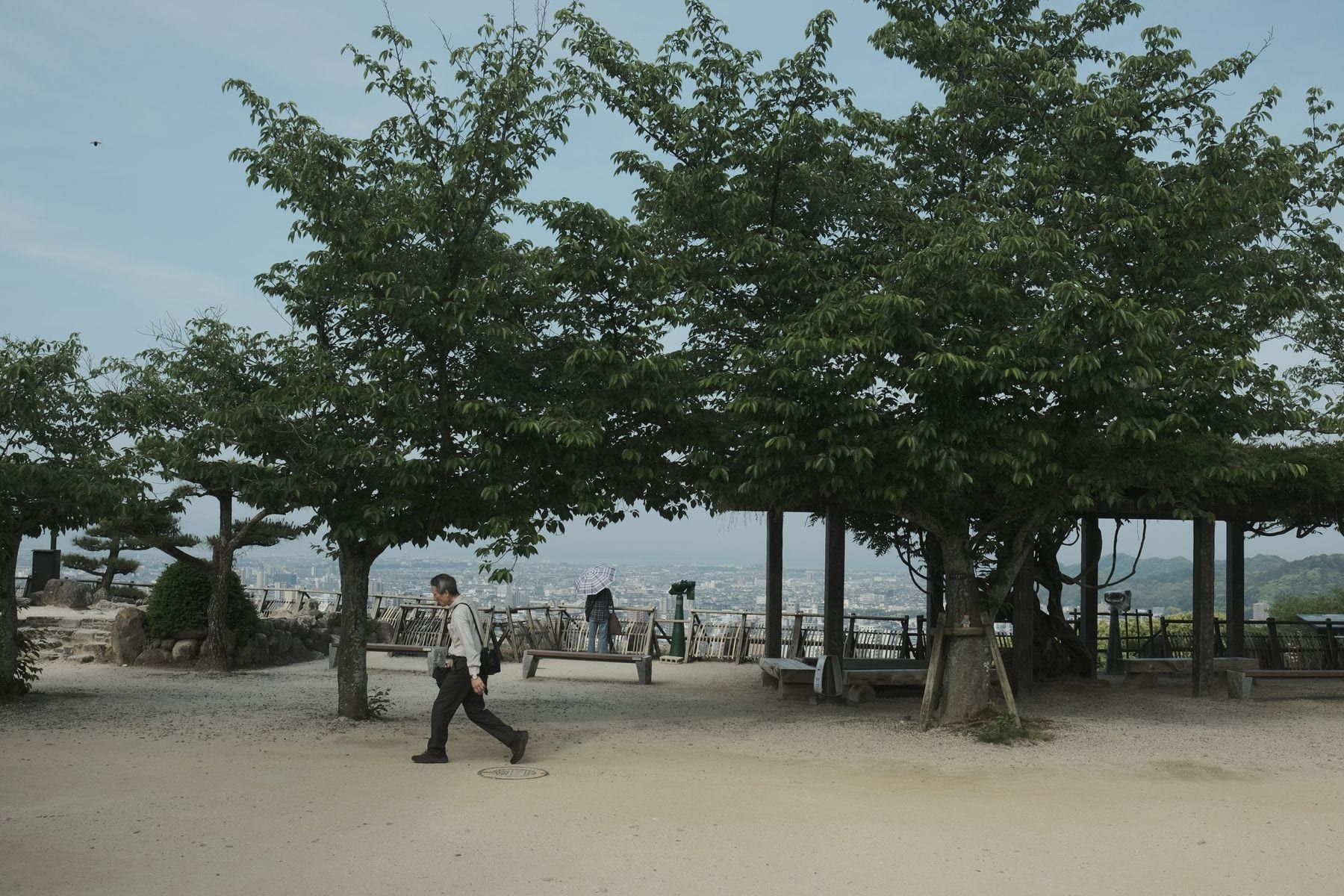
Matsuyama Castle stands on a 132-metre hill in the middle of the city, one of the twelve original castle keeps, and you get up by ropeway or open single chairlift, around CHF 3.20 (about EUR 3.40) return; the chairlift is the bigger experience. Entry to the keep is CHF 3.20, a combined ticket CHF 6. Inside you climb steep wooden stairs past armour and swords up into the keep, with a view over the city to the Inland Sea; below lies the Ninomaru garden, with ponds in the shape of the old palace rooms. Plan two hours; during cherry blossom in early April the castle hill is where the whole city meets. The Botchan train is a replica of the 1888 steam locomotive Soseki described in the novel. It runs several times a day between the city centre and Dogo on the tram tracks, 20 minutes for around CHF 8. Expensive for the distance, but the manual turning at the terminus is worth watching. At Dogo station the Botchan clock strikes every hour with figures from the novel, free, and busiest at 9 am, noon and 6 pm.

Where to stay: Dogo or the centre, ryokan or business hotel

Matsuyama has two centres: the city centre around Okaido and Matsuyama-shi station, and the onsen district of Dogo, 20 minutes away by tram. Business hotels in the centre cost CHF 55 to 90 (about EUR 59 to 96) for a double room; in Dogo there are a few simple places from CHF 70. Ryokan in Dogo with half board run to CHF 120 to 300 per person, and the top ones (Funaya, Dogo Kan, Yamatoya Honten) have their own large baths with Dogo spring water and kaiseki with fish from the Inland Sea. The honest recommendation: one night in a ryokan in Dogo, with a stroll in your yukata through the shopping arcade to the Honkan and a foot bath on the square, then two nights in a business hotel in the centre for the castle, food and day trips. Many Dogo hotels, including the cheap ones, have their own onsen baths with spring water, which spares you the queue at the Honkan. Book early for Golden Week, Obon and cherry blossom; Dogo is more popular with Japanese travellers than with foreigners.

Ishite-ji and the pilgrimage: an hour of something different

Twenty minutes' walk from Dogo lies Ishite-ji, temple number 51 of the Shikoku pilgrimage, which takes in 88 temples and 1,200 kilometres on a loop around the island. The Niomon gate from 1318 is a National Treasure, and the pagoda and main hall date from the same period, but Ishite-ji is no tidy Kyoto temple: Buddha figures, incense and handwritten signs are everywhere, and behind the main hall a dark, 160-metre tunnel lined with statues leads through the hill to an inner sanctuary. No admission fee, one hour, and you see pilgrims in white with straw hats and staffs having their pilgrim books stamped. If you want to try it yourself: temples 51, 52 (Taisan-ji) and 53 (Enmyo-ji) are all within the city and can be linked in a day on foot and by train, around 15 kilometres. You get a pilgrim book and stamps at the temple for around CHF 15 (about EUR 16) plus CHF 3 per stamp. You do not need to be a believer, just respectful: wash your hands, bow, drop in a coin, keep quiet.

Day trip: Shimanami Kaido from Imabari, and Uchiko

From Matsuyama the limited express takes 40 minutes to Imabari (around CHF 9, about EUR 10), the southern end of the Shimanami Kaido. At Imabari station there is a Giant store with good road bikes and e-bikes (from CHF 36 per day); the standard rental bikes cost around CHF 18. From the station it is 8 kilometres to the Kurushima-Kaikyo Bridge, which is itself 4 kilometres long and 65 metres high, with views of the whirlpools in the strait, and this bridge alone is worth the day. Continue to Oshima and Hakatajima, where the salt comes from, and back, for 40 to 50 kilometres. If you ride all the way to Onomichi (70 kilometres, 6 to 8 hours), you drop the bike off there and continue by Shinkansen or ferry. Imabari is also Japan's towel town; the Towel Museum and the factory shops sell quality that in Switzerland you only find as a luxury brand. The second excursion goes south: Uchiko, 25 minutes by train, a merchant town with wax merchants' houses and a kabuki theatre from 1916, almost without tourists.

Frequently asked questions about Matsuyama & Dogo Onsen

How many days do I need for Matsuyama?

Two nights for the castle, Dogo Onsen, Ishite-ji and a good dinner, three nights with the Shimanami Kaido from Imabari or Uchiko. As the start of a Shikoku tour with Kotohira, the Iya Valley and Takamatsu, allow a week in total. The ferry from Hiroshima also makes Matsuyama a sensible two-day detour: there by high-speed boat, back on the slow ferry.

Can I go into Dogo Onsen with a tattoo?

In the Honkan, Tsubaki no Yu and Asuka no Yu, yes; the public baths allow tattoos without restriction. In ryokan baths it varies, and many places offer private baths for hire (kashikiri) for CHF 15 to 30 (about EUR 16 to 32) per 45 minutes. Ask at check-in rather than just walking in; a covering plaster helps with small designs.

What does a bath at Dogo Onsen Honkan cost?

The basic bath, Kami no Yu, around CHF 4.20 (about EUR 4.50); with a rest room, tea and yukata upstairs CHF 10 to 17; the private rooms up to CHF 25. Towel hire CHF 0.30, soap is provided. Plans with a rest room can be booked online, the basic bath only on site. Before 7 am or after 8 pm the queue is shortest.

When is the best time to visit?

March to May and October to November. Cherry blossom on the castle hill in early April is the loveliest time; October brings the mikan harvest and stable weather for the Shimanami Kaido. Summer is hot but drier than on Honshu, and typhoons come in September. Winter is ideal for Dogo: cold outside, hot in the bath. Avoid Golden Week and Obon.

Is the Japan Rail Pass worth it for Shikoku?

For Matsuyama alone, no. For a loop of Osaka, Okayama, Matsuyama, Takamatsu and Kyoto, the 7-day pass (CHF 310, about EUR 332) just about pays off. Cheaper is the All Shikoku Rail Pass for 3 to 7 days (CHF 60 to 100), which covers all JR lines on Shikoku, private railways and the Iyotetsu tram, but not the journey from Honshu.

Where can I go on from Matsuyama?

To Takamatsu and Naoshima on the Ishizuchi limited express in 2 hours 30 minutes (CHF 36, about EUR 39). To the Iya Valley with a change at Awa-Ikeda, around 3 hours. To Kochi via Tadotsu, 3 hours 30 minutes. To Hiroshima by boat (70 minutes on the high-speed boat). For Kyushu there is an overnight ferry from Yawatahama and Matsuyama to Beppu and Kokura.

Itineraries with this destination

Activities in the region

More destinations in Chugoku & Shikoku